The Daily Gullet is pleased and proud to serve up this, the first of five exclusive excerpts from Steven Shaw's upcoming book, (HarperCollins). Called "pure crack for foodies" by Anthony Bourdain, and "a delicious read" by Mimi Sheraton, the unique expose/diary/diner's handbook comes out 16 August 2005. -The Editors.Special to the Daily Gullet, by Steven Shaw
Some would say I became a food critic to subsidize a restaurant addiction. They would be right. But my condition is probably genetic.
Three decades before the current restaurant-architecture trend of “open kitchen” design (which typically allows customers to see a restaurant’s cooks at work behind glass), before Kitchen Confidential and The Restaurant reality show, and before Food TV was a gleam in its creators’ eyes, my father used to take me every weekend to the original open kitchen: the breakfast griddle at the local diner. We spent countless hours over a period of years watching the griddle man, and all the while my father delivered a ceaseless stream of commentary: “You see, son,” he would say, “he does the home fries the right way -- with baked potatoes. Now, pay attention while he does that big table’s order. He’s got to have all six dishes ready at the same time. Only the best cooks can do that every time. This man was a plasma physicist back in Russia, you know.” My memories of dining with my father have set the tone for my whole attitude toward and passion for restaurants. Dining with him wasn’t only about the food -- it was about people, about ideas, and especially about building an inventory of inside jokes. Once, a little old lady came into the diner and asked for liver and onions.
“Cut it up in little pieces,” she demanded.
“Cut it up in little pieces,” the Russian physicist/griddle man replied, with a bow.
“Cut it up in little pieces,” added my father, gratuitously, from the other end of the counter.
It became an inside joke for us that lasted twenty years. Even as my father lay exhausted on his deathbed, in the final round of his decade-long fight against heart disease, I was able to elicit a smile from him by whispering, “Cut it up in little pieces.”
As he did with respect to all areas of human endeavor, my father had more than his fair share of theories about restaurants. “You can’t get good service in an empty restaurant,” he used to say, since vitality is crucial to a restaurant’s performance. A literature professor, he analyzed menus with the same intellectual rigor he applied to the great books and, through such analysis, was unfailing in his ability to select the best dishes. He was fond of saying, “I’d rather have the Stage Deli name a sandwich after me than win the Nobel Prize.”
Even when eating a hamburger at midnight, an indulgence he permitted himself once a month, my father could be overheard quoting Shakespeare and Melville in his conversation with the fry cook. Waiters at the neighborhood restaurants called him “The Professor.” They would seek his advice on marital problems and ask him questions about the nature of being. My father treated the lowliest bathroom-mopper as an intellectual equal. I used to stare at him incredulously when he would try to explain Dostoyevsky to the Greek ex-con dishwasher at a restaurant on the corner of 69th and Broadway in Manhattan. “This man,” my father would patiently explain to me, “may very well be a descendant of Aristotle (or Confucius, or Leonardo da Vinci). Can you and I claim such honorable ancestry?” My father often spoke like he was reading from a book.
At holiday time, he and I would walk around the neighborhood and, with great ceremony, he would present a crisp twenty-dollar bill to his favorite waiters at each of his regular haunts. The waiters would grasp the bills as though they were the crown jewels. It wasn’t the money they were reacting to -- it was the thought, the fanfare, the connection to a different era and attitude. He always called waiters by name and he always asked a million questions about their homes, their families, and their heritage. And he remembered every answer, because every answer was important to him.
My father never managed to get a sandwich named after him at the Stage Deli, and he never won the Nobel Prize. Years after his death, however, a Greek diner on Columbus Avenue still offers “The Professor Salad,” and you can still order “Professor’s Special Lobster Cantonese” at a local Chinese restaurant. And I like to think that, somewhere out there, the Russian grill man is teaching physics at a prestigious university but still remembers how to make “Eggs Professor.”
We were a family with a middle-class income—both of my parents were teachers. As a teen, my idea of a fancy meal was the monthly visit to Gallagher’s steakhouse in the Broadway theater district with my father and my uncle Paul. By the time I was a teenager, I was cooking dinner for my friends on the Stuyvesant High School debating team -- sometimes ten or more of them at a time. In college I was considered something of an oddball because I cooked so much of my own food and would walk an hour or more in the Vermont winter to visit the only good Chinese restaurant near Burlington, housed in what I think used to be a Kentucky Fried Chicken in an office-building parking lot on a lonely stretch of Shelburne Road. I married the girl who always walked with me.
It was in my second year of law school at Fordham University in New York that I discovered fine dining, courtesy of the many law firms that came to my school to recruit young lawyers-to-be for their summer associate programs. A half-day interview with several partners would be capped off by lunch at a fine restaurant with a group of the firm’s younger associates. The legal hiring process, overseen by an organization called NALP, allowed me to schedule fifty job interviews. Even though I planned to accept an offer from the first firm that had interviewed me, which had been my top choice, I kept the other forty-nine appointments so I could get the free lunches. Whichever fool said there’s no such thing as a free lunch never interviewed for a law firm job.
My first assignment as a commercial litigator at a large midtown Manhattan law firm began the day after my wife and I returned from our honeymoon. My boss, Rory Millson, called the night before: “Shaw, it’s Millson. Come early tomorrow. Bring clothes.”
The trial had me living in a hotel and working out of temporary offices in Wilmington, Delaware, toiling 24/7 for almost nine weeks. True to my nature, though, over the course of my incarceration in Wilmington, I sussed out all the best places to eat and, in what turned out to be the beginning of my next career, I wrote a short Wilmington restaurant survival guide, which became a bit of a cult classic around the New York law firm scene. To this day someone will occasionally e-mail me a copy and ask, “Hey, did you really write this? Your writing used to suck!” As an attorney I was well paid, but if you divided the number of hours I worked each year into my salary I was probably paid less than my secretary. My wife, Ellen, and I, who as students had become accustomed to 24/7 access to one another, now had to schedule “date nights,” and we had a standing Saturday lunch date at a favorite restaurant, the now-defunct Lespinasse.
Lespinasse was one of my formative fine-dining experiences. Most of my fine dining at that time had occurred as a result of my getting involved in big law firm culture, so I was fairly new to restaurants like Lespinasse. Still, I had been to most of the big-name places by then and I thought I understood good food. That was until eight of us, including the head of the firm, went for dinner at Lespinasse, and my eyes were opened. It was an awakening. I was so astounded by the food, the surroundings (Lespinasse looked like a palace ballroom), and the service (I learned years later that our waiter’s name was Karl) that I barely participated in the dinner conversation and, instead, held a hushed dialogue with Karl about each dish, each glass of wine, and each utensil. I knew I would be back.

At first, only my friends in the law business, a few hardcore Internet junkies, and my mother read the site. Then one day the New York Times discovered my reviews and discussed the site in a food section article. Overnight, my site went from getting about twenty visitors per day to getting more than twenty thousand. I remember my Internet service provider e-mailing me that day: “We suspect your Web site may be under attack.”
New Media outlets such as Salon.com and the now defunct Sidewalk.com picked up on my work and, later, so did newspapers and magazines. But working full time as an attorney, I didn’t have the time to hone my craft. So I made a choice: I gave up my career as a lawyer in order to devote my life to writing about food.
Over a five-year period, I wrote more than five hundred restaurant reviews. They mostly followed the standard format: a discussion of the various dishes on the menu, plus commentary on the decor, service, ambience, and wine list. Ultimately, though, I found that restaurant reviews were a limited form of expression, because they answer only the most basic Consumer Reports level of inquiry: “Where should I eat?” And they answer it in the most generic way, from a reductionistic dish-by-dish perspective. I felt there were plenty of restaurant reviews out there, but that there was something missing. I began to focus my writing on larger issues, not so much where to eat, but how to dine.
On my thirtieth birthday, Ellen took me to dinner at Gramercy Tavern in New York City, then and now one of my favorite restaurants. Our waiter, Christopher Russell, who went on to become the beverage and service director at the legendary Union Square Cafe, overheard bits and pieces of our conversation and finally asked, “Are you Steven Shaw, the Internet food guy?” It was the first time anybody had ever recognized me as a writer. The chef, Tom Colicchio—who apparently had also been reading my work—came to the table and introduced himself. My moment of glory was cut short, however, by a pronouncement from Colicchio. “You know what’s wrong with your writing?” he asked. “It’s that you have absolutely no idea what happens on the other side of the kitchen doors.”
I blanched. I sputtered. I recovered. I challenged: “So what are you going to do about it?”
“Come in Monday at 9 A.M. Ask for my sous-chef, Matt Seeber. I’ll order a cook’s jacket in your size.” That week in the Gramercy Tavern kitchen, in addition to being murder on my feet, raised my addiction to a new level. I dedicated myself to learning as much as I could about every aspect of the business, from the inside out: all the things one doesn’t see as a consumer. I hit up two other chefs -- Christian Delouvrier and Alain Ducasse -- for kitchen time. I shopped with chefs. I visited farmers and fishermen. I spent time with waitstaff. A lot of time. And not just in fancy restaurants. I’m equally fascinated by temples of haute cuisine and roadside barbecue joints, by the most exclusive Japanese restaurants and the local pizzerias with their “stick men” who manipulate the pizzas with long wooden peels. I’ve spent the past several years investigating every level of restaurant, from New York to Vancouver and from Chicago to the Southeast, from the special-occasion place to the business-lunch spot to the local frankfurter stand. Though restaurants are infinitely diverse, when viewed in an operational sense restaurants at every level appear quite similar. Like any two species of the same genus, the genetic codes of the highest and lowest restaurants in America have far more in common than not.
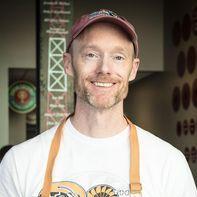
Steven Shaw (aka ) is executive director of the eGullet Society. He has been known to do other things on occasion.
Photograph by Ellen R. Shapiro.
Copyright 2005 Steven A. Shaw. Reprinted by kind permission of the author and HarperCollins Publishers.