Search the Community
Showing results for tags 'Indian'.
-
Hello. I'm very new to Indian cooking and I'm trying to wrap my head around all these different "masalas" that I see in different recipes. I'm aware that a masala is going to differ from household to household, but surely there are some general rules that apply? Garam Masala Sambar Masala Chole masala Chat Masala Chana Masala ... The list goes on... Are there any guidelines to what typically goes in these? Or when to use which mix? Are "curry powder" and "garam masala" generally used interchangeably? I'm very enthusiastic about making my own masalas but I'm a bit overwhelmed and don't know where to begin. Thank you.
-
Over the weekend, I picked up a bag of idli rava (rice semolina). I had no specific plans for it, but I do love my starch, and wheat and potatoes are problems for me, so I enthusiastically seize any fresh iteration of rice. Even if I have no idea of what to do with it. I doubt I'll be making idli, since I haven't seen anything that looks like it will work as an idli pan, let alone the real thing (the wells in an æbleskiver pan seem too small and deep), but I'd love to find other things to do with this stuff. I could experiment, but I'm using someone else's kitchen, which restricts my more flamboyant efforts just a bit. I took a peek online, and there seem to be a quite a few of confident-sounding recipes, but honestly, I'd much rather hear about what you've tried, and how it worked out.
-
Hi There are a couple of products I need to purchase including a kaldie, pressure cooker, idli pot. These items are not available where I am, so I'd like to import them. When I do a search I'm swamped with hits. I'm hoping someone can tell me a company they've used, a popular company, or one they know to have a good reputation. Thank you much, Steven
-
For the holiday, I took my camera for an evening stroll across Shinjuku and back, to my favourite Indian restaurant. Some sights along the way, from Shinjuku 1-chome and across Kabukicho: The head chef and branch manager - all the staff are Nepali: Being a bit of a girly, I ordered the lady's set. First plate: This guy was working the tandoor station: For my free choice of 2 curries, I chose my eternal favourite, dal mutton masala, which arrived with a nicely steaming plate of rice: My second choice was anda panir dopiaza, or Egg, cheese and onion curry, and the naan came along with it: This is the soirt of casual, relaxed place that you can bring your pack of tabs and a book along to, and turn up in your house clothes: Finally, this rather handsome mango lassi was included in the set, which was enough to feed two normal appetites, and came in at the astounding price of 1,580yen, or just under 13 dollars US, if my mental arithmetic isn't too far gone. I'm happy to introduce you to this place - feel free to send me a PM if you are interested.. The road home:
-
I am doing an eGullet food blog over here and would love some input on using mustard seeds with cauliflower. I want to keep things simple and was thinking of tossing the sliced cauliflower with olive oil, salt, and mustard seeds (black, white?)- would they need to be toasted first? I plan on a hot 425F oven. I know this is not a standard Indian prep but I thought cooks familiar with Indian preps would be the most knowledgeable about mustard.
-
In a few weeks I will be hosting an outdoor/indoor "party" (for lack of a better word). It will consist of 14 families from India staying here for a few years (they have been here for about a year) and the local families of the people professionally involved with the Indian group... Kids of all ages will also be coming. What should I serve? I thought about a BarBQ, for those that do eat chicken/meat, but what about those who do not? Should I have some Indian style dishes? Which ones can I make having not too much experience cooking this style of food? Should I go with what I normally would make? Any ideas and recipes? What would YOU do/want? Whenever the group gets taken out to a restaurant, they request to go to "Taj Mahal" restaurant... Thanks in advance!
-
I'm a huge fan of Panjabi style karahi dishes I've had at various Pakistani restaurants run by Lahoris in the US and Dubai. I've had reasonable luck replicating the chicken dishes, in which ginger, garlic and green chile are fried, followed by chicken, followed by crushed tomatoes and the masala. Apart from the taste, I like it because it cooks so quickly, not containing any onions. A few questions - is this a specialty of Lahore only, hence why I see it only at Pakistani restaurants, but rarely see it at Indian ones? Is my method for making the chicken more or less correct? I've seen extremely variable recipes online. Also, how is lamb/goat karahi done? I don't see any way to cook the lamb thoroughly enough in the 15-20 minutes it takes to cook the dish. Is the meat boiled first?
-
What are the traditional dishes of Mughlai cuisine? What ingredients are typical?
-
I've eaten enough bhel puri to feed a village, but I haven't prepared it in something like seven years and even then I did so under close supervision. Now I find myself needing to make it for a party. Can we get a bhel puri crash course here?
-
 http://i.imgur.com/lyitw.jpg ^^^That is the newspaper announcement the gentleman provided for me so I can tell you all about this place. Its called Super Bazaar, its on Main Street Its right up the road in Jeffersonville from the Golf club and the 7-11 Its huge, clean, and the rice and ice cream selection is humungous! Literally 30 different Indian flavors of ice cream! They have everything.
 -
What's the best non-buffet Indian restaurant in Iselin? We're staying for two days and a EG search came up with the repeated recommendation that pretty much all the Indian places were worthwhile. Oak Tree Rd, was mentioned as a mecca but I'd like specific places. thanks
-
This is a general question to the readers to think and discuss why there aren't many Indian chefs pursuing the field of food writing whereas international chefs are releasing best sellers almost every year. Also if any change can be brought about by understanding the factors which are acting as barriers and obstacles for Indian chefs to pursue food writing alongside their primary careers. when we think of Indian chefs who have released books, there may be many, but only few come to mind, such as, Sanjeev Kapoor, Vikas Khanna, Madhur Jaffery etc. Again what I wish to know is that why is the awareness level low in India as far as our own chefs are concerned? with such advancements happening in this field, why is it that many chefs find food writing a challenge?
-
Sour Tomatillo Achar Made this one up from a recipe for lemons. It really works for tomatilloes. A unique spice mix, and really sour for a 'different' type of pickle, or achar. It is based on a Marwari recipe - from the arid north-western part of India. Tomatilloes are not used in India (or at least not much) but are quite productive plants in my garden while lemons or other sour fruits are not possible to grow here. No vinegar or lemon juice is used, because tomatilloes are very acidic and don't need any extra. Ingredients 3 lbs tomatilloes husks removed and quartered 1/4 cup salt 1 Tbs black mustard seeds 2 star anise buds 10 dried chilies (I used very hot yellow peppers) 1 tsp fenugreek seeds 2 inch ginger (ground to a paste) 2 TBL dark brown sugar 1/2 cup sugar 1. In a large bowl, put the tomatilloes and sprinkle salt over them. Cover it and leave for a day, mixing occasionally. 2. Next day drain the tomatilloes. 3. Dry roast the star anise (put in first as these take longer, the black mustard, and the chilie pods (add last and barely brown in places). Cool. 4. Grind the roasted spices with the fenugreek and put aside. 5. Add tomatilloes, ginger, sugars, and everything else to a large pan and heat to boiling. 6. Cook till fully hot and boiling. 7. Fill half-pint jars and seal.
-
- 1
-

-
- Indian
- Condiments
- (and 2 more)
-
Sweet Eggplant Pickle This is an Indian pickle, some would call a chutney, that I made up from several sources and my own tastes. It is based it on my favorite sweet brinjal (eggplant here in the US) pickle available commercially. It has onion and garlic, which are often omitted in some recipes due to dietary restrictions of some religious orders. It also has dates which I added on my own based on another pickle I love. I also used olive oil as mustard oil is not available and I like it's taste in these pickles. Use other oils if you like. This has more spices than the commercial type - and I think it's superior. I avoided black mustard seed, fenugreek, and cumin because almost all other pickles use these and they start to taste the same. One recipe from Andhra Pradesh used neither and I followed it a little. It's wonderful with all sorts of Indian foods - and also used for many other dishes, especially appetizers. SPICE MIX (Masala) 4 Tbs coriander seeds 3 hot chilies (I used a very hot Habanero type, so use more if you use others) 18 cardamom pods 2 inches cinnamon 24 cloves 1 1/2 Tbs peppercorns MAIN INGREDIENTS 1 cups olive oil 4 inches fresh ginger, minced fine, about 1/2 cup 6 cloves garlic, minced 1 large onion finely chopped 3 lb eggplant, diced, 1/4 inch cubes 1/2 lb chopped dates 1 1/2 tsp turmeric powder 2 cups rice vinegar (4.3 percent acidity or more) 2 cups brown sugar 2 Tbs salt 2 tsp citric acid Spice Mix (Masala) 1. Dry roast half the coriander seeds in a pan till they begin to brown slightly and become fragrant - do not burn. Cool. 2. Put roasted and raw coriander seeds and all the other spices in a spice mill and grind till quite fine, or use a mortar and pestle. Put aside. Main Pickle 1. Heat half the oil and fry ginger till slightly browned, slowly. 2. Add garlic, onion, and half the salt and fry slowly till these begin to brown a bit too. 3. Add eggplant, turmeric, and spice mix (Masala) and combine well. Fry for about 5 minutes, stirring occasionally. 4. Add rest of ingredients, including rest of the salt and olive oil and heat slowly to a boil. 5. Boil for about 5 minutes. Add a little water if too thick - it should be nearly covered with liquid, but not quite - it will thin upon cooking so wait to add the water till heated through. 6. Bottle in sterilized jars and seal according to your local pickling instructions. This recipe will be sufficiently acidic.
-
Hi all, been away for a while, but the pressures of Christmas have brought me back. I'm married to an Indian and as the family chef, have been tasked with cooking for all the in-laws yet again! Thing is, they always claim that they want a 'traditional' English Xmas dinner - which I do believe they love. However, last year, I made an Indian alternative chicken dish - pieces marinated in garlic and ginger and roasted with spices - and it suddenly became the winner. So, I think I'll go full-blown Indian this year, except with the constituent ingredients of the traditional feast. Something along the lines of: Starter: spicy prawn cocktail starter Main meal: Whole Tandoori roast Cockeral (what I need is to get that red-roasted effect with the tinge of marinade going well into the breast meat) Sage and onion stuffing South Indian stuffing (curry leaves, split urad daal, chillies, mustard seed etc - a crunchy stuffing) Spicy roasted potatoes (Jeera etc) Minted peas Carrots with jeera/thania (coriander) Brussel sprouts with caremalised onions, chillies and ginger A gravy made in the traditional way, but with some curry leaves, imli (tamarind) and chillie (I may also use a little pre-prepared Gitt's sambhal powder) Dessert: Flambeed Christmas Pudding (already spicy enough!) with brandy butter Any ideas? Advice? Cries of "Don't do it!"? Suggestions? Come on e Gullet - don't let me down!
-

Identify these flavors in Indian/Nepalese food
Dianabanana posted a topic in India: Cooking & Baking
We had an early lunch at a little Indian/Nepalese place last week. I satisfied my craving for poori, potato masala, and a cup of chai, and my husband had some kind of Nepalese vegetable curry, and a Nepalese spinach salad with roasted soybeans. Now I have questions. 1) The spinach salad was like cooked spinach wrung very dry, with (according to the menu) roasted chopped soybeans on top. To me these tasted almost exactly like wasabi peas, except not as pungent and not lurid green (they were regular tan soybean color). Definitely a horseradish type of flavor. What was it, and is this common in Nepalese food? 2) Both my chai and my husband's curry had a delicious, elusive smoky flavor. And please note that I have a horror of most smoke flavors added to food. These things tasted like they were prepared over a high-mountain campfire, but this restaurant was tiny and in a basement and I'm very sure that the only flames in there were from a gas range. And anyway, how would that flavor get into chai or a curry in which nothing was roasted? It had to be some ingredient they were using. I bought some Tao of Tea "Pine Smoked Black" tea and added it to chai in an effort to recreate the flavor, and it's similar, but very crude in comparison to the delicate smoke flavor at the restaurant. Yes I am kicking myself for not asking while I was there . . . I could call but thought I'd ask you guys first. -
I am looking for recommendations for a gift. I want to give a cookbook on Indian food to someone who is a relatively sophisticated cook but knows very little about Indian cooking. He works full time (not as a chef) and cooks mostly for his family. Thus, he is not going to want recipes that take a long time to prepare. Suggestions?
-
My 10 year log enjoyed wonderful Indian food on a visit to Chicago & now insists we must find something good here in Settle. I warned him this might not be possible since I've never heard of good Indian food here. Let me know if you've found anything you like here other than Poppy which we know & love. It's a bit pricey for an entire family.
-
I have been successfully making idli for a few years but have had problems lately that I don't fully understand. My recipe uses 64g of urad gota (decorticated whole black matpe beans), 192g of parboiled rice, 1-1/4t salt, and 1/4t guar gum (as a tasteless, colorless substitute for the methi seeds which according to a researcher at University of Mumbai act only as a thixotropic agent). The beans and rice are soaked separately for 6 hrs (the rice is washed the urad not) in RO filtered water (no chlorine, mineral content< 10ppm). The soaked beans are then ground (with water to make a total dry beans + water weight of 256g) plus salt and guar gum for 5 min in a stone grinder, producing a very smooth paste. The soaked rice (dry rice plus water to make 550 gm) is added and ground for 11 min until the particle size is like coarse sand or idli rava. The batter is then covered with plastic and fermented at 30°C (86°F) until it at least doubles in volume. When it works, it works fine, taking about 13 to 15 hrs to double. The batter is then steamed in greased idli pans for 13-15 min, cooled slightly and served or cooled fully and frozen. The problem I have been seeing is that the batter does not ferment (after 48 hrs it just picks up a pink bacterial growth on the top surface that stinks but does not get foamy or rise). I have an active hypothesis that the beans I have bought were treated with heat or radiation to kill insects before they were imported and that the process also killed off the leuconostoc mesenteroides bacteria that is the active agent for the fermentation. Does anybody have any insights that support or refute the hypotheses? Or is there something I don't yet fully grasp that is essential to the making of these wonderful fluffy little steamed dumplings?
-
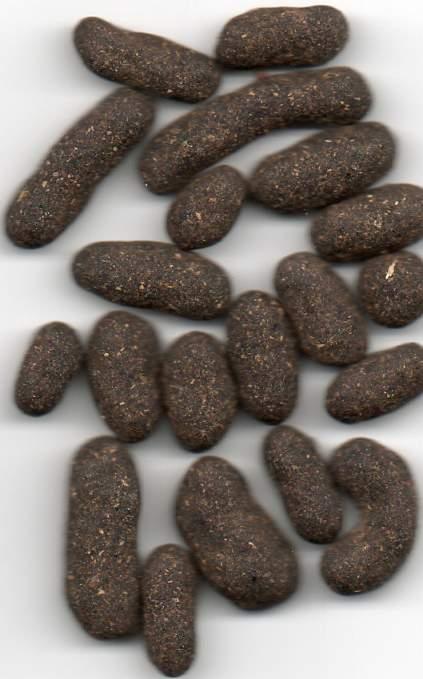
I bought these at an Indian Grocery store. They were not named or described, except with the brand or maker - Jay Andeshwar. They are salty - like they are made with black salt - Kala Namak as they are sulphury too. They also may have sour plums (or any other sour fruit like tamarind) and a few spices. Each pellet is about 1/2- 3/4 inch long and about 1/4 inch in diameter. Most of us thought they were horrible. I sort of liked them in a strange way. I want to know what they are (what are they called?), what's in them, and why would people eat them (are they medicinal for instance)? Thanks!
-
What do you put in yours? I have tried a method where you're supposed to deep fry your potatoes and cauliflower separately before tossing them in an onion and spice mix; and another that calls for spices and onions simmered in ghee and then tossed over raw cauliflower and potato with a bit of tomato and some water to cook down. Both were internet generica recipes; neither impressed me much. I want the ne plus ultra aloo gobi recipe; one with melting cauliflower, creamy spicy potato; piquant spices with chili and ginger and crunchy coriander stems to set it off. No peas. I know how I want it to taste, but no idea how to get it there. Help?
-
My local Indian place has wings that that they call Mirchiwalla wings. The wings are obviously cooked in a Tandoor but I can't seem to figure out the spice mix on the outside. Anybody have a recipe or an idea of what spices to try (I have a clay oven)? P.S. I understand that this might actually just be a name given by the restaurant that doesn't relate to a specific traditional dish.
-
I'm just beginning to venture beyond my preferences for American and French cuisine and exploring the cuisine of India. As a novice cook in terms of the variables and subtleties involved with Indian cooking, I thought I would start with just one ingredient-Lamb. I've been reading through At Home with Madhur Jaffrey as a reference to my introduction to Indian cookery. I started with Jaffrey's recipe for "Punjabi Lamb Kebabs." While staying fairly true to the recipe, I substituted rack of lamb for the boneless lamb meat called for in the recipe. I couldn't find, (nor did I take the time to make), the mustard oil called for in the recipe so I used a combination of Chinese Chili Oil, Sesame Seed Oil and Olive oil. And due to the cold, wet weather in the Northwest today, I wasn't able to barbecue on the outdoor grill like I wanted, so I used the recipe suggestion of broiling the meat. The rack of lamb was marinated overnight in a mixture of yogurt, the three oils, salt, garlic, ginger, garam masala and I added some curry powder and an incredibly fragrant Ras el hanout mix I bought yesterday. To accompany the lamb I made some pickled red onions and served them on a bed of sliced cucumber. And a simple steamed basmati rice seasoned with saffron, tumeric and cumin. I welcome your suggestions and discussion on how you like to prepare Indian-style lamb.
-
I was in India over the winter holiday studying in a proper school for 10 to 12 hours daily — it was bliss! Since I’ve come home I can really taste the difference the types of produce and the freshness of the meats make on a given dish. Not cooking Indian everyday, I want to continue learning by keeping up the dialog I had with my teachers and the other students, hopefully with people here. In this post I was hoping to talk about Salan’s as in Mirchi ka Salan (Green Chilies in Sauce) I have two recipes and I’d love discussion on how you make it. The first version we made contained equal portions of roasted peanuts, sesame, coconut with a healthy bunch of fresh coriander and mint, a couple of dry red chilies, about a tablespoon of ginger garlic paste, salt and turmeric. (This particular teacher emphasized tasting over measuring.) These were placed in a mixi and ground into a fine paste. Next, in a large kaldie we heated sesame oil then added, in order, about a teaspoon each of mustard seeds, cumin seeds, fenugreek seeds, a sprig of fresh curry leaves, and finally the large split green chilies and cooked until the skins were seared. We then added the paste and about a cup of water and balanced it with a few tablespoons of tamarind juice and jaggery syrup then cooked it until the oil came out (about 25 minutes). It was really nice — and hot. The day we did the Hyderabad dishes was the only day I got sick in six weeks in India: way too spicy for my insides. (lol) The second recipe (made a different day) was prepared without coconut. In the mixi we added about 1/2 cup each of roasted peanuts and sesame seeds and added to that dry roasted coriander seeds, cinnamon bark, cumin, cloves and blended it into a fine paste thinned with a balance of tamarind juice and jaggery. In the kaldee we sauteed finely minced onions until very brown, added about a teaspoon of ginger garlic pasted then tomatoes and cooked until the oil came out and to that we added the paste and a cup of water and the seared chilies. Cooking was about 20 minutes. This particular teacher said that some regions add yogurt after the oil comes out. I would love to know how you all make your salans. In case anyone wants to know, this is where I studied. http://www.iactchefacademy.com/home.html
-
@ infernoo Transferred the topic here from aloo-gobhi. Hope to add some dishes common in dhabas that others have tweaked and then I have. You may play around to get to your own taste preferences. Here is an idea from Marut Sikka, much modified. The scalding cream temper at the close remains his unique, sheer genius!! In Punjab, cream probably flows in people's veins! Real white butter freshly churned from buffalo milk yoghurt, accompanied by bottomless glasses of real buttermilk distinguishes the quality dhaba [a roadside establishment] from its competitors. Chicken with Shallots & onions [sort of Do-peeaza] Boneless Chicken breast or thigh cubed, marinated with a very little ginger/garlic paste + a little salt. You can smash the garlic with the salt on your cutting board & work it with your knife or end of cleaver handle [as Chinese chefs do] to a workable paste. Ginger can be grated and squeezed. No need to work the blender for this tiny amount. Save a bit of the ginger & garlic paste for cooking. Some people might want to add chicken hearts for a chewier texture. Chicken breast is the pits, in terms of texture & flavor. Before cubing, lay the breast out and pound with moderate force, breaking up some fiber. Then cube. You will find a cube that is less stringy. Most Americans dislike bones in their food, else a chopped poussin or squab, can be tried. Onion, diced fine; use your sense of proportion. You will brown these. They will shrink! Small shallots or the big ones halved or quartered, for quick cooking; little cipollini onions, ditto, or, if you only have red onions, cut big ones into quarters or eighths, separate the leaves, & cut to appropriate size. Very lightly roast Coriander & cumin & a whole red chile pepper that is not hot but flavorful: pound them moderately fine. In the West, use a coffee grinder! Remember, this is your basic karhai/balti spice! Reserve some turmeric powder, not much. Powder some Garam masala: green cardamom whole pods, a tiny bit of mace [strength differs according to source, & aril vs powder, use judgment, not to overpower], a tiny bit of clove 5-6?, cassia bark/cinnamon: 2 tsp total for 1kg chicken? The Plain tomato base Slightly sour yoghurt, smaller quantity than tomato [1: 8], beaten well Very fine julienne ginger root, optional Cilantro, chopped, optional & whole thai chillies, for aroma. Crushed moderately fine black pepper corns or pepper mill at ready. A lemon or lime to squeeze, brought to room temperature. Tempering mix: cream, chopped fresh mint (dry if no fresh availabbl) kasuri methi leaves rubbed in palm to crush Ghee Heat ghee, when shimmering add the reserved ginger&garlic paste,stirringuntil they sizzle. No prolonged cooking. Instantly add diced onions,stir and move around until they begin to brown. Here is a flaw in the recipe. Either use slow cooked browned onions drained of fat, would be my gut reaction, or brown only until the edges are colored in a significant amount of fat [which is what dhabas do]. They add taste with fat. Add ALL powdered spices including turmeric, stir to mix with the oil, then the tomato base, cook down a bit, then yoghurt, cook down a bit, season, then chicken and shallots, cook until almost done, taste, adding garam masala, a squeeze of citrus, a mere hint of black pepper, a tiny bit of cilantro, and quite a few whole green chillies to release their aroma. Remove to a serving dish. Scatter some julienne strings of fresh ginger on top. Do not cover the serving dish. The chicken is cooking away in hot clingy gravy, so remove it on the side of underdone, not stringy. In a small saucepan, add cream and bring to scalding, add other tempering ingredients, heat few seconds until aroma released, pour over chicken and serve hot. Adjust all spicing to suit your taste. You understand, of course, that in restaurants, the onions & tomato base are cooked in a flood of butter & ghee over a hot flame that is "invited" into the pan several times, much like the Chinese wok hei. That is the particular taste patrons crave, and the butter/cream swimming around never ever hurts a naan fresh from the tandoor. 66% of the world's cardiovascular cases will be confined to India in the next decade or two, according to official forecasts from diverse sources! P.S. Don't add all the garam masala. Start with 1/8 teaspoon. You can always ADD more. Likewise, a light hand with the spice powders. You want to taste the shallots & chicken here. In Bengal, we have, or used to enjoy, a preponderance of small tropical shallots over onions, so those were favored in Chicken Do-peeaza in the style of West Bengal, Calcutta.