
Mjx
-
Posts
7,674 -
Joined
Content Type
Profiles
Forums
Store
Help Articles
Everything posted by Mjx
-

Advice, Please: Equipment for Modernist Cooking/Primitive Resources
Mjx replied to a topic in Kitchen Consumer
Nope, no sv rig, and no crock pot or rice cooker, either, although I'm lucky in that I travel quite a bit, so if I can't get something reasonable locally, I can usually get it from Germany at a decent price, or pick it up when I'm in the US. What I didn't mention is that I'm currently using someone else's kitchen, so I'm holding off on larger items for now, since there's no place to store them, and I can't really leave them in the kitchen. I figure that this is a good time to focus on getting my hands on smaller items. Thanks for the heads up on the pH meter (which I was sort of considering) and the whipper v. creamer! I have a Jennings CJ 4000 that I'm very happy with it, so I was thinking of getting one of their jeweller's scales, would you happen to know anything about them? I know companies are not necessarily consistent across all their product lines. Any other measuring devices worth considering? -
Thanks, Digijam, that definitely puts this on my book list!
-
I've been sitting on USD250 of amazon gift certificates for while, debating what to use them for. I was given Modernist Cuisine as a gift for my birthday this year, and despite the fact that USD250 is a tiny amount in the face of the recommended equipment list, I do want some of my purchases to go towards making some of the recipes a possibility. I have no special equipment, unless you count a scale (a good one) and the Adria spherification kit (also a gift, accompanying Modernist Cuisine). I've been considering one or two iSi whippers, a couple of Silpats, some silicone moulds, a jeweller's scale, for really small masses of ingredients, Migoya's The Elements of Dessert, and a Thermapen. I'm most interested in smaller, non-mechanical items, or less-expensive mechanical ones (more expensive items with the potential to conk out, e.g. pressure cookers, I'd rather purchase here, where things come with a two-year money-back guarantee). At this time, my interests in modernist cooking are focused on appetizers, garnishes, and desserts/sweets; I also have a weakness for gels, and I'd like to experiment a with transglutaminase. Given my interests and restricted budget, what would those of you who've been working quite a bit with modernist cooking/Modernist Cuisine advise, in terms of crucial pieces of equipment? Your thoughts/input tremendously appreciated! Thanks in advance, M.
-
This sounds extremely appealing, but how demanding is it, in terms of necessary equipment? Approach- and aesthetics-wise this kind of sounds like a 'desserts, the missing manual' companion to Modernist Cuisine, but it would depressing if it turned out that making even the simplest recipes would require an outlay of hundreds of dollars (which I haven't got) for specialized equipment/tools.
-
For Copenhagen, I want to mention Brewpub (which I'll review properly as soon as I have a little free time). It's located at Vestergade 29, easy walking distance from Copenhagen's central train station and Rådhuspladsen. We ate in the restaurant, but there's overlap between the pub and restaurant menus, and there's a single kitchen, so the quality is likely the same for both. We both had the exceptional rabbit fried with pepper bacon & liver mousse as a starter, followed by the very good ribeye (for my boyfriend) and breast & confit of duck (for me), and quite outstanding the porter-chocolate cake with carrot and sea buckthorn sorbet. We left feeling extremely happy with the meal. My only real complaint is with their knives: we struggled a a bit with our main courses, even though the meat was just as tender as it ought to be. I thought about requesting a steak knife, but when I looked about to see whether any other diners had something of the sort, none were in evidence, so I didn't ask. Especially since I haven't had much luck finding places in Denmark with excellent, reasonably priced food, I'd categorize Brewpub as a something of a find.
-
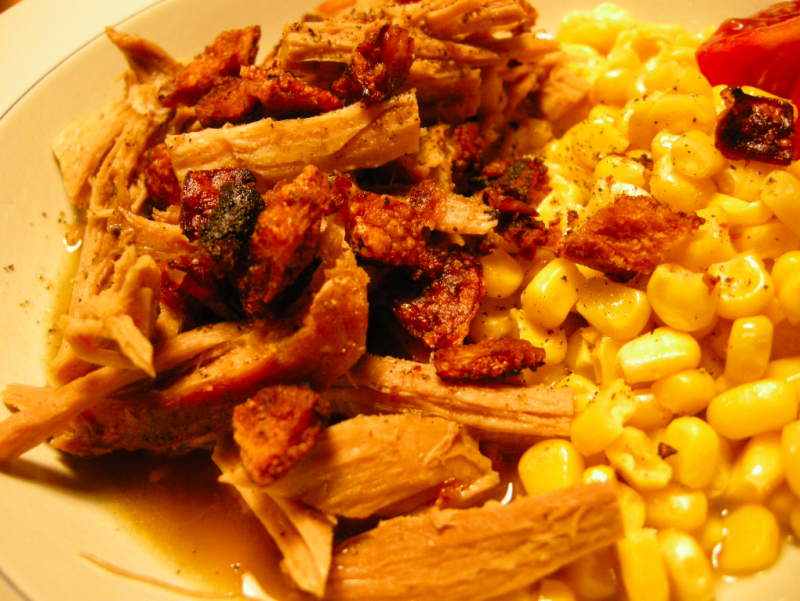
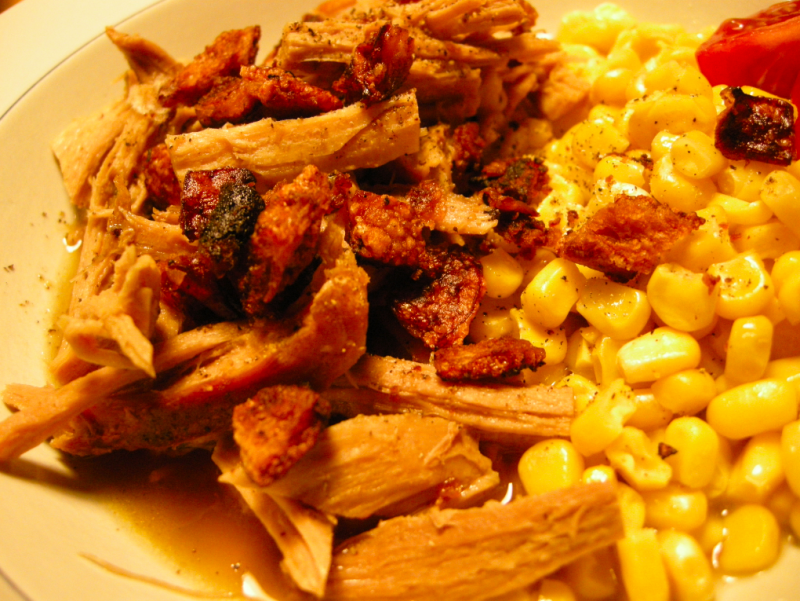
Shredded pork with microwaved crackling: The pork was a skin-on cut traditionally used here for flæskesteg, braised in a litre of stock plus a beer, seasoned with fresh lovage, garlic, a bit of ground cloves and nutmeg, a chili, a pinch of ground vanilla bean, and a little vinegar and sugar. Since this was braised, the skin was soft and gelatinous by the time the meat was done; I started to finish it a high temperature to crisp it, but everyone was hungry, so that went to the wall. However, I was curious about something I'd read in Modernist Cuisine about making beef jerky in the microwave, and wondered what would happen to the skin if I I cut it away from the meat and just nuked it for a few minutes (folded up in paper towel, to absorb the grease, and because I don't love cleaning microwaves). In about half a minute, it sounded like I was making popcorn. At the two-minute mark, the skin was (as you can sort of see; it was a bit dark when I took this shot), beautifully, deliacately crisp and browned. Since the traditional method of browning the skin in the oven tends to make for rock-hard results without anything special in terms of flavour, I intend to go the microwave route from now on.
-
Special presentation jar for sweets or some other specialty that doesn't require special preservation measures?
-
I was equally surprised.. One hour and nutmeg, Mjx you either have a strange taste or are a ground breaker. :-D Maybe i should have made it clear: I'm talking about a pinch of nutmeg. I find that it offsets the 'wet dog hair' smell I sometimes detect in stocks, particularly ones that are bone-heavy, but it draws no attention to itself. Although I will admit that my tastes run a bit medieval, and I really enjoy a faint presence of nutmeg (or cloves) in meat dishes.
-
I'm going to have to go with 'wow', which I realize is spectacularly inarticulate. This is the the first time I can recall seeing a savoury gel and thinking, 'I need to do that'.
-
Yep Nope. My point is that if the stock solids are cut into small pieces, their size is such that any water-soluble flavour molecules are very quickly extracted, and you get something full-flavoured in a short time. If I'm cooking up a big batch of whole bones, I don't expect much flavour from them; increasing the cooking time won't change that. But you will get a lot of gelatine. I'd saw up the bones in small slices, and cut the cooking time down to an hour; why run the stove for 8 hours to accomplish what only need take an hour? If the stock solids don't have much to contribute in terms of flavour (e.g. bones), lengthy cooking can't actually change that. Usually, If I cook something on the bone, I leave a bit of meat on, and I save cuts that don't have much to offer in the way of meat for stock (e.g. bird backs); I just keep chucking all this stuff in a bag I keep in the freezer. Often, I don't even use vegetables, just a bay leaf and little nutmeg and salt. I roast the bones before making stock. If the stock comes out kind of wimpy, I may simply save it to use as the liquid for my next batch of stock, rather than using it as such.
-
That seems contrary to tradition and the experience and recommendation of many chefs... nevertheless it has a point (continue reading). I think it is not poosible to make a general statement: different components of a stock have different optimal extraction temperature & time profiles. Gelatin from bones needs the longest times, much longer than one hour. For beef meat one hour simmering may be optimal in many cases (actually 60 minutes at 85ºC was found optimal in this study). Vegetables likely have a similar profile (in my experience). Aromatics are often considered to produce highly volatile aromas that do not stand long times, so some suggest to add them at the end of the cooking (either some time before finishing, either when the heat is stopped -infusing while it gets cold-, either putting them when reheating the stock for using it). . . . . I do agree with you regarding the extraction of gelatine from larger bones, but I personally prefer the flavour of more briefly cooked stocks to that of longer-cooked stocks (this is inevitably going to be subjective, and vary considerably from person to person). Although I often make mixed-source stock (chicken, lamb, various game), I break things down into small/thin pieces, which optimizes extraction, and even with the brief time-frame I described, it gels as firmly as any longer cooked stock I've seen (cleanly spoonable). If I'm boiling up a bunch of more or less intact larger bones, I'll cook them for a quite a while, but I'm not aiming for flavour.
-
By 'the end' I'm understanding you to mean when the stock is finished; since that's the point when you remove the solids from the stock, adding something at point would have no effect of the finished product. For whatever it's worth, I haven't found any advantage to using more than about an hour to make stock: prep/roast/brown the components, then sweating them 20 minutes, and simmering barely covered in water 20 minutes. Any longer doesn't seem to give more flavourful results, things just get more murky and dull (I may use some extra time if I want to reduce the stock, however).
-
Unless you're cutting something very hard and bulky, like a winter quash, I'm fairly certain an adequately sharp blade shouldn't require much force or speed to move through what you're cutting. One other possibility: if you're very tall, the cutting surface might be too low for you to bring the knife all the way down, without your paying constant close attention (owing to the angle between your hand and the cutting surface at the bottom of your stroke). I noticed tall friends had this problem in the kitchen in our flat, when they used the pullout cutting table which was exactly the right height for my rather short self.
-
These are lovely, Dave, exactly the sort of thing that makes me love gelled things so much. Also, the pretty moulds inspired me to try to get my hands on some myself; mysteriously, nothing even remotely like this is to be found, hereabouts. Any shots of the inside? Did the flavour/texture combination meet your expectations?
-
It would also be a good idea to wait tables for at least three months. When you're familiar with what is happening on both sides of the service equation, it is far easier to pinpoint the source of inevitable kerfuffles (i.e. difficult diner/incompetent waiter). It's also an excellent way to confirm whether or not one is truly a 'people person', not to mention, waiting tables while acquiring the skill set he's seeking would be concrete evidence of genuine commitment to this area of work.
-
Are you looking for a slicer, or something else?
-
How liquid is the mixture you're putting into the bag? I've never experimented with a bag, but I've watched others do this, and usually something very juicy was used, and the mixture in the bag was quite liquid. However, I have worked quite a bit with quinces (I put the pulp through the finest plate of a food mill). It's never occurred to me to try to get a clear gel from them, but if I was going to give this a go, I'd add a lot of water; quince is mostly dense pulp, and although it contains a fair amount of water, I believe the pectin in it sequesters it, so the pulp does not easily part with its juices.
-
Two weeks into what? That is, in what sort of place are you working (e.g. restaurant, diner, hotel restaurant, catering service)? Not sure what you mean by 'a lot of people'; well-connected to others in the industry who have useful jobs to offer? Without knowing anything about your relevant background, it's not possible to really say; more details are definitely needed, but a 'little prep and a lot of pot washing' is not going to get you far. What sort of offers have been 'flying about', and are they being offered to you, or someone who's only done a bit of prep and washed dishes? Well, what is your goal? Apart from that, if you look at the careers of various successful chefs, it's pretty clear that there's no one winning formula, but no one gets far without working their arse off and being in the right place at the right time, with a robust skill set (regardless of how acquired) ready to deploy.
-
Heidi, this was pork. I had this idea that, given that the meat is pounded thin, and veal, pork, and chicken breasts all tend to run dry, the handling could be the same for any one of them, so I thought I'd ask more generally; evidently not the case! I salted the meat, ground pepper over it (I wanted to get these worked into the meat a bit), then pounded them not-thin-enough. I then did them natur style, with a bit of salt, pepper, and nutmeg mixed into the whole rice flour I used. I gave them 3 minutes on the first side, which gave alovely golden brown result (I used grapeseed oil), but the second side was tricky, since the meat curled (because the fibres weren't broken down enough?), so they didn't lay flat, and mostly were only exposed to direct heat if I pressed down on them, which I didn't discover until about 2 minutes into the second side. They were pretty tasty, anyway, although a little too thick and dry. Did I make an insane number of mistakes?
-
Bumping this, since I'm interested in hearing whether anyone has come up with some fantastic recipe for schnitze, which they'd like to sharel. I've got some meat ready to prep., and I'm going with the previous advice to give it three minutes per side, although I'm wondering a bit about just how high a temperature is regarded as ideal.
-
Off-hand, I'd have to say head to the local slaughterhouse, since coagulation happens really quickly (in fact, without salt or something stirred into it, I'm not sure you'd get it home still liquid), so this isn't something you're likely to find at a butcher, but one of the vendors at the greenmarket might be more accessible/helpful.
-
No luck with forming it on parchment, then using a peel or baking sheet slipped under that, to transfer it to the oven?
-
I really regret being pushed to eat certain things when I was a child, since these efforts effectively acted as aversion therapy, and to this day, my inability to even gag/keep down most cheeses is probably one of the saddest things.
-
Thanks, Kim! Your shrimp look so delicious; I really miss good shrimp (I cannot understand how I live in a coastal town, yet finding decent shrimp is so difficult!). The chicken was roasted according to the simplest and best roast chicken recipe I've yet found, from The Best Recipe (with a few very minor tweaks). The recipe calls for buttering the chicken, and then seasoning it with salt and pepper. The chicken is not trussed. My tweaks are all in the prep: I prefer olive oil to butter (butter does give better browning, however), and since I always brine the chicken, I actually don't salt the chicken after oiling it (the double salting gets too intense). Also, instead of distributing the pepper over the chicken after oiling it, I mix the pepper right into the oil, and it all goes on at once. The recipe recommends preheating the oven with the roasting pan and rack inside, for even browing of both sides, but following an incident that yielded spectacular burns, I no longer bother (also, the ovens here are all convection ovens, which helps avoid unevenness) The roasting times are the same as the ones in the recipe: preheat the oven to 190C/375F, and roast the chicken 15 minutes on each side, then turn up the heat to 230C/450F, and roast the chicken on its back for 20 to 25 minutes (keep an eye on the chicken during this last step, if your oven runs hot). The skin is amazingly crisp, and we often end up eating most of it while carving, so there's not much left by the time it's plated (we restrained ourselves, for the sake of better-looking pictures).
-
Roll out, maybe season it, and make crackers?