
Mjx
-
Posts
7,674 -
Joined
Content Type
Profiles
Forums
Store
Help Articles
Everything posted by Mjx
-

Single burner induction cooktop with easy temperature adjustment?
Mjx replied to a topic in Kitchen Consumer
As I made a point of saying, what I described was my experience. Nothing against induction in terms of function, but I've personally have seen no advantage; the array of options available in the US may mean that this is not the case there. Also, I wasn't arguing against induction as such, but pointing out that at a given price point, you can get a better quality standard glass cooktop than an induction one. Since he's only looking at a single burner unit (which I didn't realize originally), if the thing dies in a short time and isn't under warranty, it wouldn't mean that he has nothing to cook on, so I guess that isn't so important. Still, all the recent model glass cooktops I've used came to full temperature extremely rapidly; I haven't noticed that induction units are quicker, but if they are, it's a question of seconds, and if seconds are an actual issue in terms of heating time, then a gas burner is the way to go. I expect burners to be hot, so rapid cooling isn't something I expect of them, or care about (but I don't have children, either). I've yet to see an induction cooktop that has better temperature controls than regular glass ones, but that may be due to the fact that here, glass is standard, so the array of options is broad, and there is a lot of competition. -
I just measured my 1L unit, and the body is about 11 3/4". If you look at their site, you can see the smaller-capacity units are shorter, although I don't see a spec. list that gives the height, but just eyeballing it, it's got to be about an inch shorter.
-
Westminster City Council demands burgers be fully cooked
Mjx replied to a topic in United Kingdom & Ireland: Dining
Everyone is entitled to take the risks that attract them. But if a mountaineer, fell walker, or sailor is damaged or killed, they/their families usually don't look about to see who they can scream at and sue. They accept the consequences of the activity in question, do their moaning/grieving, and carry on. Presumably, anyone who can afford to eat at a restaurant is paying some sort of taxes, and they've contributed their little bit to the national health plan, so they're certainly entitled to be patched up by same. What I take issue with is someone demanding their burger rare, becoming ill, then trying to pass blame for their decision to take this risk. I realize it's difficult to be philosophical about this sort of thing when your dinner really opened things up at both ends, but presumably when the decision was made to request the burger so underdone that it moos, this contingency was considered worth it, so I guess... think back to how fabulously delicious the burger was? The first time round, that it -
Single burner induction cooktop with easy temperature adjustment?
Mjx replied to a topic in Kitchen Consumer
I've used induction cooktops, and haven't found them to be any better or worse overall than a standard glass cooktop/burner. I know they're popular with people who have small children, but aside from the cool surface thing, they seem to offer nothing worth paying extra for. That said, I've only worked on glass models, since it's difficult to find anything else here (in fact, I didn't realize until now that there were induction cooktops that aren't glass). However. In the EU, Siemens is reliable and in the 'decent' price range (virtually all their glass cooktops are now induction), with discontinued models being readily available at low prices, still with their full warranty, plus they have great, fine-grained controls, so it's a brand I recommend (I'm pretty sure it's available in the US). Miele is good too, maybe a notch up from Siemens, but last I looked, it was being sold as luxury brand (WTF?!) in the US; if that's changed, I'd look into Miele, too. None of the other brands I'm familar with seem to be distrubuted in the US, so I'm afraid that's it for my recommendations. -
Cookbook owner's dilemma: buy, borrow, ebook - what's fair?
Mjx replied to a topic in Cookbooks & References
The thing is, since I do have a fair amount of experience, a quick glance tends to reveal that a lot of what's out there is a mess. There are some gems, but I'm not keen on having to paw through masses of rubbish to find them. With wikipedia, I seldom bother with the articles, but look at the references and investigate those as starting points; with a lot of online recipes, you don't even get that to work with. I've definitely found things online that are brlliant, so I return to these sources again and again. But just trawling the web... no thanks. Progress is founded on new understanding, not just mistakes, as such, because all those might do is make you realize 'Okay, that was a bad idea'. I experiment quite a bit. I also have a good deal of respect for scientific method, and figure that if I don't have a clue as to what caused a problem, I get nothing from the experience. If I start from something I know to be solid, I get to choose the variables I with to play with. -
Single burner induction cooktop with easy temperature adjustment?
Mjx replied to a topic in Kitchen Consumer
Does the cooktop you get have to be induction? Bear with me: There are a lot of non-induction glass cooktops out there at lower prices than the induction ones, meaning that for the money, you can get a better non-induction cooktop, many of which have extended warranties. You want as extended a warranty as you can get, because the hot-spot issue you mentioned plagues all glass cooktops, regardless of whether or not they're induction (for the past eight years I've spent most of my time in a country where glass cooktops, both induction and standard, are the default, and have lived worked on many, many glass cooktops in that time). -
En croute? I've made individual serving beef Wellington, and they're fun and not particularly difficult to make. The pâté and crust give you lots of options for adding flavours and scents that really complement the meat.
-
Westminster City Council demands burgers be fully cooked
Mjx replied to a topic in United Kingdom & Ireland: Dining
Where I live I do (but then I pay far less tax than the UK so have not "paid" for the NHS and the promise of universal care). And yes I am still quite happy to order rare and raw food. You have to remember it isn't really the food that makes you ill, its he handling, preparation and care. Mince steak for your own burger, hand carve your steak tartare, open your own oysters (from a good source) and you should have no problems. Choose a good restaurant etc etc and again very unlikely to have problems. . . . . The problem is that the restaurants have to take it in good faith that the food they purchase and carefully handle was treated with equal care before they received it. True, with mince you can grind your own, sterilizing the exterior of the meat before passing it through the (carefully and thoroughly maintained) grinder, but I'm not sure how many restaurants an afford to do this, which means that regardless of how scrupulously clean the restaurant is, if the meat was contaminated beforehand, there's a risk customers will become ill. If customers are willing to take that risk/insist that they have a right to eat as they please, fair enough. On the flip side, they also have to acknowledge that they're taking a gamble, and be willing to accept the possible consequences (i.e. not expect others to pay for their gamble; a law suit is seriously not on). -
You don't need to fill the whippers to capacity, but for the 1L one, you still need to use two chargers, even if you're using less than the full amount it will hold. It seems that the advantage of having a 0.5 L unit is that you use fewer chargers, if you're making just a single, smaller batch at a time. I recently got an iSi Gourmet Plus (thanks for your advice, pep.!), and decided to go with the 1L size, because my usage pattern is more likely to be 'occasionally, but a good-sized batch', rather than 'small amounts often'; if I'd got the 0.5L model, I'd probably still be using two chargers, plus have the hassle of having to stop to refill, part-way through (you can't overfill).
-
Cookbook owner's dilemma: buy, borrow, ebook - what's fair?
Mjx replied to a topic in Cookbooks & References
Recipes share the same fundamental problem as software: If the instructions are flawed, the process will produce rubbish. The organizations that produce software (including the Unix core of the Macbook I'm typing on) are therefore based very heavily on peer review. Code from all sources is screened through both preliminary testing and the watchful eye of experts before actually being used to run, say, the New York Stock Exchange. Overall, it works quite well. While there's no admissions organization for potato spaetzle, it's possible to obtain very similar function. Many authors proudly link to others who document their recipes, and any comments are frequently filled with such references. Even in the case of more baroque configurations, it's trivial to google the URL to see if others link to it. I've found some of my favorite recipes by reviewing the results of others with similar preferences to my own. The combination of peer review and multiple documentation I find very effective indeed. If it works for you, that's great! I find the open source format intrinsically vulnerable to certain flaws, including someone 'fixing' a previously solid recipe (e.g. changing weights to 'more accessible' volumes, and really blowing the conversions), effectively reducing it to uselessness; and while it's easy to see whether or not someone has linked to something, this doesn't guarantee that they've tried it (it my just be on their 'must try' list). I do research professionally, much of it online, and I have to admit that the idea of trawling through the internet swamp to find recipes isn't particularly attractive; I prefer to go more closed-pool for that. So, most of what I do in the kitchen relies on a tiny, carefully selected range of books that are heavily focusd on the science of cooking, augmented by past experience, and a file of recipes and notes that I've built up over time. -
Cookbook owner's dilemma: buy, borrow, ebook - what's fair?
Mjx replied to a topic in Cookbooks & References
Only if those eyes belong to not-idiots. Unfortunately, this is seldom the case, and let's face it: ten thousand imbeciles is five thousand times worse than two. All you need to do is to go to Yahoo! Answers to see that in action. Technology may have changed, but humans are exaclty what they were, only they can can now share their wisdom in a way that was once impossible; today's self-styled pundit may have been yesterday's village idiot. Open sourcing may have done wonders for software development, but it's not truly open; you need to be able to code to contribute, so the pool of actual contributors is relatively small, compared to the pool of people adding their two cents to wikipedia, for example. The fact that anyone can contribute to wikipedia it makes hideously unreliable. Open source source recipes? No thanks, unless I'm well-acquainted the people who happen to be contributing the advice I'm reading and considering acting on. -
I'd bet you just haven't tried a reliable recipe. Most cookies really do seem impossible to screw up; once, to my horror, I realized I forgot the baking soda called for by a recipe for spice cookies (I had this revelation as I was forming them), and they were still okay. Maybe not ideal for people with poorly attached teeth, but still tasty.
-
I'm mildly concerned about jaccarding and safety, too; since you're leaving the dry rub on long enough to penetrate the meat without jaccarding, I'm not sure it's worth it. How low of a temperature are you planning on using, if you're rendering out the fat for half an hour? I generally start a duck breast skin side down in a cold pan, turn the heat to medium, and just keep an eye on it. Takes maybe 15 minutes for most of the fat to render out and leave the skin nicely crisped and browned (at this point, being a Luddite about this sort of thing, I turn up the heat, flip the breast, and brown the other side for a few minutes, which gives me a nice pink centre and well browned exterior). If you're doing this sous vide, you might just want to remove the skin and crisp it between a couple of Silpats; in a bag, it's just going to be flabby (after dirtying a pan, to boot).
-
This. One of the reasonable expectations of dining out is 'service is more or less polite'. I'm not disagreeing with the discussion about how one takes a comment, regardless of intent, but it seems reasonable to expect restaurant waitstaff to meet some sort of basline for courtesy, and there's no getting away from the fact that this is not it. Put it another way: I've worn glasses since I was about nine, and it certainly isn't something that I'm troubled about (or I'd wear contacts much more often), but if I got a bill that listed me as 'four-eyed freak', I'd be annoyed. Not because it is hurtful (it isn't, to me), or 'reduces me to a pair of glasses and freakiness' (see previous), but because, dammit, if I wanted to eat someplace where food comes with a side of snark, I don't want to pay for that, I could just dine with my family!
-
Thanks to some amazon gift certificates from my sister, I recently added Francisco Migoya's Elements of Dessert and Judith Benn Hurley's The Good Herb to my collection (I'm not sure whether 'added' is correct for the latter, since I owned a copy that mysteriously vanished at my sister's place, where it may still be lurking).
-
And..? Arguable: at least some of the people doing the judging are fellow chefs and others who are equally knowledgeable. Regardless of the truth of the statement, it is irrelevant. Seriously, stop and think about it: The chefs are preparing food for which they wish others to pay. If these 'others' don't consider the food worth seeking out and paying for, then this process comes to a halt. Cooking for the unappreciative/clueless can be unbelievably frustrating and disappointing. Even I know this, from personal experience, which is one of the reasons I'd never, ever even consider being a chef. If I'm cooking for a bunch of people who simply stuff their faces with food, chewing without even pausing in their conversation, automatically pouring a flood of Heinz's over a reconceptualized, deconstructed Beef Wellington, that's not going to happen twice. I know that people don't really change (neither the diners or the chef). Surely, professional chefs must know this too, having lived on this planet amongst their fellow humans for several decades. The fact that a chef may know more about food than the diners is not relevant, because the restaurant exists for the diners, not the chef. It would be wonderful for chefs if virtually all the diners in a restaurant were dining out because they were interested in thoughtfully conceived, skilfully presented dishes, but that's never going to happen, since most people don't devote much conscious thought to food and eating. And some diners are unquestionably self-important ego trippers, just like some chefs. However, even if it is apparently unbearable, you bear it if you're a restaurant chef, because unfortunately, this is what you signed on for: restaurants are full people, and, well, people can kind of suck. Hurling babyish abuse makes no sense (and if we move past its putative shock value, calling someone a 'cunt' is as infantile and unintelligent as calling someone a 'poo head'). At best, no one will care. At worst, it alienates the small number of people who genuinely care about and appreciate a chef's efforts, but find screaming tantrums and public scenes so distasteful that they wish to distance themselves from its source, which is sad, because these are the diners are the restaurants should be paying attention to, the ones they want to attract. 'I'm off an a rampage because I'm standing behind my commitment/integrity' doesn't hold up as an argument, either, since that is accomplished by doing one's best job (i.e. they've probably already done that). If it really comes down to defending one's restaurant, fine, but credibility is only going to be maintained if the defence is couched in language that doesn't suggest a fight between small boys at a playground. Is the possible relief of blowing off steam in public really worth the longer-term cost to the restaurant? It would make more sense for chefs to form local supper clubs, where they could dine out on diner horror stories: the chef with the best (i.e. most appalling) diner story doesn't have to pay for his or her share of dinner that time round
-
Does it have the complexity of a traditional roux? What he said. I'm curious; what would be the advantage of a pressure-cooked roux? If it's a question of saving time/effort, seems like the microwave option would be at least as solid an option.
-
At this point, what you are actually asking is 'Would you like to save money?' The answer to that is almost always 'Yes'. That doesn't mean anyone is going go for this product, since without tring it, there is literally no usable information on which to base any feedback. People don't regard money as saved unless the cheaper product meets some minimum standard, and there's no way of knowing whether or not this is the case without trying the product. The only way you're going to get useful feedback is if you get samples out there, and then start asking questions.
-
Since we're on the subject of modernist roux, does anyone know whether or not this could be done in a microwave (I may have seen something like this in MC, but a [quick] look isn't revealing anything). Until recently, I'd held the microwave in mild contempt as a second-rate device for preparing food, but recently I've found some interesting things it can do, so it's more or less at the front of my mind.
-
This topic continues in Dining in Las Vegas: Part 2.
-
I'm completely on board with the more traditional concept of the chef being in the kitchen and waitstaff acting as liaison (of course, the tipping aspect isn't usually a part of the equation in EU countries), but it seems to me that the chef's presence in the front has become standard in restaurants with a strong modernist aspect. In fact, I can't think of any restaurant of this sort where I haven't seen the chef wandering about. These chefs seldom look particularly comfortable; I get the impression that as a group, restaurant chefs aren't particularly gregarious, so being out front is probably an added stress. Going out front also means moving from an environment over which the chef has control, to one in which he (so far, all the ones I've seen have been men) has no control, which would make most people feel a bit vulnerable and defensive; understandable, but hardly an ideal state for either eliciting an honest yet tactful critique of your labours, or discussing it calmly. In such cases, since the chef is already face to face with the diners, restoring some of the his or her sense of control over the situation via occasional one on one conversations might do a lot to avoid public messes, since most people seem to be more thoughtful in their criticism of someone with whom they've spoken directly (looking at the online/blog review end of things), while the chef would have the opportunity to address criticism directly, and be spared unpleasant surprises.
-
The best strategy for avoiding conflicting statements would be to get in-person responses that were truthful in the first place. Whether or not any criticism can be respected depends on how it's presented. I just can't see taking many bloggers out there particularly seriously, regardless of what they say. I pay attention to a reviewer's tone, their level of awareness of their own subjectivity. This blogger was not anyone who was getting a significant amout of attention, until chef whatsisname decided this nearly invisible person's opinion mattered enough to blow up. He pulled the roof down on his own head. Ignoring people isn't always a good strategy, but how could he imagine that this response to the blogger was going to do anything other than make readers think, 'You know, this blogger may have a point'? To elicit honest responses in the first place, all I can really suggest is what I think I'd do, if I were a chef (something I could never ever even begin to handle; the pressures involved are not the sorts I'd be able to deal with), which would be to ask customers whether they'd be up for a bit of a chat. Surely it would be possible to pull one party a week aside, and talk with them a bit? Particularly in places that have restricted numbers of seatings? I'm thinking back to a lunch my boyfriend and I had at Osteria Francescana, not that long ago. The chef kept popping into the dining room, and spoke with us a couple of times. I loved the meal, but couldn't help noticing that the chef looked a bit anxious and tense (or maybe had a toothache, what do I know). When, at the end of the meal, he asked how everything was, we were able to truthfully say that we'd loved it. The thing is, if there had been something I didn't like, I wouldn't have been able to bring myself mention it to the chef. He seemed to be so invested in it, and there were other people around to hear, and... I would have incredibly uncomfortable criticizing the food or wine (and in that case, I would have addressed any problem as delicately as possible in my review and indicated that because I'm a gutless wimp, I hadn't mentioned this while I was at the restaurant). On the other hand, if, he'd asked whether we'd be up for talking about the meal for a few moments in the back, over a glass of wine or something, I would have been forthcoming with any criticism. As I said, the meal was great, so that wasn't an issue, but still. I did once have a meal where one of the courses was a tartare that frankly reminded me of catfood, and was a bit clammy. It was a sort of textural/visual thing, and the flavour and scent were fine, but I didn't really enjoy it. And no, I didn't mention it while we were there. In fact, I didn't mention it in my review, either, because I've never been sure whether or not it wasn't just me, and that's the way this tartare was supposed to be. However, sitting head to head with the chef, I would definitely have asked questions about this, mentioned my reaction (probably not using the cat food simile).
-
It would be necessary for chefs to find a way to set up a situation where they could ask questions and get honest answers, before the customer leaves the restaurant. Obviously, this couldn't be done with every customer, but carefully selecting intelligent waitstaff would mean you'd have people in the front of the house who could identify diners who were sober/thoughtful enough to give an objective opinion of their experience, as well as communicating to the kitchen what diners were saying. Then, chefs would need to listen to the diners they spoke without becoming immediately defensive or hostile; they'd be requesting a critique, and reassuring the diners that they wanted honest feedback (the herring ice cream that seemed like such a brilliant idea may be so awful that it's destrying the entire evening). It would be important to speak with diners who were really interested in what was going on, not in throwing their weight around. Hell, I'd LOVE to speak with chefs about the meals I eat, but quietly and comfortably, not in the main dining area, which is where diners are usually asked 'How was everything?' I guess I'm saying that both parties would need to act like grownups interested in an intelligent discussion.
-
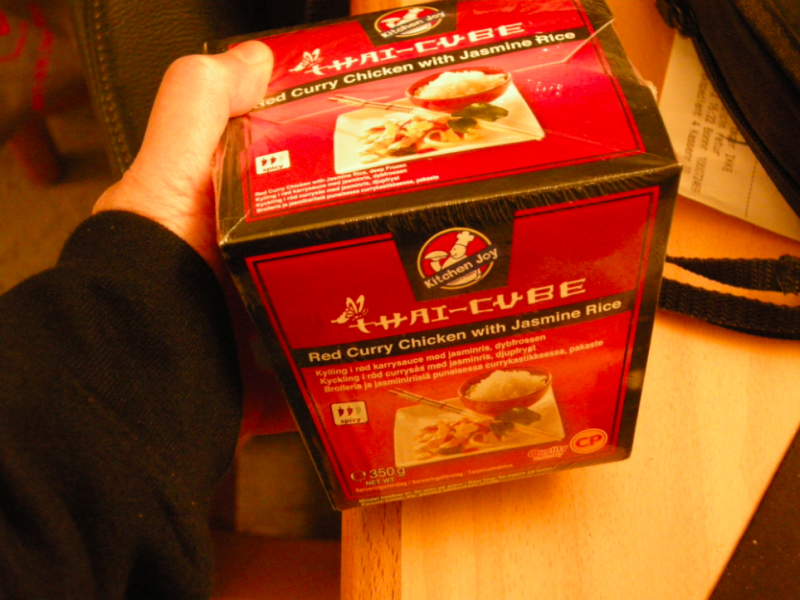
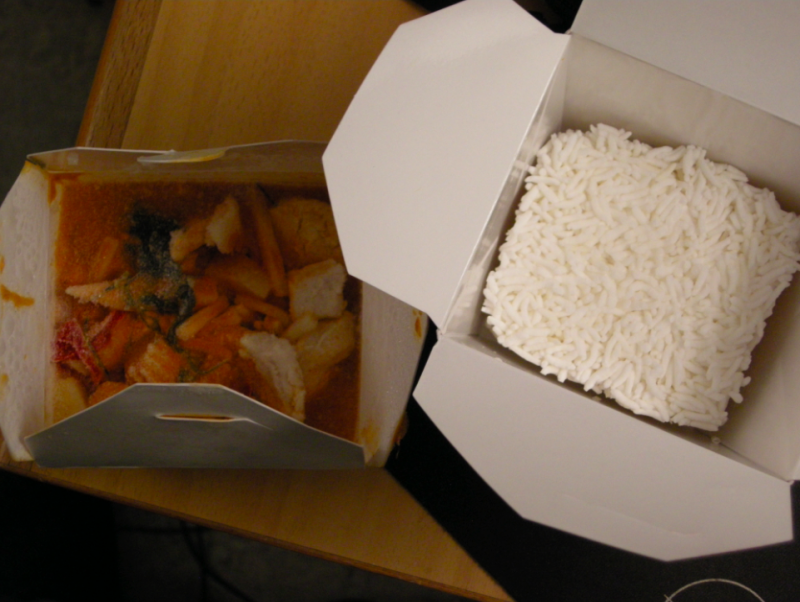
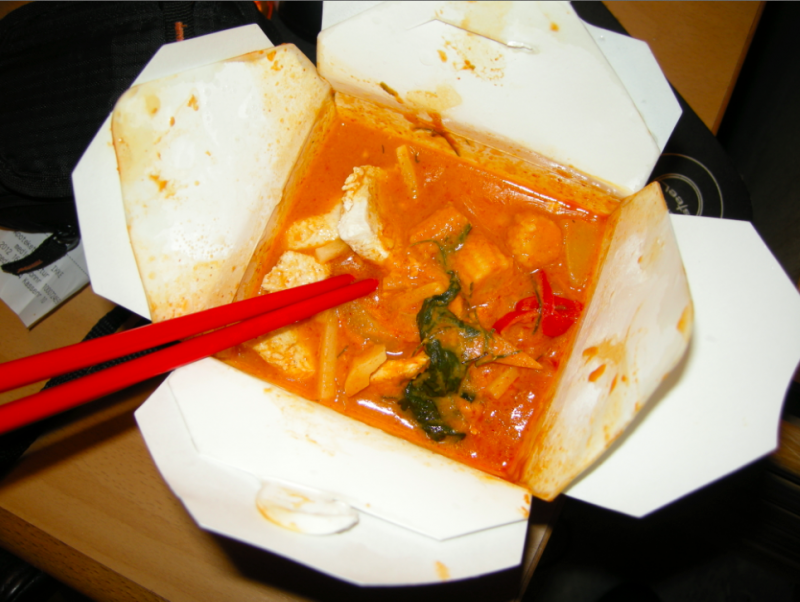
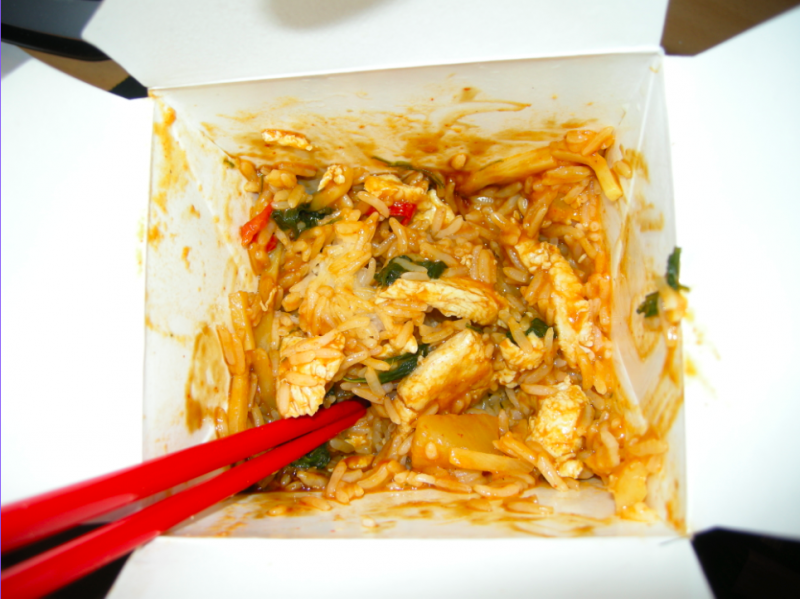
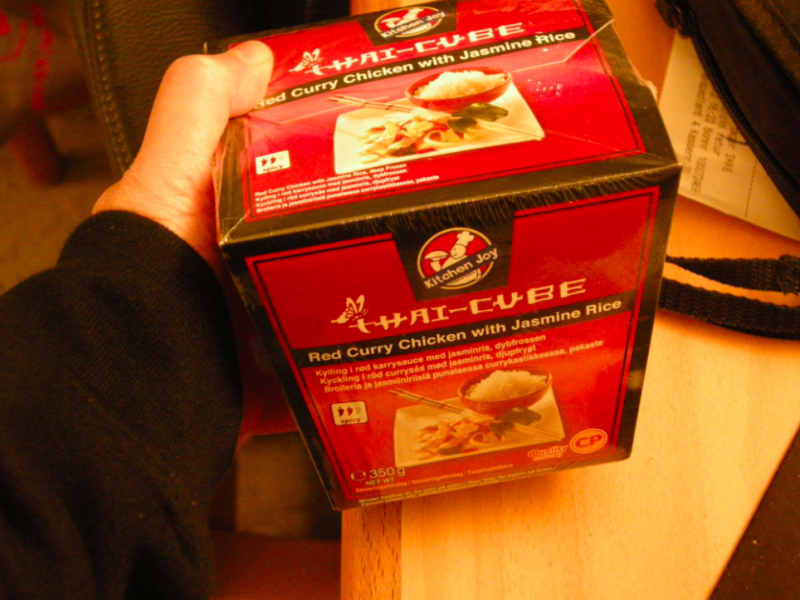
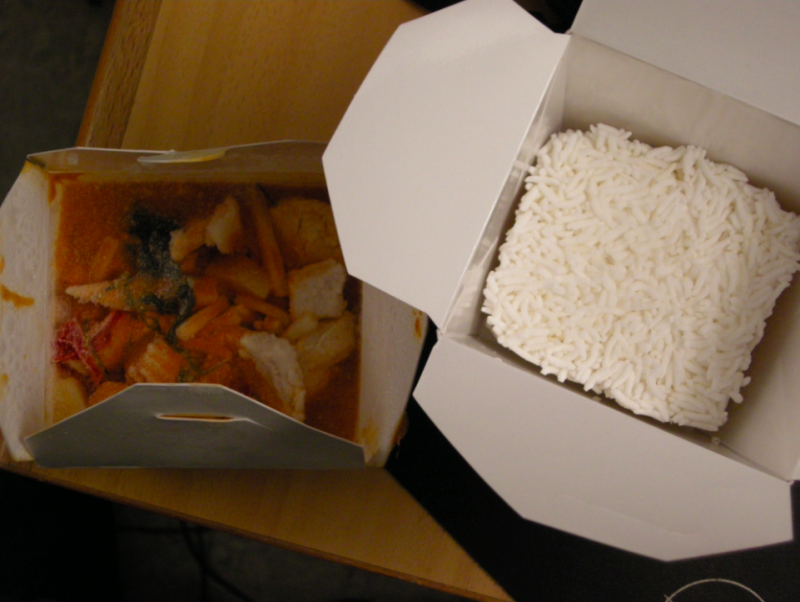
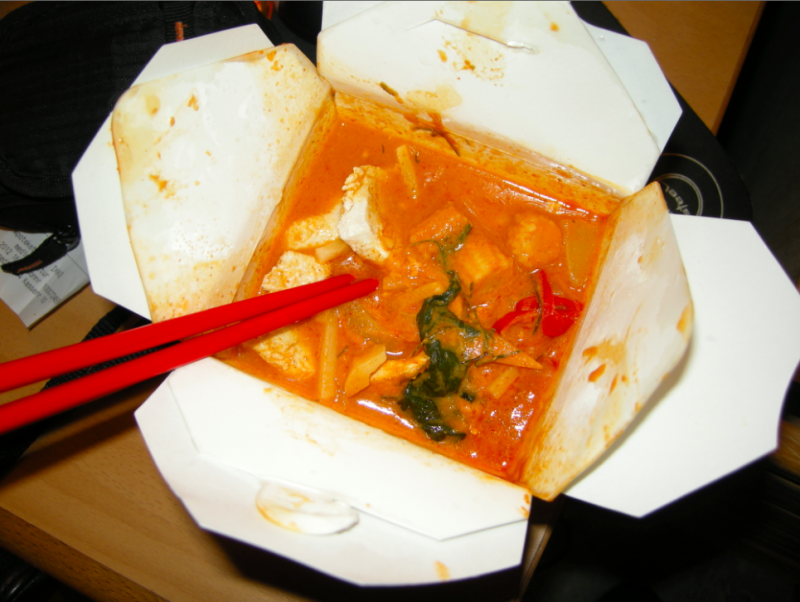
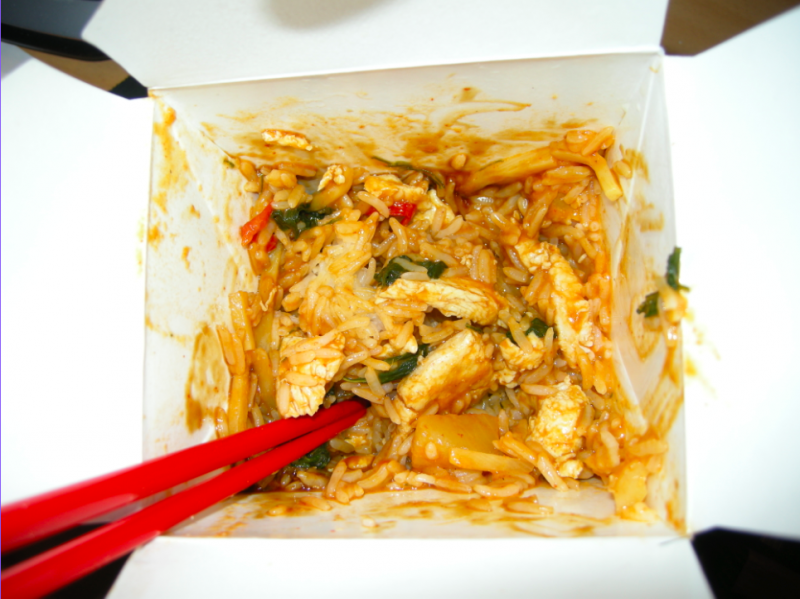
Owing to my parents' careful efforts to shield me from popular culture, frozen dinners have always been kind of off the radar for me, sort of like dentures or chaps; I've always been peripherally aware of them, but could not imagine they would have any relevance to my life. But I've been curious. And my while my boyfriend is jet-setting around India and the Alps, I'm snowed under with work, and have little inclination and even less time to prepare actual food. After a few days of pinto beans, edamame, and bresaola, this seemed like an excellent time to explore frozen dinners, particulary since there's a line of these things that I've found a bit eye catching: Thai - Cube. Seriously, how could this possibly go wrong? The instructions say to just remove the plastic outer wrapping and shove the thing in the microwave for 4 to 6 minutes, but I decide to investigate a bit: Hm. Well, okay. I pack everything back inside, microwave it, and carfully pry open the flaps with chopsticks, to avoid getting scalded: Ah. That shade of orange... At this point, I realize the damn thing is leaking remarkably unappetizing-looking liquid all over the my boyfriend's mouse mat (by his computer is where the lighting is best). I put the whole thing in a bowl, tidy up the mat, tip the top container of mixed chicken and veg stuff onto the rice clump, and mash about with chopsticks. I go to a dimmish corner, and eat this. It's... adequate? Not really gross or anything. Not delicious, either. Some heat, but otherwise bland. The chicken is not remarkably rubbery, and the vegetables could be quite a bit worse. This was all about half an hour ago. I felt kind of queasy immediately after, but I think that had mostly to do with the really unfortunate colour of this thing. I feel fine now. If I had to eat one of these in the future, I wouldn't kick, but this is definitely not an experience I'd voluntarily seek out. I should mention that of the frozen offerings at the local supermarket, this line of products struck me as the least unattractive; frankly, I can't see myself trying any of the other options anytime soon. If the frozen dinners of my parents' era were worse than this, I'm honestly not surprised that they made sure I never went near one!
-
With a small sharp knife I make a longitudinal cut in the wrapping about as far along as I'm going to take off a bunch of slices. This notch give a starting point that makes it easy to peel off the band of wrapping.