Shel_B
-
Posts
4,805 -
Joined
Content Type
Profiles
Forums
Store
Help Articles
Everything posted by Shel_B
-
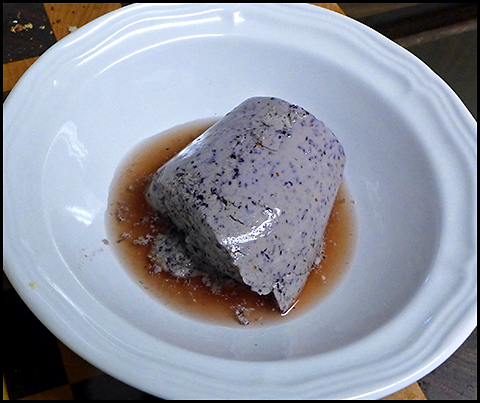
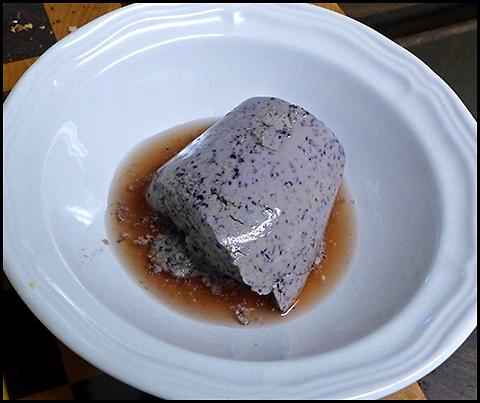
For lunch, I whipped up a blueberry smoothie: fresh blueberries in some home made almond milk. I took the glass with the smoothie to the dining area, and, a few minutes later, when I started to drink it, the contents were somewhat gelatinous. The longer the drink sat, the more gelatinous it got. Here it is after about ten minutes: What would cause this to happen? And how can this be prevented? My first offhand guess is that by blending the blueberries, pectin was released, and that firmed up the drink. Just a wild guess.
-
For those interested in this story, here's a little more .... http://www.cornucopia.org/2015/06/whole-foods-faces-ftc-mislabeling-investigation/?utm_source=eNews&utm_medium=email&utm_content=7.4.15&utm_campaign=WFFTC
-
I rarely drink, but I do like a good (dry) vodka martini. Since I may only have one or two a year, I'd like it to be something special. While there are a couple of vodka brands that I enjoy (Stoli & Absolut), I know next to nothing about vermouth. Which vermouths might go well in a martini made with Stoli or Absolut? Or does it matter at all?
-
I'll look at the Vollrath. Can't use gas here .... ETA: Yikes! $500.00 for the Mirage Pro at Amazon ... more than I care to spend.
-
I have a question about induction burners, specifically about the stand-alone or portable burners. Can any of them be set to maintain a specific or steady temperature over a period of time, such as a couple of hours?
-
My uncle is a designer, engineer, inventor, and cook, and some of his products are microwave ovens. In response to a video I sent him, and comments posted here, this is what he has to say about using SS bowls in the microwave oven. And my subsequent comment.
-
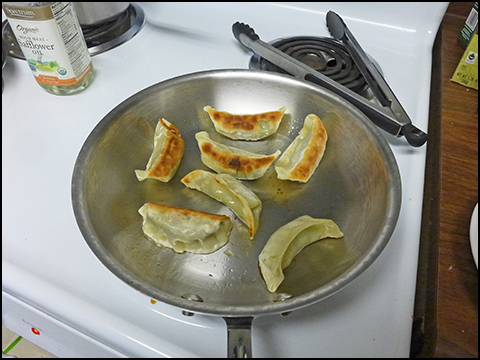
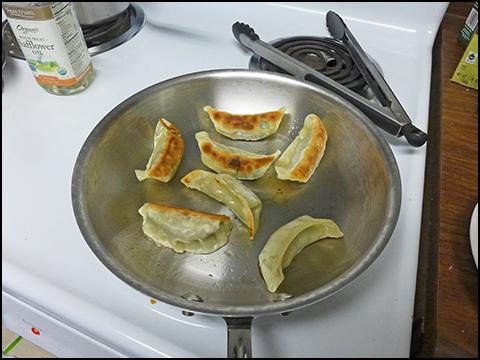
That's not a problem here, so maybe it's a difference in technique or ingredients <shrug>. However, one thing I do that some people may not, is to clean the pans frequently with Bar Keepers Friend. I just don't allow any buildup of dirt or grease of any sort. That's probably more about how I like all my dishes and cookware cleaned, but I am absolutely convinced that a clean SS skillet can only work in your favor. If you're talking about starches not releasing, note that the pot stickers in the pics above didn't stick at all. Maybe it's a different kind of starch ...
-
It's almost impossible to say how much I've spent for kitchen and cooking gear. It's been an ongoing - seemingly never-ending - process for almost forty years. The one thing I've learned is that you don't always need what you think you need. Take your time making decisions, and take your time deciding just what to get. Wherever possible and appropriate, buy the best that you can afford, and look for things that will last as well as give you pleasure and good cooking results. I second looking in thrift stores, garage and yard sales, and using eBay and Craigs List. I've gotten a lot of great items at thrift stores and garage sales for just a dollar or three. Recently I purchased a 32 piece set of dinnerware for $19.00 at a thrift store, four different sized Corningware casseroles with lids for an average price of $2.00 each ... the list goes on and on.
-
The problem with only SS bowls is that they can't be used in a microwave oven, so it may be a good idea to have both glass and SS bowls. I agree that avoiding plastic is a good way to go.
-
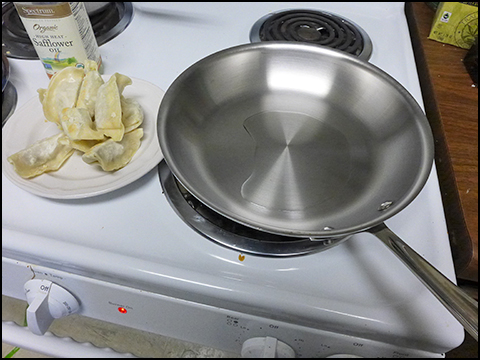
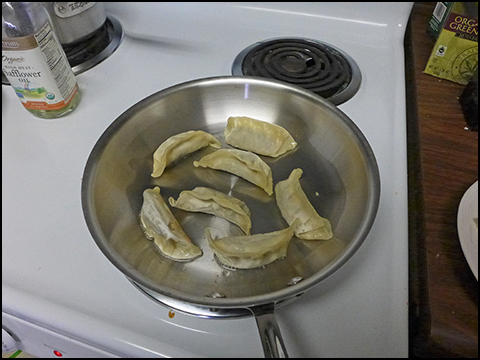
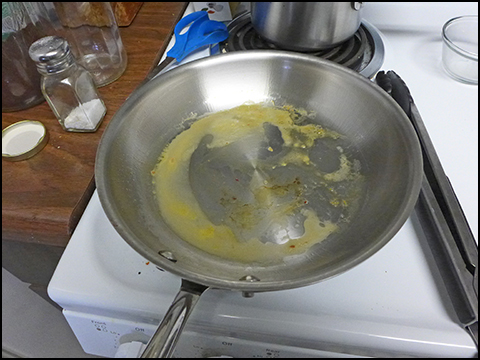
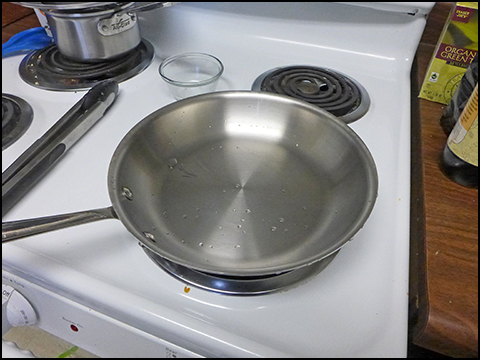
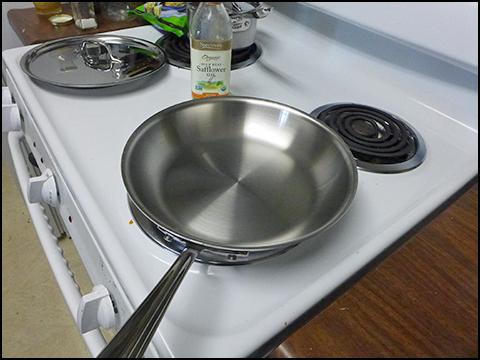
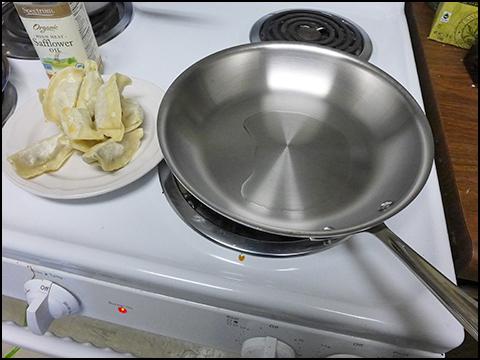
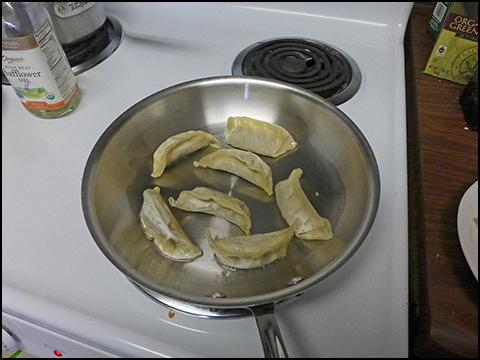
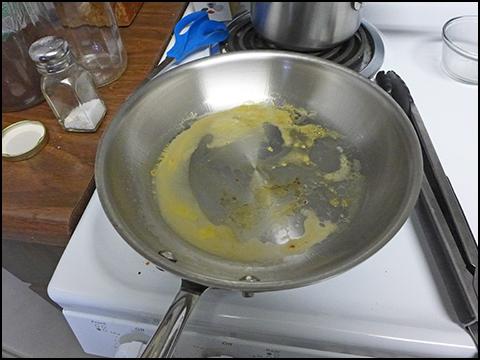
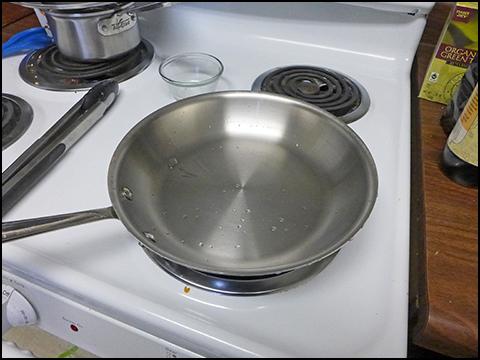
Hi Sylvia ... When I first started using SS I had the same problem, and almost ruined an All-Clad 12-inch skillet. It looks awful but, almost 40 years later, it's still a kitchen workhorse. I've found that there is a substantial difference in the results with different SS pans. All SS is not created equal. For example, Toots purchased an 8-quart Martha Stewart soup pot, which has about the same shape and dimensions as my 8-quart All-Clad soup pot, and whenever I cook using Martha's pot, I have to "fight" the pan. Food sticks much too easily, and the pot, after just a few uses, is showing signs of distress. It's definitely more difficult to clean than the All-Clad and the one small Calphalon saucepan that I have. Here's the 10-inch All-Clad on the stove, cleaned and ready to use. I'll be cooking some pot stickers. Here, after heating the pan, I've added just a small amount of oil to the pan, about 1 Tbs, maybe a scosh less. You can see that not a lot of oil was used. I've added the pot stickers to the pan after the pan and the oil has been heated. Here you can see how nicely browned the pot stickers are. Notice that there is absolutely no sticking. This is the pan after cooking the pot stickers. Again, note that there is no sticking, although there is a small area where the oil stuck to the pan a bit. When The pot stickers were removed from the pan, I removed it from the heat to allow it to cool down a bit before cleaning the pan. And here's the pan after cleaning. Looks just as it did before cooking. I just used some hot, soapy water and a touch of Bar Keeper's Friend to remove the sticky oil patch. I didn't dry the pan before photographing it, so you can see some water beads. IMO, the trick is to heat the pan first, and not too hot, add the oil or fat and let it come up to temp, then add the items to be cooked. With the All-Clad, I rarely use more than medium heat, but sometimes I'll bring the heat up to what might be called medium high. When cooking meat, I want a little sticking in order to develop the fond. Deglazing usually removes any stuck on bits, and anything remaining is usually removed with a soak in hot, soapy water and, worst case, a touch up with Bar Keeper's Friend. As suggested elsewhere in this thread, when cooking meat and other proteins, just let the meat cook without moving it around. The meat will develop a nice crust and will release easily and cleanly from the skillet. This is the Bar Keepers Friend product I use on my cookware. I hope this helps you a little ....
-
Does TJ Maxx and Marshalls carry All-Clad?
-
Might there not be an issue with condensation when storing flour in the freezer?
-
Wow! I didn't know that. Thanks!
-
It would be workable if I can store the flour in the bag it comes in inside a Cambro. I'd have to check my freezer space ... I don't have a lot. There's a Smart and Final less than two miles from my apartment. I'd neither store leftovers nor do any microwave cooking in them, though. I just don't store food or cook in plastic. Thanks for your suggestions.
-
Why did you leave a tip if the food and service was so bad? Twice in the past fifteen years some friends and I have encountered atrocious service, both times at well-regarded restaurants, and both times we left a $1.00 or $2.00 tip, only because we wanted to be sure the recipient knew that we didn't forget leaving a gratuity. In the second instance I followed up with a letter of complaint describing the problems we had and our dissatisfaction. I never heard back from the restaurant. I believe that rewarding poor service with a tip and not complaining to the management just fosters continuing poor service.
-
Allow me to preface my questions by saying that I don't bake very much, and often a 5-lb bag of flour may hang around for months, and then I may engage in a flurry of baking. So, what's the best way to store flour, both white AP and whole wheat? I am thinking of getting one of those canisters with a tight fitting lid, something like these. I'd like to stay away from plastic and go with stainless steel, or some other non-plastic material, but that's not a requirement. Are these types of containers a good choice for storing flour? Is there another alternative? How long can flour be stored and still remain viable? I'm sure it depends some on conditions, but a rough idea is fine. What can be done to extend the life of stored flour? And how might I know if the flour has gone bad? Thanks!
-
I just remembered, Trader Joe's in my area carries the Tejava. Maybe it's elsewhere, too.
-
Not that I recall ...
-
In a video about making potato dishes, Heston Blumenthal showed how potato starch could be used as wallpaper paste. In fact, he papered a room using potato starch as the adhesive.
-
The product is "It's It" and you can order directly from them if you prefer.
-
Health issues re: plastics, waste because non-stick has to be replaced frequently; yes, it's a personal manifesto in some sense of the word; and it's a curiosity to see how other people feel about non-stick cookware.
-
Things change ... new info about plastics and non-stick cookware and cooking experiences have come about. And some of the info I got from the past threads have influenced my current thinking. I still like the Calphalon pan - which, as noted in my original post, I shall keep and use when appropriate.
-
I wouldn't use that stuff on my pots, or anything that I eat from. I don't even use it in my oven. There's no need to possibly ingest toxic chemicals.
-
Another reason to cook with and eat "real" food.
-
After reading and researching about the deleterious effects of plastic, and getting tired of replacing my non-stick skillets (even though I get years of use from them, and the ones I buy are not expensive, the idea of tossing old skillets into the landfill is bothersome), I've decided to stop using these plastic-lined pans. I replaced my 10-inch Calphalon Contemporary non-stick skillet (which I like very much) with a 10-inch All-Clad. The first thing I noticed is that I had to relearn how to use a non non-stick skillet, learning the best heat and amount of oil to use. It took a few tries to dial in the new skillet, but now I've pretty much got it, and have figured out how to use a minimum amount of oil. In fact, in many situations, I use as little (or even less) oil than with my non-stick. Even eggs slide right out of the pan with the use of a minimal amount of fat. The stainless skillet cleans up easily, although I sometimes need to let the skillet soak a while to make cleanup a little easier, however that's not an issue for me, yet I know that for some people it can be. Anyone else giving up Teflon, or perhaps never used it in the first place? Just curious ... And while the subject of this post suggests that I've totally given up using non-stick skillets, I still have the 10-inch and 12-inch Calphalon pans, and may at some point find a use for them.