


teonzo
-
Posts
1,290 -
Joined
-
Last visited
Content Type
Profiles
Forums
Store
Help Articles
Everything posted by teonzo
-
Glad you liked it! I would suggest you to give a try to some other matcha teas (I suppose you used a "cooking quality" one and not a top choice) and Japanese teas in general (sencha, gyokuro...). For drinking, not for sorbets eh. There are wonderful teas out there, pretty far from the supermarket teas we can find here in Europe. Only problem is their cost! Teo
-
I've never seen any other recipe for matcha tea sorbet. Usually it's a dairy recipe (gelato, ice-cream, whatever, I always get lost with English terms for these things, I'm sure you understand since you speak Italian), most of the time with yolks. The recipe I wrote is one of my "creations", so it's most probable you won't find anything similar since I created it from scratch. My reasoning started from the Modernist Cuisine pistachio sorbet: sorbets let the main ingredient shine more, since there are no added flavours from dairy stuff and eggs. Balancing a nut recipe is difficult, due to the varied composition of the nuts. Balancing an infusion recipe is much easier, since it's just water plus some aromatics (you could make a water sorbet, as you can make a water pate de fruits, the only thing you will taste will be sweetness). In the same way I made a honey sorbet, mint sorbet, cinnamon sorbet... After trying this road I'm not going back, they taste more pure and clear. About proteolytic enzymes dissolving gelatin, no need to worry with tea, they are not present in tea leaves. Even if they were, matcha tea is produced via steaming, so those enzymes would be deactivated by the temperatures reached during steaming. If you have an ingredient with proteolytic enzymes you just need to bring it to 100°C to deactivate them. I'm pretty sure tea leaves do not have them since I made a couple of tea mousses, starting from a cold infusion (tea leaves in water in the fridge for 24 hours), then I heated it to about 50°C to dissolve gelatin. If they had those enzymes those mousses would not have set. While they were not matcha teas but other teas, all of them are made from camelia sinensis. Teo
-
For sure it would work, since it's been used for a lot of time. But I don't have direct experience, never used pure gelatin as sorbet stabilizer, so I'm not sure about ratios. 2 g for a total of 500 g sound fine, but I would suggest you to make a comparison with some other recipes with gelatin ad stabilizer. I gave a quick look but unfortunately I don't have one. If you use gelatin for other sorbets / ice creams / gelatos then try using the same quantity as there. Teo
-
I have this one: 350 g infusion (water) 150 g sugar 2 g stabilizer (simple locust bean gum works fine) The reasoning behind it is pretty simple: sorbets work when the reading at the refractometer is within a certain window. The problem with fruits is that they have different solids content (sugars and so on), so you need to adapt each time basing on those values. With infusions it's much more simple, you just have water and sugar, so you can calculate it beforehand with a simple proportion. Stabilizer is highly suggested, otherwise you risk getting a grainy sorbet. Stabilizer ratio can vary depending on which one you are using. I would suggest to make a stronger infusion than usual, since you must factor the cold and the sugar. I would say to use 50% more tea leaves than if you had to drink the standard tea. With matcha tea just make the base syrup (with the stabilizer), add matcha tea to taste, blitzing with an immersion blender. Since you need really few grams of matcha it won't unbalance the recipe. This recipe works for spice infusions as well, in this case it's better to make the syrup and add the spice to the boiling syrup just when you put it out of the flame. The aroma extraction in syrups is much better than in simple water. Teo
-
Fist things that come to mind. If you just washed a wood utensil (spoon, whatever) and you need it perfectly dry, put it in the MW for about 1 minute (30 seconds on one side, then turn upside down and other 30 seconds). Beware to not keep it for much more time otherwise it will burn (literally). Kitchen sponges are one the favourite places for microbes and so on, so after using them you can put them in MW to dry. Some fruits (like apples and pears) get a nice texture (cooked but firm) and not oxidize if cooked (after peeling and coring) for few minutes in the MW. You can heat water for tea in the MW (hahahahhaha, I'm running for cover). Teo
-
Just a minor criticism: displaying only 1 item per type, like you did for the jams, is a deterrent for sales. It's much better to display multiple items, like you did for the cookies. Teo
-
Your Daily Sweets: What Are You Making and Baking? (2016 – 2017)
teonzo replied to a topic in Pastry & Baking
I suppose you know how many jokes you would get in a real kitchen after saying this! That was a first for me. You need to be lucky to have enough ingredients with those letters and after that you need to be even more lucky that they pair well together. Making something with Z ingredients would be pretty hard! If you need more infos/other feel free to ask. Beware that the pumpkin version is a bit trickier than the sweet potato one, the pumpkin inclusion is softer and needs more care during lamination. Before creating confusion, I used the "delica" variety, you can see it on this photo for example. I don't know how it's called outside Italy, I don't even know if it exists outside of Italy. I'm also pretty ignorant about differences between pumpkins and squashes, here we call all of them "zucche". The "delica" variety is the one with the firmer (cooked) flesh we have here. Teo -
So, did you start considering about taking over the Blue Chair business? Teo
-
Your Daily Sweets: What Are You Making and Baking? (2016 – 2017)
teonzo replied to a topic in Pastry & Baking
(Was not able to insert 2 images in the same post, so I had to make 2 different posts) Saccottini Kukkis These are made with the same technique I used for the pomegranate + sweet potato viennoiserie I posted some weeks ago. This time I made a pumpkin dough, using pumpkin juice instead of water for the basic dough. For the inclusion I used pumpkin puree, but I had to work it a bit before getting the right texture (standard pumpkin puree is too watery and soft): first I reduced it to 50% to loose some moisture, then I cooked it with 20% flour to give it more body. Filling is persimmon jam. All the recipe is vegan. Just after taking the pan out of the oven I brushed them with hot syrup (2 parts brown sugar, 1 part water), it helps giving a shining finish, plus it acts as a barrier for moisture, leaving the cooked dough more tender. This is not a light viennoiserie (well, which are?) because pumpkins and persimmons have earthy and prominent tastes, but who cares, I liked them. Teo -
Your Daily Sweets: What Are You Making and Baking? (2016 – 2017)
teonzo replied to a topic in Pastry & Baking
Dessert Mel This is composed by: - melissa mousse (the 2 whitish pieces on top image) - pomegranate "waffles" (don't know how to call them in English, the 3 thin things sandwiching the mousse) - pomegranate jelly (the 2 curved strips) - quince cheese (not set, still pliable) Decorations are melissa leaves and pomegranate seeds. The idea for this dessert started from a play on words, the 3 main ingredients all start with the same 3 letters in Italian (melissa = melissa, pomegranate = melagrana, quince = mela cotogna). This is a light dessert that can appeal to anyone. I used no sugar for the 2 pomegranate components, their acidity help to contrast the fattiness of the mousse and the sweetness of the quince cheese. The citrus tones of melissa help to light it as well. Teo- 489 replies
-
- 11
-

-
I always dreamed of making a month traveling from farm to farm, this site is a great help, thanks! Teo
-
Your Daily Sweets: What Are You Making and Baking? (2016 – 2017)
teonzo replied to a topic in Pastry & Baking
Crostata Nisba An earthy pie made with fall ingredients. Layers from bottom to top: - millet shortcrust (half millet flour, half wheat flour) - medlar jam (this layer is not visible) - horseradish "cake" (flour + sugar + grated horseradish + water + oil) Decorated with confectioner's sugar and medlar jam. The recipe is vegan (not how I realized it, since I used standard confectioner's sugar). I'm happy with the result, it's a weird combination so this is a pie for adventurous palates. The main tone is the earthiness by all 3 ingredients. Medlars give a good acidity, horseradish (used few) gives spiciness and a long aftertaste. Millet flour is coarse and make a raw effect, which is ok for the pie: this is a blue collar pie, not a white collar one. I'm always happy when I use poor ingredients (medlar and millet are used as animal feed here in Italy) and get good results. Teo -
Your Daily Sweets: What Are You Making and Baking? (2016 – 2017)
teonzo replied to a topic in Pastry & Baking
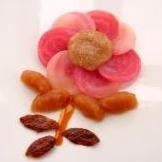
Torta Biema Layers from bottom to top: - poppy seeds biscuit - beets and yogurt jelly - beets mousse - poppy seeds biscuit - yogurt mousse - beets glaze Decorations are pure yogurt on top, a white chocolate strip sprinkled with poppy seeds (a bit too much seeds) on the side. Beets are totally unusual in pastry here in Italy, I was curious to try making an entremet with them. The result is very light and "catchy". I gave a slice to a few people for a blind taste (without telling them what was in the entremet), all of them liked it and cleaned the plate. After telling them there were beets all them made a puzzled facial expression (or worse) but they couldn't argue about their appreciation for it. It's always fun seeing such reactions. Teo- 489 replies
-
- 10
-
-
Your Daily Sweets: What Are You Making and Baking? (2016 – 2017)
teonzo replied to a topic in Pastry & Baking
I wondered the same question, I suppose the oil quantity should be too high. As far as I understand the yeast cells attack and process both the wheat flour and the sweet potato starches, this way they develop gas bubbles in all the layers. The standard lamination technique used in viennoiserie is to include pure butter, not mixed with flour (as most professionals do with their puff pastry recipes), this must be for a good reason. Another problem is that oil is liquid, so adding it to the sweet potato pulp would make it softer and more fluid, this would cause a good amount of troubles during lamination. I see this technique more as a way to include (a high amount of sweet potato pulp in the dough without it absorbing flour) than laminate. Since the result is a really tender and light dough (more similar to bread than buttery viennoiserie), then I'm fine with the current state. Teo -
Your Daily Sweets: What Are You Making and Baking? (2016 – 2017)
teonzo replied to a topic in Pastry & Baking
Saccottini Hinaqu Don't know how this shape is called in English, in Italian it's called "saccottino" which means "little pocket". It's a sort of turnover made with leavened dough and jam inside. Flavors here are sweet potato (here in Italy we have this kind, grey flesh) in the dough and pomegranate in the filling. I tried a new technique for the dough: when eating a sweet potato I thought "this has the texture of soft butter... I can use it instead of soft butter somewhere". So I tried it for a viennoiserie piece. I picked up a recipe for croissant dough and used the cooked sweet potato pulp for the lamination instead of the usual butter. Since I was substituting a dairy product with a vegetable I decided to make it a vegan recipe. Laminating the cooked sweet potato pulp inside the dough has the advantage that the potato is not aborbing flour as if you were adding it to the main dough. In this way you get a lighter result, not as heavy as the usual sweet potato doughs. After cooking you loose the lamination effect, you don't see the different layers and don't get the crispy flaky crust of croissants. This because croissaint lamination works thanks to the butter fat (the fat of all the mini butter layers works as a shield for vapor, keeping divided the layers), sweet potatoes are mainly starch and not fat, so that effect is null. No problem, I'm happy the same since I got a light, soft and tender dough. Filling is a sort of pomegranate custard: pomegranate juice, sugar and cornstarch, cooked together. I used the cornstarch method to avoid the risk of the filling spilling outside the dough. I'm really pleased with the result. Texture and taste are quite different from all the usual viennoiserie, but it's really a pleasure to eat. Plus it's vegan, good thing because making vegan viennoiserie is always a challenge. Teo -
Simply I don't like it, hehhehe. I'm a bit of a pistachio "purist", I'm not a fan of the pairing with caramel. Using top quality pistachios in a praline is just a waste of good ingredients in my opinion, you loose the nuances that make good pistachios good. Giving how much pistachios cost, I don't see much sense in buying something where pistachio qualities are covered. As I wrote, it seems like a way to use non-top pistachios and ask premium prices for them. Good for their wallets, not for mine. Same as above: I don't think they use their top cocoa beans for caramelized products, but they ask premium prices for them. Ok, caramel flavored things will always appeal to the masses and be a good sell, but there are cheaper ways to get those flavors. Teo
-
Just a way to utilize the byproduct of hazelnut oil production? I've been puzzled when I saw about their pistachio praline: I said to myself "a bad way to ruin good pistachios, or a good way to recycle bad pistachios". Call me old, blind or whatever, but they lost me with all that stuff like Dulcey, Caramelia and so on. Teo
-
Baking (Etc.) with David Lebovitz's "Ready for Dessert"
teonzo replied to a topic in Pastry & Baking
These kinds of troubles with pâte à choux are usual when you make small quantities (5 eggs or less) and add one egg per time. It's better to pour the eggs in a jug, whisk them briefly to mix yolks and whites, then add the lightly beaten eggs from the jug, few quantities each time. This way you won't be adding a whole egg (about 50 g) but much less (say about 10 g), so it's much easier to control the final texture of the mixture. If you need to rescue a liquid pâte à choux, then you can prepare some more of the cooked mixture, add it to the liquid pâte à choux, then add other egg if necessary. It can be a problem due to bigger eggs. But it's not a given, the required amount of eggs depends on how much liquid evaporated during cooking (can't control it) and how much starch gelification happened during cooking (can't control it). So the required amount of eggs will always vary from time to time, unless you are a cyborg or are using machines. Teo -
I would suggest you to go to a health store and give a look to their selection of essential oils, dried flowers and so on. Teo
-
Snack Narin Layers are hazelnut "cremino" (don't know how to translate it in English, it's equal parts of milk chocolate and hazelnut paste) on the bottom and bergamot white chocolate butter ganache on top (simple butter ganache with added bergamot essential oil, can't find the real fruit where I live), enrobed in milk chocolate. Visually they are simple (more a triple bon bon than a snack) and full of defects, it's just a try at home made completely by hand (I'm not willing to buy guitar and molds to make experiments at home, no sense). The idea is to make something similar to Ferrero's Duplo (don't know if they are sold outside Italy, probably with a different name): a mold with 3 demispheres cavities, each one filled with a half hazelnut (not whole like Duplo) plus hazelnut "cremino" and bergamot ganache. Taste is pretty familiar and catchy (nothing new or weird), all people who tasted them were happy. Teo
-
If you don't have experience with quince then it's quite easy. Wash the quinces. Prepare 2 bowls with water and add some lemon juice to both to retard oxidation. Pick a quince, peel it and put the peel in the first bowl; cut the peeled quince in quarters, core it, cut the cores in small pieces (the ideal thing is to cut the more seeds possible, they are full of pectin and the cut ones release more pectin) and put them in the first bowl (with the peels); cut the remaining pulp in pieces (2-3 cm wide) and put them in the second bowl. When you finished with all the quinces then drain the second bowl and weigh the pulp pieces. Then calculate the amounts of sugar and lemon juice: for 1000 g of quince pulp you need 500 g of sugar and about 15 g of lemon juice (this is up to taste). Transfer the content of the first bowl (peels, cores and acidulated water) in a first pot, put on a lid and let it boil for a good amount of time, the ideal is 6-8 hours, the more it boils the more pectin will be released in the water. Transfer the quince pulp pieces in a second pot, cover them with water, add some lemon juice (usual oxidation reasons), put on a lid and boil for about 2 hours, until the pulp is tender. Before boiling the pulp it most probably started to oxidize and brown, not a big problem because during boiling it will come back light yellow and then reddish. Check the pulp consistency every 15-20 minutes, if only just to remove the lid and breath that wonderful floral scent. After boiling the 2 pots for the required time proceed this way. Drain the cooked quince pulp and put it back in the pot, discarding the cooking water. Drain the peels and cores, keeping the cooking water (just the opposite, you are keeping the water and discarding the peels and cores). Add the pectin water to the cooked pulp, mix with a stick blender till having a fine puree. Add the sugar and lemon juice, mix again. Put it back on the stove and cook to desired texture. At the beginning you don't need to stir, it's pretty fluid. The more it cooks the more you need stirring, since it becomes denser and denser and you risk scorching. You can cook it to gelification and get quince cheese / pâte de coing. If you stop before gelification you get a spreadable paste, so you can put it in cans like jam. When making most jams the key for best flavor is to cook them the less time possible. With quinces it's almost the contrary, they "open up" with long cooking, if you go quick you don't get the best result. About flavorings, quince pair well with citrusy tones: citrus zests, melissa, lemongrass, lemon verbena, coriander seeds, juniper berries... Plus all the spices that pair well with apples: cinnamon, nutmeg, cloves... About persimmons, don't know which method you used. I put the persimmon pulp (no skin, no stem, no seeds of course) in a big bowl, mix it with a stick blender, add 50% sugar (500 g sugar for 1000g persimmon pulp) and lemon juice (to taste as usual), mix again, put on the stove and cook as quick as possible. My favourite pairings with persimmons are licorice and mace. Other choices: bay leaf, cinnamon, cloves, amaretto, nutmeg, long pepper, allspice, thyme, ginger... It's miakawa season here in Italy, they are a kind of green/yellow mandarins, pretty tart and bitter, so they work great for marmalade. It's chestnut season too, so you can prepare crème de marrons. Of course it's a PITA, but here on eGullet there was a great suggestion to speed peeling, you just need to cut the chestnuts almost in half, cook them a bit until the peel start detaching, then with pliers you go totally quick (can't find the thread, sorry). It's a good task to assign to the girls, of course with heat gloves. For flavorings you can use: bay leaf, cinnamon, cloves, amaretto, nutmeg, armagnac / brandy, rum, all kind of peppers, rosemary, fennel seeds, thyme, ginger... Sweet potatoes can give a similar result to crème de marrons. Cook the sweet potatoes, peel them and weigh the pulp. Calculate 50% water and 70% sugar, make a syrup, add the cooked sweet potato pulp, mix with stick blender, then proceed like crème de marrons. Flavorings: same as chestnuts, or whatever you use with sweet potatoes. Not only fruits are suitable for jams, vegetables too. My favourites are radicchio and red onions, these jams are a good alternative to pair with cheese (blasphemy for a French, I know). For radicchio: cut it in thin strips (almost julienne), calculate 80% sugar and 80% water, make a syrup, add the radicchio then cook to jam consistency. For red onions it's almost the same. Better using 60% sugar and 20% corn syrup, since it tends to cristallize. I like to add nuts pieces to these 2 jams, they pair well and give a desirable crunch. Or you can flavor them with whatever herb/spice you use in savory dishes. You can make beet jam too. Cut beets in small dices, weigh them and calculate 50% water and 50% sugar. Cook the beet dices, divide them in half. Put half in the syrup, mix with stick blender. Add the remaining dices and cook the jam. Remember one thing: you are selling things to other people, each person has different tastes from the others, so if you don't like something then this does not mean all the customers will hate it too (quite the opposite). The more diversity the better, this way it will be easier for everyone to find something to their taste. So I would try to make more than 1 flavoring for each fruit. Worst case scenario: you won't sell everything, so you will have cans to give as gifts or to consume at home. Teo
-
Some more books from France: Valrhona - Aux Sources du Grand Chocolat: Recettes d'experts Frédéric Bau - "Envies chocolat" Christophe Felder - "Le dessert: Bistrot / Palace" Pascal Caffet - "Praliné: 100 recettes 100% praliné" Eric Frechon - "Eric Frechon" Arnaud Lallement - "Emotions en Champagne" Jean-paul Jouary - "Akrame, instincts de cuisine" Alexandre Couillon - "Marine et végétale" Jean-Yves Schillinger - "JY'S" Teo
-
I'm not an expert on caramels (far from it, I much prefer ganaches in my pralines), but I would reason this way. Butter is composed by about 82% fats and 18% liquids (mostly water). So when you add butter to the caramel (cooked sugar, not the final product) you add fats and water (plus few % points of other stuff). Then you need to cook the mixture to a desired temperature, this is to reach a fixed % of water (different boiling temperatures, different water %, they are pre-determined in the sense that the same mixture boiling at X temperature always have Y% water). So you can "deconstruct" butter in oil + water. I would use a neutral oil to not add flavours, like rice oil, corn oil, peanut oil (they are pretty easy to find in Italy, don't know elsewhere). And I would add a bit of lecithin to help the emulsion. But I would proceed differently than with the butter caramels. With butter caramels you add the butter to the boiling caramel. In this case I would add boiling water, then when the temperature dropped I would add the vegetable oil (the less you heat vegetable oils the better) and lecithin. Then I would proceed as always: cook to the desired temperature, let it cool, then deposit in moulds. Since you add only water to the cooked sugar, it means lower mass, which means more evaporated water. So I would raise the amount of water. This does not change the recipe balance, since when you cook the caramel to the desired temperature you will evaporate all the extra water. My hypothetic next attempt would be: - pick-up my go-to caramel recipe (dairy version), keep all the amounts except butter, then substitute butter with 0.8x vegetable oil, 0.5x water, 0.005x lecithin, example if your recipe calls for 160 g butter then I would use 160 x 0.8 = 128 g vegetable oil, 160 x 0.5 = 80 g water, 160 x 0.005 = 0.8 g lecithin; - cook the sugar as usual to get the caramel, in the meantime heat the water to boiling point; - deglaze the caramel with boiling water (being careful as usual, of course); - add vegetable oil and lecithin, mix with stick blender; - cook to desired temperature; - cool to working temperature; - deposit in moulds. I don't know how much far off the water amount is. It can be too few (which means when you cook the mixture to desired temperature then it will start boiling at a higher temperature), or too much (it will take a lot of time to evaporate excess water and reach desired temperature). You can only know this after your first attempt, write down the results and change accordingly. Another problem can be texture. Since butter fats cristallize at room temperature and vegetable oils not, then this vegan caramel most probably will be more fluid than the dairy version. You can counterbalance this by raising the desired temperature, or lowering the amount of vegetable oil. I suppose that your "glue" problem is given by the fact that coconut milk has starches in it. Teo
-
Your Daily Sweets: What Are You Making and Baking? (2016 – 2017)
teonzo replied to a topic in Pastry & Baking
Torta Eheca Layers from bottom to top: - chocolate biscuit - carrot mousse (with candied carrot cubes) - chocolate biscuit - corn mousse - cocoa glaze Decorations are simple corn grains on top, candied carrot on the side. I made this cake for a child who loves chocolate, hates all vegetables except carrots and corn. I wanted to show her that vegetables can be good in cakes, so they are much less fearful than what they seem. I've been satisfied with the result: the pairings work well together, plus it's not so sweet (the less sweet a cake is the happier I am). It's a bit weird of course, since the sweet part is given by carrots and corn, while the chocolate parts are bitter. But this is the intended effect to send the message to her: if the sweet part is given by the hated vegetables and the bitter part by the beloved chocolate, then bitter vegetables are not those frightful monsters they seem to be. Teo- 489 replies
-
- 13
-
-
Great stuff! Love this kind of happenings, kudos to you! Teo