
nakji
-
Posts
3,664 -
Joined
-
Last visited
Content Type
Profiles
Forums
Store
Help Articles
Everything posted by nakji
-
I'm not sure how it would come out with jasmine rice, but my house white is japonica rice - either from Korea or Japan. Sometimes, I'll even cut in about 25% mochi rice if it's hanging around. Is it exactly the same as a risotto made with arborio? Not really - arborio seems to be a longer grain, and seems more, "ricey" when I've made risotto with it. When I use the short-grain rice, it comes out very creamy and smooth. I like it, and it's a lot cheaper, so that's enough for me for week-night dinners.
-
I laughed at this. I was supposed to, right? That's a good sign?
-
Actually, this is something I've been thinking more and more of starting lately. I started to really buy nice bottles of wine - and by nice, I mean more than $20 a bottle - obviously I'm a beginner, here - only in the last two years or so. My husband and I became interested as we had a really good wine shop that was able to offer thoughtful recommendations in our price range. Now we no longer have such a resource, and we're going to have to start developing some opinions of our own, and some idea on how to choose wines. What kind of information, other than maker; year; taste; rating/preference might be relevant?
-
The first beer I ever enjoyed was a Leffe blonde. For the first time, I realized beer could actually have a flavour other than weak toast. I love the wheat beers, however. Hoegaarden is all over Asia (although Erdinger from Germany is starting to edge it out in distribution - I wonder why?), and it's one of my favourite wheat bears. I think of it as a "morning beer" - so if I'm at a brunch or on the sort of holiday where beer is being considered before noon, it's a go-to beer for me. I've heard it described as having citrus or coriander notes, and that also (apparently) makes it go well with curries. I made a great biryani last weekend from the BBC Food magazine that had in the drink notes a recommendation for Hoegaarden. Oddly enough, a Nepalese restaurant opened locally that specializes in Nepalese, Chinese, and Northern Indian curries, and they have Vedett on tap, another Belgian wheat. So if you want to try and pair some of these with food, try wheat beers with spice.
-
Does Popeye's use the same sort of packet for their jam in the US? I remember getting biscuits at Popeye's in Korea and they had these sort of packs, but with strawberry jam in them instead. I remember thinking at the time that it got rid of the need for knives..clever. If this confuses people, I can't imagine there being much hope left for humanity. /Pictures people, frozen with indecision; poised over their fries - "Do I dip? Do I squeeze?...!?"/ Actually, there may be an ad campaign in there somewhere.
-
I make risotto with regular white rice.
-
I always found the bottled stuff was more likely to be carbonated than bowls I was served in a restaurant. I'm not sure why, but I quite enjoyed the carbonated effect. How do you drink your makkeolli? Neat? With food? I couldn't imagine drinking it without a nice kimchi pancake on the side.
-
This? Is genius. I'm lamenting a lack of fish sticks right now. I enjoy mine best with peas and oven fries, and if we're in Canada, it has to be Highliner brand, merely for nostalgia's sake.
-
Crazy! The sugar I use on the mainland is "Tai Koo" brand. It never occured to me (despite the spelling) that it had its origins on Hong Kong.
-
Thanks anyway! Too late for this trip, alas, but there is more Hong Kong in my future. Actually, I was at that very train station, which kills! My friend lives near there. Perhaps you can tell me - what came first, the sugar, or the place name? What are the tenets of molecular cuisine, and do they conflict with (all) Asian cuisines? How so? This is a very interesting question, but I don't know enough about either cuisine to comment thoughtfully. I'd like to hear what others have to think about it, though.
-
Part of the ability to be creative and menu plan on the fly depends on how broad a selection of "staples" you keep on hand, I think. I always have in the cupboard/fridge: Fish sauce dark/light soy sauce miso mirin gochujang oyster sauce black bean sauce olive oil peanut oil sunflower oil sesame oil cooking sake Shiaoxing wine cheap white wine Dijon mustard some sort of chutney garlic lemon ginger cumin chili gochugaru bay cinnamon star anise sichuan peppercorns sesame seeds garam masala sea salt pickling salt sugar pepper sticky (mochi) rice plain rice long-grain rice canned tomatoes dried penne parmesan cheese sherry vinegar smoked bacon butter stock (homemade or powder) Any of these things runs out - it's an automatic re-load. Fortunately, they don't run out at the same time, or it would cost a fortune! Experience has taught me that if I want to run a flexible kitchen, this is my range. It's not very deep into any cuisine - I can't make a biryani or a Thai curry without buying specific things. But from this, I can make anything from a nice roast chicken to dry-fried green beans, depending on what's on sale or in season. So when I'm at the market, I can look at a pumpkin and think - Pumpkin with sesame - Japanese. Or Curried pumpkin soup. All I need to get is the pumpkin. Usually I go through my cookbooks at the weekend and decide. If ingredients are fragile, like tofu, then I plan to shop the day I want to cook it. I always try and keep a "cupboard" dinner - pasta amatriciana is a good one for that - for later in the week, or for days I can't get to the market.
-
Since I have a fairly limited range of things to buy from - no processed foods; and very little selection of traditional western staples like cheese or beef - my decision making process is pretty simple. I work within a range of recipes that can be executed with the ingredients and substitutions I have on hand. On the weekend, I usually go through my tabbed cookbooks to see what dishes I want to make that week. I have a whiteboard in the kitchen, where I schedule the meals, based on what's happening in the evenings during the week. Usually I choose dishes that will yield leftovers for a packed lunch the following day. Right now I'm on a roasting chicken kick, because I want to get good at roasted chicken. So I buy one once a week, cook it on either Saturday or Sunday, then have to do something to address the leftovers and the stock it yields. Last week it was a curry and Thomas Keller's lentil soup. This week I think we'll do risotto (using a mix of glutinous and plain rice) with the stock, and maybe tackle a chicken pot pie recipe. I buy meat, bread and any staples on the weekend. During the week I pick up vegetables on an as-needed basis from the wet market on my way home from work. If I didn't plan, I'd never be able to cook at home. Supermarkets in China don't invite contemplation of the ingredients to decide something on the spur of the moment. They're too bustling. I need a game plan when I get home in the evening, or I'll just give up and grab something on the street.
-
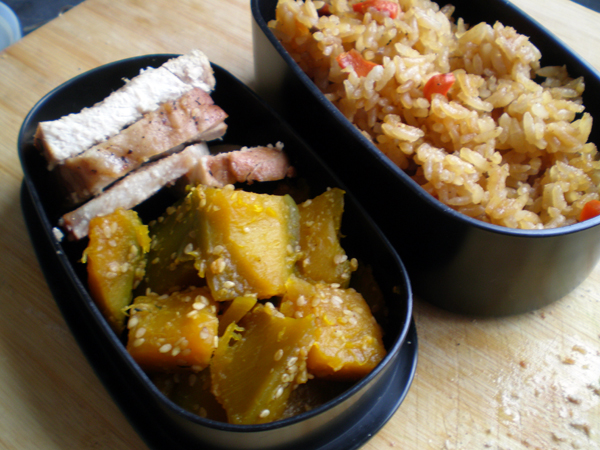
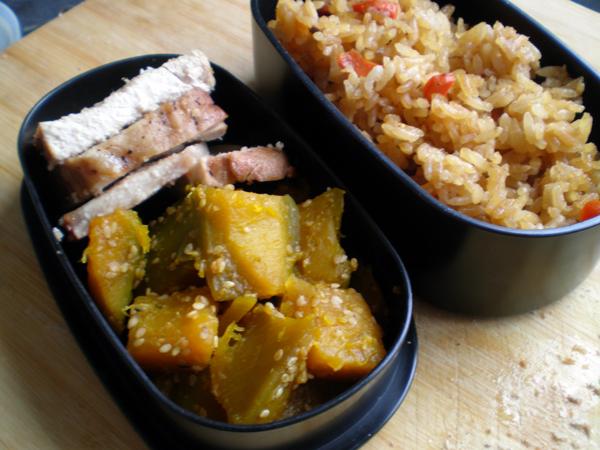
Is that cheese sliced up in the above bento? What kind is it? It looks like a thoroughly satisfying lunch. I continue to make myself and my husband's packed lunch every day, much to the bemusement of our co-workers, who usually eat in the school cafeteria or at the local noodle shops around our campus. We usually end up having to work through our lunch, however, so I always make something we can eat at our desks while marking. Mostly these days I've been making soup, but this week I had tried out some new recipes from a Harumi Kurihara book I'd picked up in Hong Kong over the term holiday. The leftovers suited a bento perfectly, along with some leftover pork loin I'd made. Pork loin with pumpkin in sesame sauce; rice with dashi, carrot, and pepper. I forgot how satisfying a well-made benot is for lunch, although I wish I'd had something green on hand for contrast.
-
Can you freeze them? I remember taking a cooking class in Thailand, and the cook recommended freezing the herbs over drying them, as they retain more of their flavour that way, supposedly. I've never tried it, as that was the last time I saw holy basil. The same goes for kaffir lime leaves, I recall.
-
As in - "I'm going to Keller-up these carrots by sprinkling fleur de sel from a height of 30cm." Yeah, that works. Also: why so much fennel in this book? Am I only noticing it because I can't find any?
-
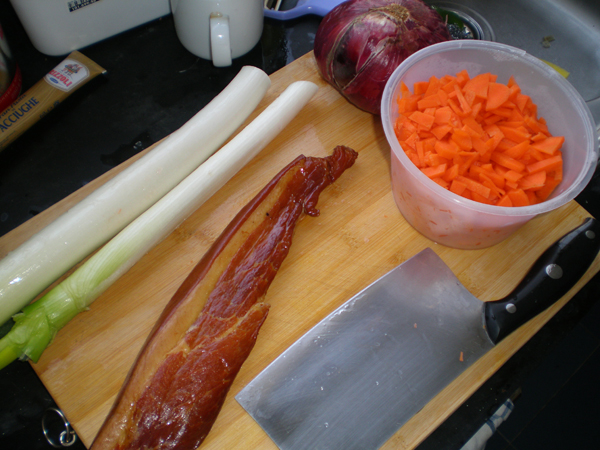
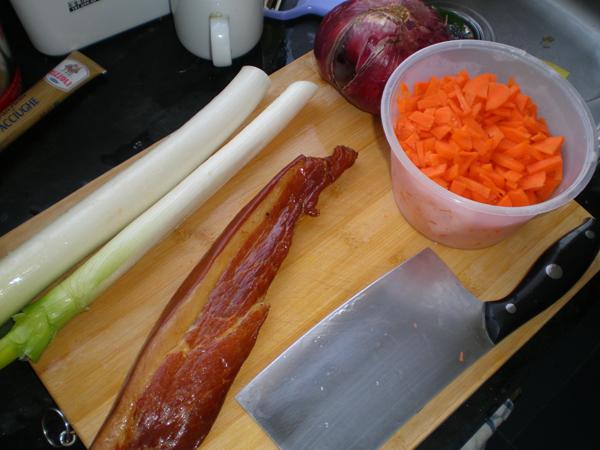
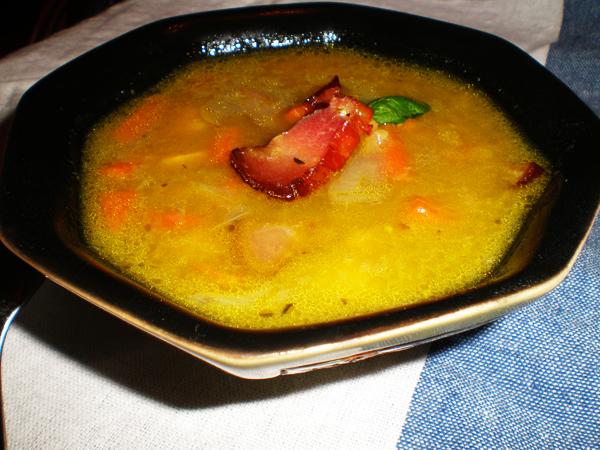
Right, the first recipe I tried was the lentil and sweet potato soup. I had to halve the recipe, as I don't own a large enough stockpot for soup-making. My largest pot only holds two litres, as a matter of fact, so I had to make do. My raw ingredients: Plus I used random green (brown?) lentils found at the western supermarket. It was my first time making lentils, and they were much easier than I thought - for some reason, I thought they'd be tricky like beans, but they weren't at all. I was quite happy with the texture. I had some rather run-of-the-mill end of season sweet potatoes, too, not pictured. What made this soup for me was the really excellent pork I was able to use - Chinese smoked pork. I think you've really got to use a good pork product to make this soup really worthwhile. If you've just got supermarket bacon, I don't think the flavour will really come through. (Husband:"Eating lentils just feels so virtuous, doesn't it?" Me: "They've been coated in pork fat, soo...") I had a quick bowl the first evening, with crispy bacon on top. The rest came to work with me on Monday and today for lunches.It was at its best today, and I got to torture my co-workers with soup-smell, something I like to do on semi-regular occasions. Although usually the weapon in question is from Marcella Hazan.
-
So...is it a worthy practice for the home cook? Will it make my grilling more efficient or more tasty? Or should I just leave it on the grill as is?
-
That picture of the curries sent me scrambling for our eGCI course on North Indian breads - which includes a method for paratha. I'd never tried one before last year, and now I'm hooked - especially after three weeks in Malaysia eating roti canai every day for breakfast.
-
I like how you're noting what skills you're learning along with the recipes. I'm sucking up the courage to start breaking down my own chicken, since it seems like an incredibly useful skill. I need to get some poultry shears to help. I've been reading this book through extensively, hoping to avoid that kind of frustration. I'm saving most of the recipes for Sunday afternoon cooking, until I get used to them. I'll need the time. The first recipe I want to make is the lentil-sweet potato soup, followed closely by the cauliflower soup. Only I can't find beets where I live, so I suspect I'll make sweet potato chips as a substitute. Also, no applewood smoked bacon to be found anywhere, so I'll be using Hunan smoked ham. Probably not what Chef Keller had in mind. The other thing I was wondering while reading through the pork loin recipe - the pork available in China is quite fatty and rich - not at all lean like it is in North America. I wonder if I need bother brining?
-
I'm just back from Hong Kong with four more - I'll have to start a new shelf! The Essential of Classic Italian Cooking, Ad Hoc, Everyday Harumi, and the Taste Bible. I'm not sure how I'll keep a record of all the recipes I want to try.
-
Not only does she decry it, she writes, I hate to be accused of missing the point! And I've never tried lasagne made with fresh pasta, so I can't help but feel I've been missing out on a whole lot of pleasure. I have a box of Barilla no-cook noodles in my cupboard, but I've been unimpressed with the results of using those. Unfortunately, I don't have other pasta options at my disposal. I favour a mock-lasagne made with fresh vegetables over a poor-quality noodle version. I wonder if Marcella would concur?
-
For me it was kimchi when I first moved to Korea. It's always described as a "pickle", and so I really looked forward to trying it when I was reading about it in preparation for my move. I knew it must have been a challenging flavour, as previously noted, Jeffery Steingarten listed it as one of his dislikes. But, you know, I figured he just didn't like pickles as much as I did. I love pickles, right? Steingarten is an amateur. So I get off the plane, go right to my new home, where my fridge was helpfully pre-stocked with a tub of kimchi, and boldly take a big bite, right there in the kitchen with my bags still unpacked, stacked up beside me. My first thought was,"You know, that's not quite the pickle taste I was expecting. Hmm." In my ignorance, I had assumed all pickles involved vinegar, and occasionally, sugar. Imagine my surprise to learn you can also pickle things with plain ol' salt. And brine shrimp. Not in my mother's Ball Pickling book. But you can't make it happily in anywhere if you don't give the local food a shot, so I tried it every time it was offered to me. It took me about a year of eating it several times a week to move through shock, then dislike, to acceptance, and then love. I learned the home-made stuff was the ticket, less salty and often more gingery or tangy than the store-bought kinds, and that all things being equal, the radish kind is my favourite. I can even produce a creditable version of my own, but the rest of my family dislike the smell in the fridge, so I have to content myself with enjoying it when we go to Korean restaurants. I cannot get over the look of tripe. Sichuan peppercorns taste like soap to me, which is a shame, as my husband loves them.
-
I've just gotten back from a trip in Malaysia, where I noticed that all the satay stands were manned with people frantically fanning the meat over the grill with hand-held fans. This reminded me of yakitori chefs in Japan I've seen who also emplyoed this method, and all of the bun cha stalls on the streets of Hanoi which were equipped with electric fans blowing meat smoke out to the street to lure in hungry customers. Advertising strategy aside, what's the goal of fanning meat on a grill? I assume it's to better distribute the heat in some way, but are there other benefits? Should we all be buying fans for our summer grilling season? Does anyone try this trick at home?
-

The Ice Topic: Crushed, Cracked, Cubes, Balls, Alternatives
nakji replied to a topic in Spirits & Cocktails
Hmm, mine didn't split like that. I usually start with room temperature water, and leave it in the fridge for a couple of days before using one. We don't go through much ice at my house. -
Floss is a necessity for this very reason. Sometimes you just have to use your chopsticks and teeth to finesse the lot into your mouth. I think texture is an extremely important factor in Asian cuisines, and I find people don't seem to mind a bit more mouth work than we're necessarily comfortable with in the west. Meat often comes in small pieces on the bone where you need to use your chopsticks and teeth in harmony, too - it's not just a vegetable thing.