
teonzo
-
Posts
1,290 -
Joined
-
Last visited
Content Type
Profiles
Forums
Store
Help Articles
Everything posted by teonzo
-
I haven't found any regulation talking about that. I checked my capers package and it's not written there, so I'm pretty sure it's not required by law, at least here in Italy. Just checked the producer's catalogue and the info in Italian is "calibro" (= caliber / size / diameter). I suppose it's a label info used by this particular producer to state the caper size, 7 indicates capers that pass through a sieve with 7 mm holes, 13 for 13 mm holes. Teo
-
Being Italian I use capers in a boatload of dishes, even a plated dessert and a praline. My favourite one is sauteed mackerel with eggplant puree and capers. I make the eggplant puree this way: cook a couple of whole eggplants in the oven at 180° C for 60-90 minutes without piercing them, this way the skin will become hard and the inner flesh will steam and remain soft; after cooked cut in half and pick the cooked flesh with a spoon, put eggplant flesh in a bowl, blitz with hand held mixer, add olive oil while blitzing until you get your preferred texture, then season with salt and whatever pepper you prefer. This is my favourite way to cook eggplants. Another favourite is a risotto with cantaloupe and capers. Usually risottos don't fit well during summer cause they tend to be on the heavy side of food, this one is light and refreshing, it's even vegan. Prepare a stock using only the cantaloupe peels. Cut away the orange cantaloupe flesh, cut it in 1 cm dices and reserve in the fridge. After this you are left with the peels, which have an inner green side and the brown outer side. Cut away the brown side and discard it, keep the green side and use it to make a stock (gentle simmer for 1.5-2 hours). When the stock is ready then dry toast the rice: just put rice in the risotto pot, no fats nothing, just rice. Toast rice on low flame, stirring about every minute, until it's toasted (as usual for risottos, just avoid fats onions whatever). Don't deglaze with any wine, just start pouring the cantaloupe peel stock and cook as a normal risotto. About 2 minutes before the end of cooking add the cantaloupe dices. When risotto is cooked then turn off the heat and let it rest in the pot for about 2 minutes. Then add the de-salted capers (don't exaggerate since they easily overpower the cantaloupe) and "whisk" with olive oil (I'm not good in translating from Italian to English, google translator gives "whisk" as translation for "mantecare" but I'm sure it is the wrong one and don't remember the correct one). Season with salt (if needed, due to the capers) and black pepper. This risotto is ultra easy to do, very flavourful and refreshing. People tend to be puzzled when hearing about cantaloupes in a risotto, but they always appreciate it after tasting. Personally I stay away from capers in vinegar, they loose their personality. Only salted ones, the smaller the better as people already wrote. Caper fruits (see this photo) are a delicacy, but I suppose they are really hard to find outside Italy. If you buy salted capers, always remember to rinse them quickly 4-5 times, then soak them for about 10 minutes. I live alone and I use a 500 g package in about a year, but as I wrote I use them a lot. If you can find only 1 kg packages then consider using some of them as a gift, they are totally easy to repackage and can be an appreciated gift for Chinese people into exotic stuff. Teo
-
Well, it should not be that strange after considering this thread! First time I saw them in a pastry shop I said: "hahhahaha they look like the gloves you use for ____________!" (insert dirty description for the use of vet's gloves). Answer (showing me the box with explicit drawing): "they ARE those gloves...". Back to the topic, @JeanneCake, I would suggest you to check the ingredients listed on your mascarpone package. It's possible they are adding some gums to it to make it firmer, this could cause the troubles you are facing. If so, try another producer that doesn't add gums. Teo
-
What @jmacnaughtan said. If you want to incur in less troubles then you can add 30%-50% cream to mascarpone. I mean 30%-50% weigh related, if you have 1000 g mascarpone then add 300-500 g of cream. I'm talking about standard cream for here in Italy, which is 35% fat, don't know what you have for sale there in the USA. Teo
-
A shop gets money for repeating a recipe, most of the times created by others. A YouTube video gets money for repeating a recipe, most of the times created by others. The value for a shop is phisically creating an item and making it available to the customers. The value for a YouTube video is phisically recording/editing the video and making it available to the viewers. Teo
-
Here in Italy eating genitalia and related stuff was traditional up to the 50's, when most people were still farmers and definetely poor, so they ended up eating anything edible. Eating meat, even genitalia, was a luxury. Cow udders and vaginal labias were considered a delicacy, same for testicles from whatever animal. Pigs sphincters can end up still now in tripe cuts, especially suckling pigs. Nowadays it's hard to find this stuff, both because butchers and customers are not willing to deal with it. Most offal parts go directly to waste, there's no request. It's more than possible that a butcher will give you sweetbreads, kidneys, brains and so on because it's impossible to sell them and they have to pay to get rid of them, so you are doing them a favour to get them for free. Some "adventurous" butchers are still willing to carry these traditions if you ask them, but it's more and more difficult due to EU legislations. Just for example dealing with cow udders is a huge PITA because you must certificate them as mastitis free. That's a pity, I had the luck (as a curious eater) to taste some of this stuff and I always liked it. Too bad it became such an hassle to find the ingredients and someone else willing to eat them (looking for a special ingredient and then being forced to eat it alone is one of the saddest things ever). There is a good tradition involving fish too. If you go to Sicily it's quite easy to find tuna's "lattume", it's the fish spermatic pocket, if you order "pasta al lattume" you get pasta with tuna's sperm. Bottarga is prized everywhere, they are ovaries. Teo
-
What about most pastry shops? Do you think each and every pastry shop uses only personal recipes? I would say that at least 50% pastry shops (I'm speaking for here in Italy) never developed a single new recipe, they just copied from someone else. If the requirement for making money with food was to be restrictively creative then most professionals should have to close shop. We all build from stones created by someone that came before us, we can't claim to be purely original, neither Pierre Hermé nor Albert Adrià can claim that. We can only put our own twist, someone put a bigger one, someone else a smaller one. Just repeating a recipe written by someone else means putting our own twist, since it's impossible to make it the same way, each person unconsciously make things in a slight different way. Teo
-
Generally speaking, cold infusions give a different result than hot infusions: you extract more of some aromatics, less of others. Plus you don't cook the infused ingredient, meaning you get a more "natural" taste (this is evident for some herbs and flowers). As a general rule, a cold infusion gives a smoother, rounder, more delicate result. There are exceptions, some ingredients give a more bitter result (marigold or rhubarb root), others a harsher result (if you cold infuse tobacco you get way much nicotine). For delicate ingredients usually the best choice is cold infusion. In some cases it just depends on the result you are aiming for: if you cold infuse whole coffee beans then you will be surprised on the result, I wouldn't say it's better than the usual hot infusion (uhm well, I would say so to be honest since I'm not an espresso lover), it's just different. About the "cooked" sensation, it's much more limited if you cold infuse something, strain the cold infusion, than boil it, since you are not cooking the ingredient, you are heating the infused aromatics. For ganaches you can't avoid this, you would face shelf life troubles. Teo
-
They look like dried goji berries, it seems a clear mistake by the manifacturer (wrong product in wrong package). There are a boatloads of uses for dried goji berries, but they are an acquired taste, if you didn't like them as an infusion then it's hard to think about alternative uses. Teo
-
Your Daily Sweets: What Are You Making and Baking? (2016 – 2017)
teonzo replied to a topic in Pastry & Baking
Radicchio's bitterness is present but not overwhelming. You can definetely taste it, but the overall effect is not that strange if you don't know what you are going to taste. I don't know if you ever tasted amaretti cookies, you get a similar balance: the base recipe is pretty sweet in both cases, the bitter component (bitter almonds in amaretti, radicchio in my experiment) cuts through and counterbalance the sweetness. It's a game of contrasts, where bitterness does not have to be too strong. People raise an eyebrow when hearing about this kind of stuff mostly due to food conventions (vegetables in savory, fruits in sweet), but if you think about it those are just conventions. Cacao is definetely bitter, not sweet, but chocolate is the most popular sweet thing in the world. Similar for coffee, it's a given in sweets because it became traditional. Chestnut honey is another case. You just need to avoid getting bitterness as the frontal kick, which is relatively easy when you start from a really sweet recipe (panettone has a lot of sugar). Teo -
Your Daily Sweets: What Are You Making and Baking? (2016 – 2017)
teonzo replied to a topic in Pastry & Baking
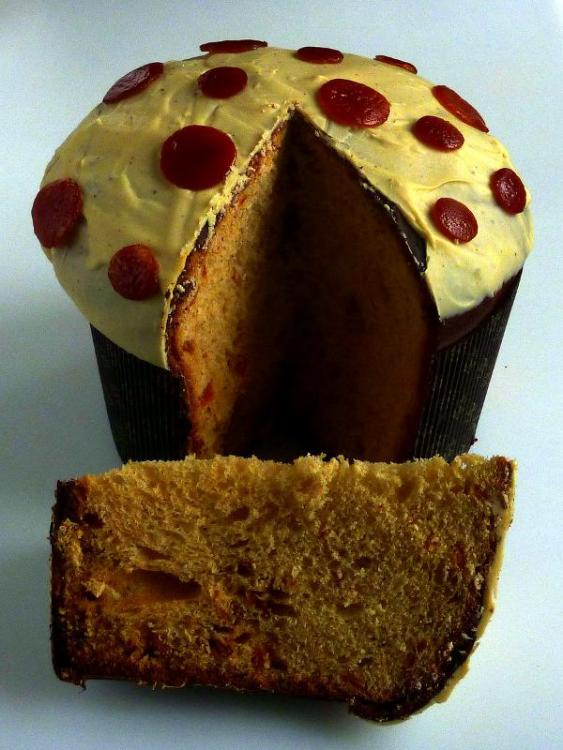
Panicio "Panicio" is a play on words between "panettone" and "radicio" (dialect term for "radicchio", the place where I live is the home of the best radicchio in Italy, we are quite proud of this). Dough is made replacing half water with reduced (30%) radicchio juice. I added candied pumpkin in place of the usual candied orange peels / raisins. For the glaze I used amaretti (the traditional cookies made with bitter almonds). This is a first try made at home. Esthetically it came ugly, making panettone at home is a huge PITA, especially when your oven it totally unbalanced (top side is 40°C hotter than bottom side). I tried a new recipe for the glaze, I don't like the traditional glazes because they break in pieces during cooking, I'm aiming for a glaze that gives a "smooth" surface, I think I'm on the correct road, but I need to make a test with a decent oven, with this one I get horrible results even with the traditional recipe. I'm happy about how it tastes, it's balanced and reflects the autumn produce of this land. I hope it will sell well when I'll open my shop. Pationkin "Pationkin" is a play on words between "panettone", "Tonka" and "Kotiomkin". It comes from a cult scene in Il secondo tragico Fantozzi, which is now part of pop culture here in Italy (if you say "Kotiomkin" to an Italian then he immediately thinks about that scene). It's almost impossible to explain if you haven't seen the movie. Dough is almost the same as traditional panettone, I replaced vanilla with Tonka beans, then replaced the usual candied orange peels and raisins with candied clementine peels (which pair better, in my opinion, with Tonka beans). Glaze is white chocolate with some Tonka beans, then the circles are candied clementine peels (the look is chosen to recall that movie scene). I'm happy with this too, final taste is not that far from the traditional panettone, pretty enjoyable. I always laugh when I think about it, this is a plus in my book. Teo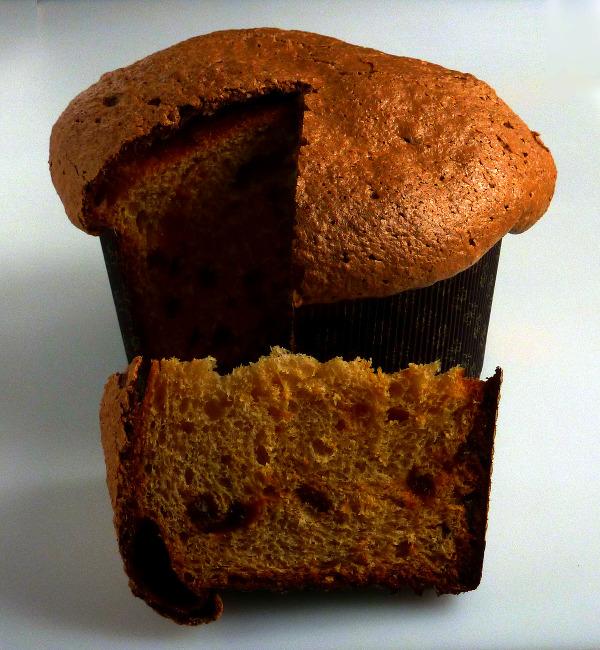
- 489 replies
-
- 10
-

-
My blind guess is that butter acts like a barrier for the internal moisture in pecans, retaining part of it. If you roast them before coating then you should get drier (more roasted) pecans, this should be the difference you prefer. Next time you roast them (alone, no butter or other coatings) then try to weigh them before and after roasting, so you'll get an idea about how much moisture they loose during the process. Teo
-
Your Daily Sweets: What Are You Making and Baking? (2016 – 2017)
teonzo replied to a topic in Pastry & Baking
Pistachio + apricots = UBER WIN Teo -
I'm really glad you purchased and appreciated it! "Vacche rosse" (translated "red cows") is the best consortium making Parmigiano, so I would suggest to keep buying that type and not other Parmigiano. When you have a high quality product like this one then the best thing to do is to cut a piece and eat it on its own as it is. Keep it in your mouth for long time, chewing the less possibile, like you do for a high quality dark chocolate. For portioning you can use an oyster shucker, if you don't have the appropriate tool. There is a great use for the rinds, it's traditional for Italian farmers but never became mainstream. Pick a piece of rind, grate the outer layer with your favourite grater (Microplane or whatever) until you get a "clean" piece (you need to grate away the wax and the marked prints). Pierce it with a fork, then roast it on an open flame. You need to keep it about 5 cm (2 inches) far from the flame, on the top side (not directly on top otherwise some fat will drip on the flame). Move it slowly to get an equal heat distribution, trying to avoid burning the surface. When one side of the rind is roasted, pick out the fork, pierce the roasted side and repeat the roasting for the unroasted side. After this you end up getting a tender melt-in-mouth piece of Parmigiano rind, one of the best snacks ever. Almost heavenly if you eat it with a slice of "lingua salmistrata" (corned beef tongue). If you have a bag of rinds in your fridge then you have a treasure to put to good use. Teo
-
I would suggest you to try eating some walnuts when drinking milk oolong, I love this pairing. Teo
-
If you want to make a smoked tea ice-cream and lapsang souchong gives a too smokey result, then there is another way: you can prepare your favourite tea-flavoured ice-cream base, then add few drops of liquid smoke. This way you have total control both on the smokiness and the tea flavor. Teo
-
Try reading the vanilla extract's ingredients, probably there's something with proteolytic enzymes (stuff that dissolves gelatin). Teo
-
Starting a high profile new restaurant (after closing another)
teonzo replied to a topic in Restaurant Life
Cool! I misunderstood what you wrote when you explained the calculations behind the drink pairing price, I thought you were going to offer only one. So that calculation is for an average of the different drink pairings? I'm really happy to see you are going to offer a huge diversity, so I can't wait to read your first menus. This is one side were fine dining restaurants lack in my opinion. Ok, wine pairings can give great satisfactions, we all know that. But, as a customer, I'd like to get more choices, especially for non alcoholic pairings. It's underwelming to go to most michelin starred restaurants here in Europe and finding that the only wise choices are wine or water. I can drink water whenever I want. If I'm driving, I'm not going to drink wine. Another option to enhance the drink pairing experience would be more than welcome. Teo -
You can try different infusion temperatures and times. Different aromatic molecules diffuse in different ways, which means that at different temperature you can get a different ratio of the aromatics in the infusion. For example, say that at 80°C you get 50% aromatic A and 50% aromatic B, if you change temperature to 50°C it's possible you get 60% aromatic A and 40% aromatic B. You need to find the temperature (if there is one...) at which you get your desired result. For tobacco I founf that my favourite results are at 40-50°C, at that range I get more subtle aromas if compared to the strong ones (pungent and smoked). There is another consideration. Cream and eggs tend to mute subtle aromas. If you make a lapsang souchong ice-cream (dairy recipe with cream and possibly yolks) then what you taste is the strong aromatics of lapsang souchong (smokiness) and cream fats + sugars. Subtle aromatics from lapsang souchong get lost, buried by cream and so on. Just to get an idea, make 2 parallel infusions with the exact same method (temperature and time), one of lapsang souchong in cream, one standard in water. It's interesting to notice the differences. In the cream one you taste strong aromatics from lapsang souchong then the cream, in the standard water infusion you get the frontal kick from the smokiness then the whole rest of background tea aromas. Those background aromas get buried by cream and similars. That's why I decided to stop making ice-creams for this kind of stuff and go with sorbets. Teo
-
Starting a high profile new restaurant (after closing another)
teonzo replied to a topic in Restaurant Life
What kind of drink pairing are you planning to offer? Wine from small producers? Craft beers? Cocktails? A mix of the above? Will you offer a non alcoholic choice too? Teo -
Sorry, I've never tried lapsang souchong in any dessert. It's one of the things I keep repeating myself from years, but still haven't done. When I order teas online (brick and mortar stores carry only industrial stuff like Lipton, sometimes you see a generic "green tea" which seems more like straw) first thing I do is surfing for the teas I want to drink. My preferences are towards oolong and sencha, so I spend an hour surfing those categories, forget abot the rest and make the order. I'll have to write a note on my nose to remember, since lapsang souchong, pu-er, assam and so on (even rooibos) have the potential for great results. I tried to make a praline (bon bon) with a pu-er ganache and figs pate de fruit, I was satisfied with the result, but I used a generic pu-er which was just average, pu-er world is so vast in aromas that the potential is great. On a related note I made a tobacco sorbet, same technique (tobacco infused in water, then syrup). Taste was pretty clear, you could feel all the tobacco nuances, especially spiciness and smokiness. I would have to say it was even too strong. So if tobacco's smokiness did not get lost, then I assume lapsang souchong's won't neither. Teo
-
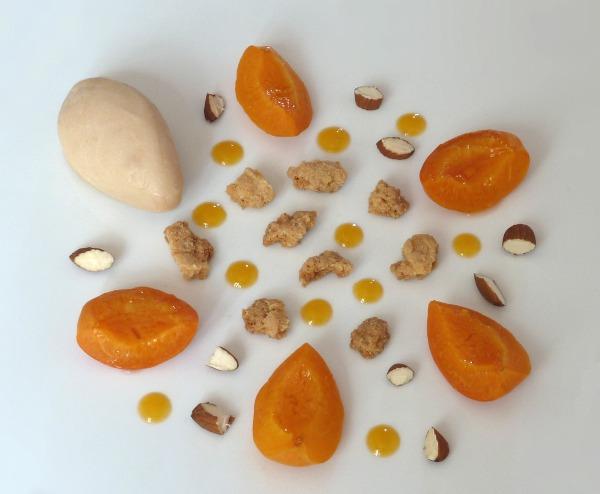
Well, you are lucky to have found matcha tea in a store, here I'm forced to buy it online (TeaWay from Italy, great selection, great customer service, tons of infos, in my experience the best food e-commerce in Italy). There are various grades for matcha (as for every tea), "cooking" grade is the lowest one. Highest grade matcha teas are REALLY expensive, even cooking grade matcha tea is pretty expensive if compared to other ingredients, so when people need matcha for desserts then usually the choice is for the cooking grade. The difference in taste is subtle, it goes totally lost if you use matcha tea in a dough, a mousse or others, so it has no sense to spend huge money for subtlety when you are going to loose it. Probably you could taste a difference between a matcha sorbet prepared with top grade and another one prepared with cooking grade, since the sorbet is just water and sugar, no cream / flour / butter / eggs or other ingredients that cover subtleties, but I'm pretty sure the nuances would be muffled by the cold and the sugar. If you are willing to spend top money for top matcha, then the wisest thing is to enjoy it in the traditional Japanese way (bamboo whisk and so on). First time I made a tea sorbet was with a black tea actually, a Darjeeling one: It's Darjeeling tea sorbet (top left, I hard froze the quenelle to have some time to take photos, so it lost the shine and got grainy), quartered apricots, almond crumble, apricot sauce and raw almonds. Teo
-
I second Kerry's suggestion for savoiardi. They are definetely crumbly (when natural, meaning not soaked). They soak well and keep their structure. If you need coarser texture then you just need to add nut flour, processed to your desired width. Teo
-
Kerry, thanks a lot for trying and reporting! Teo
-
So far it seems like a great value-for-money package! Teo