


AlaMoi
-
Posts
1,654 -
Joined
-
Last visited
Content Type
Profiles
Forums
Store
Help Articles
Everything posted by AlaMoi
-
giggle. cooking up the lasagna noodles is the one thing I get to use my fish poacher for . . . (g) do they get flexible if soaked in water? not seen the thin stuff. another thing to keep an eye on....(sigh) - but thanks both for the tips!
-
I've done the no-pre-cook lasagna technique a couple times using 'old fashioned' noodles. works fine - but one does need to increase the liquid content by roughly 4 fl oz / 120 ml for a 9x11 pan
-
huiray - ah, today the 3 are showing up. things were a bit flakey yesterday. I have made fresh pasta - it is not hard. the hard part comes when you want something other than a flat sheet or wide noodles... somebody gave me the pasta extruder thing for a KA one Xmas. total waste of wrapping paper and bow..... it does not work so well. our nearest Trader Joe is a two+ hour round trip. but I'll stop if get the opportunity. I think I've seen De Cecco in the store. the price is a minimal impact for us - two people, we don't eat pasta every day... per person I use: 65 g angel hair 80 g fettuccine and for a main: 120 g for mac&cheese so, cheap to expensive we're looking at $0.25 vs. $0.50 on mac&cheese that makes a meal+leftovers for 2. not what I would consider a major budget buster. what surprised me is the Rienzi just would not cook properly. my first thought was 'well, it's different, let's see how to handle it.' but taste testing from 10 minutes to near 20 minutes with the same 'glued to my molars' result was not what I would have predicted.
-
... https://forums.egullet.org/search/?type=all&q=different+pastas About 3,810 results (0.50 seconds) hmmmm, I'm of retirement age; can you narrow down something particular I should look into before I die?
-
the quick cooking thing I suspect grew out of the technique of using dry / uncooked pasta for lasagna. similar things with grits and oatmeal. never gone there, no intention of going there. when I can't spare an additional 6-8 minutes to cook pasta, I'll settle for graham crackers. I do not belong to the "nuke it or else" crowd.
-
to my dismay, I have lately discovered that all pastas are not alike - or even close. for a long time I used Mueller's. This is an old line Amrican/east coast company. actually had no real issues with their product. thence I got into Barilla. it is also an old line company of Italy. note however that all but a few shapes/products are made in USA. I've never cooked a Barilla product that disappointed.... well, DW wanted rigatoni - not on the shelf in my preferred brands. or I couldn't find it - Giant is rearranging every shelf / aisle on a weekly basis - but that's a different rant. so I bought Rienzi rigatoni. imported, made in Italy, how can you go wrong? DW made her chicken in tomato sauce recipe. the pasta was inedible - over-cooked on the outside, hard&gummy&stick-to-your-teeth on the inside. some days later I did buttered noodles. I opted to use up the Rienzi rigatoni. being aware of "cooking issues" with the Rienzi, I brought salted water to the boil, dumped in the pasta, regular stir, started checking 'the chew' after 10 minutes, continued checking 'the chew' up through 18 minutes. fish out a chunk of rigatoni - eat it. acid test... it never got better that DW's "over-cooked on the outside, hard&gummy&stick-to-your-teeth on the inside." so - I'm thinking that not all pasta is even remotely the same - any similar experiences?
-
'lost me'... well, yes and no. I've seen people make (horrible) homemade pizza using catsup/tomato sauce/paste/what not. I have personally cooked down garden fresh tomatoes 'like Aunt so&so did' in some mis-guided attempt - and it was so bad I tossed it - overdone tomato gravy is overdone and not very tasty. first keep in mind, there is no accounting for taste. second keep in mind before the first - what variety of bbq sauce are we talking about? various regions have different tastes - sweet , sour, tomato, vinegar, you name it. I cited one plain & simple approach. some people will like it, some people will hate it. questions on that?
-
DW worked the counter in the 1970's at DD. everything was a mix - donuts to toppings to fillings. but the dough was mixed/raised at the stored, fried/baked at the store; filled donuts were made and hand filled at the store - fruit, creme, whatever. there was a big glass window where one could look in on the dude who got up at 3AM to make the donuts.... I doubt any "chain" made stuff from scratch - i.e. leaving ingredient source/quality and proportions and prep up to the individual site/store. the whole point of the big sign is "they taste them same everywhere" - if you want to own a KK shop, you buy virtually everything - machines to mixes - from the parent company. 'same everywhere' - which btw is not true of places like McDonald, PizzaHut, KFC, etc. they adapt their recipes to "local tastes / preferences" - especially outside North America. last time I was in a DD - there was no window. someday I'll stop in and ask if they mix their own dough anymore. my wallet has not yet recovered from the price of the last visit - donut and coffee - you needed an Amex BlackCard......
-
so....we've all seen the recipes for award winning bbq sauces - the forty hour cooking with 1/4 tsp this and 1/8 tsp that plus 30 other spices/seasonings..... this ain't that. simple - clean tasting veddy refreshing sauce. I don't dislike the billion spice stuff - but sometimes clean&simple is a nice change. my favorite use for this is poured over fast&heavy browned boneless skinless chicken thighs (+/- 1 lb / 450 g.) brown the chick nicely - but do not cook it through - who needs tough chicken? it gets 'finished' in the oven. used for oven bake 325'F post pan browned chicken. in 2 T / 30 ml oil saute until soft - medium onion, diced medium to fine per personal preference add: 1 cup / 240 g ketchup 2 Tbsp / 30 ml Dijon mustard 1 tsp salt 1/2 c / 100 g (dark)brown sugar 2 Tbsp / 30 ml apple cider vinegar simmer about 30-50 minutes that's it, that's all there is. there is not a hint of blue tinged pink Himalayan salt with just a nuiance of east African googoo pink hot pepper as passed by a civet but only in August.... etc. plain, simple, really dang taste bud refreshing. pour hot sauce over browned / cooled chicken chunks into oven at 325'F / 165'C for 30-40 minutes holds well. reheats well. I serve it over rice with a twangy side such as brussel sprouts. the sugar amount does result in a distinctively sweet sauce - bit like sweet/sour oriental preps - makes for a crusting sauce. sugar can be cut in half if you're not a sweet sauce fan; just as good.
-
to paraphrase some famous guy . . . "Well, you see here, what we have is a problem of well defined differences." if you want to start a war, go to the Baking section and ask "How much does a cup of flour weigh?" rather a lot of foodstuffs are of varying density - natural products tend to vary like that . . . and how they are processed can make quite large differences - salt is salt, but a cup of popcorn salt and a cup of coarse sea salt do not weigh the same.
-
dry measures are pretty much left in the Wild West. "dry" pints/quarts/etc are defined in cubic inches - but not the same cubic inches as liquids. thence commeth the issue of "the flat" classically it is a wooden doohickey that holds 12 dry pint containers. but, measuring the len x width x ht of "ye olde typical flat" - you get more cubic inches. why? well, you may have noticed the classic dry pint container is tapered to the bottom.... so, 12 "containers" - but sans containers, more cubic inches fit in the wooden thingie.... bottom line: you may have to travel many worlds before you find a binding definition.
-
ah! it is curious as to how the nickel plate evaporated from mine - I've "heard" the initial attempts were just nickel plated handles - but the hand is the blended rib design which puts it closer to the 1920 series 'end'
-
curiousity question: what is "plain cast iron" in this regard? I have a #8 - 704 E vs H - but alot of the chrome has worn off - or perhaps it previously belonged to a clean freak who scrubbed it off. I don't collect cast iron, paid $12 for it in a junk shop - but I will state without reservation - I would not sell that pan for ten bucks to anybody!
-
well, is is and it ain't. "as served in our restaurants" is now 55% maple syrup and 45% cane sugar syrup.... zoom in on the label... http://shop.crackerbarrel.com/Cracker-Barrel-Old-Country-Store/dp/B00PWNH93G apparent some maple syrup producers are now using reverse osmosis to 'get the water out' vs the traditional boil - I've written to two brands asking about that - been met with stone silence. not looking all too good . . . .
-
veddy nice! but where's the cheese and vin? incomplete photo! that crust looks stunningly munchy-chewy
-
this not being a Forum for Professional By-The-Case Prep Chefs Only, the theory of things that make for carpel tunnel fatalities seems pretty far off the wall. that being said, bad information should be challenged. the worst I have ever seen was a link to some homemade video of how to sharpen a knife. it started out with "Hold the knife at a 45 degree angle . . . "
-
or perhaps more fat renders out of fattier meats and drips / floats away, taking the salt one put on the outside with it.....
-
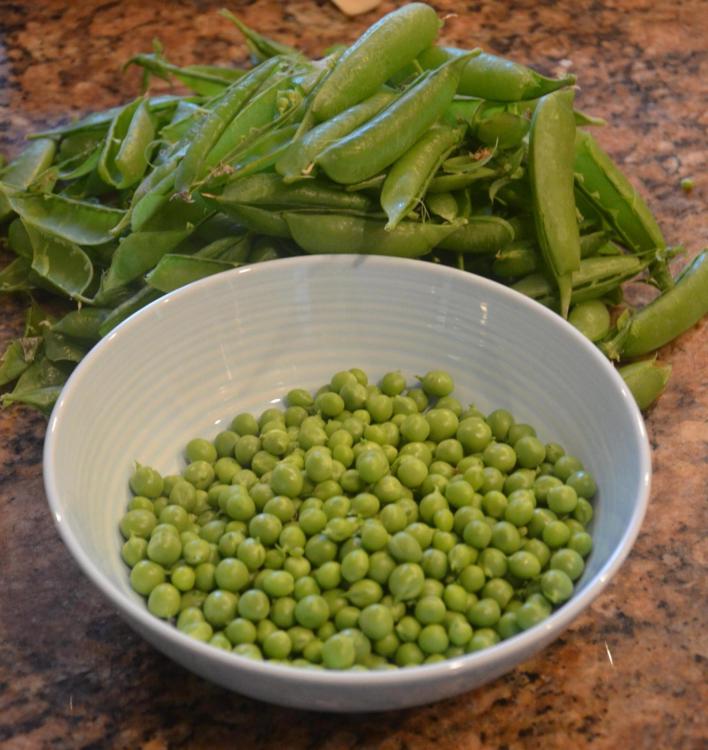
oh dear. garden peas are methinks even more better than garden tomatoes. I do feets and feets of peas. I don't grown my own corn. when corn is locally in season, it is very inexpensive - shuck, slice off the cob, freeze. forget the blanch and extraordinary lengths nonsense. freeze & eat. but.... I always save a bag or two of peas for Christmas dinner.
-
following up on the kind interest in this thread, here's the latest on "How to Break the Rules Without Really Trying" the above loaf was 430g KA Bread flour + 345g hot water + 1 t DAY + 1 tsp salt in a 9x5 loaf pan. "Smart Living" - coated, which I buttered&floured just to be safe on the first try. no need to grease/flour that brand - they are 'coated' and this second loaf released cleanly without the grease/flour routine. the first try didn't fill the pan to my heart's desire, so I upped the volumes: 645g flour + 518g hot water, same yeast&salt. many descriptions of no-knead cite mixing to a shaggy dough; and I've seen questions: "whot?" so, this is a shaggy dough - immediately after adding water & a good stir with a wooden spoon: the lid (aka dinner plate, in my case) goes on and after 16 hours at a cool 68'F rise looks like: panned, rising prior to ovening. when lacking a cover, invent... pre-heated to 500'F; 20 minutes covered at 475'F; uncovered 10 minutes; reduced heat to 450' for another 10 minutes. it popped out of the loaf pan immediately on leaving the oven - I could hear the crust crackling as it cooled. this volume fills makes for a nice size sandwich slice. the smaller cross section, and the rounds, are nice for a 'dinner bread' - but a bit skimpy for a sandwich. max height here about 4.5 inches. and the crumb shot...
- 1 reply
-
- 4
-

-
the classic no knead bread is started in a covered pot - many shapes used but using the same technique, reducing the hydration about 5%, makes for really nice rounds (done on a stone) an upside down stainless bowl creates veddy nice crackle so why not a loaf? this is a 9x5 pan; thinking I'll up the volume next try crumb shot
- 1 reply
-
- 9
-
-
and limits apply. we have a Giant and a Weiss within spitting distance of each other. once-upon-a-day-dream-dreary this Giant location was, by sq ft, biggest in the state. the manager tells me they continue to "set records" amongst their peers. they have 20+ checkout lanes plus six self-check out stations. most of which are working on any given year, but the self-checkout units are Windows based software, so every month at auto-update time things get , , , ah,,,,errr, uhmmmm, interesting. the Weiss Market has markedly less business. better produce, better prices on many things. they had self-check out lanes but took them out. the employees should all be fired and replaced. two OMG examples: - months back, shopped, went to check out. two cashiers - one a (at least 70+ yo) dear lady who clearly had issues scanning anything without a protracted visual check of every single item. there were 11 customers + me in two lines to check out. I counted. the on duty 'manager' approaches the front in conversation with an obvious personal acquaintance - she looks at the lines, says to her friend "come over here." the """manager""" then opens a register, checks out her """friend""" and closes the register leaving the rest of us standing tooth in mouth. - last week went in on a similar relatively minor shopping expedition. one cashier/check-out lane open; three fake cashiers/employees/check-out females holding up the dividing wall to the customer service counter area, peering at their smart phones, ignoring the 8+ line of customers waiting. so I picked out the most decent looking one, and stood staring - perhaps glaring is a better word, at her until she finally opted to wander over to a check-out lane and open it up. it took 10.5 minutes of staring; I timed it. I would shop there more often/extensively had any upper management a clue about what makes for customer service. as it is, I go only when I am repulsed at the Giant produce selection. which, regrets, is rather often.
-
>>> Ken Forkish' video helps with the shaping. an item to note from that video - handling is done from the board (down) side - where the bench flour is. if the top of the loaf is "well floured" and then put to the stretch&fold technique, it is possible to develop a "weak layer/bond" resulting in something similar the pix'd voids. I've done it - the problem was not quite as pronounced - but the bauer style loaf 'cleanly' separated 'in the middle' - so I don't wildly 'flour the whole dough' when I turn it out anymore... more flour on the hands, less/none on the loaf proper... from the size of the split, methinks it must be generated by oven spring - i.e. gas (co2) is already there, and rapidly expanding when it hits the oven. this could mean the dough needs a bit more 'punching down' prior to shaping to avoid large trapped bubbles. I've also experienced the 'dense bottom' issue - baking on a stone, my fix was to reduce the heat after 10-15 minutes. high heat initially to set the dough; reduce temp & open door to spill the heat.... the dense bottom "cause" may be completely unrelated to the "mega holes"
-
...I'd like a brick oven meeeeee 2! for bread as well as pizza. I have many times gone into the initial planning and to-date have abandoned the idea for one simple reason: it takes longer to preheat a (massive) masonry oven that to mix, rise & bake the bread. and pizza ... what - 10 minutes....? however comma I could be coerced into a propane fired "loose built" unit - "loose" as in not a massive mortar type construction - because the theory behind using propane would be to hit the ignite button, turn it up full blast to pre-heat as fast as possible. "fast heating" and "masonry" are not compatible. but a pile of insulating/fire brick & a gas burner would work.... any one run across such a set-up?
-
wonder which came first - the egg or the debate on how to cook one . . . the "add salt / sugar / vinegar / baking soda / baking powder / etc" has one interesting aspect. supposedly "it" passes through the shell and changes the white, somehow, making it non-stick. and - cited by many many people is the air sac on the big end. the resulting dimple, etc... the "air" is actually not "air" - the gas is carbon dioxide which has come out of solution from the egg white, and accumulates at the big end. the older the egg, the more carbon dioxide accumulates and the larger the air sac. now, as is famously said at cookware demonstrations.... "we all know" gases expand as they are heated. this means the interior of the egg is "pressurized" - which raises the question of how the liquid solution of water plus salt / sugar / vinegar / baking soda / baking powder / etc gets through the shell, through not one but _two_ membranes, thence affecting at least some outer depth of the white, making it "non-stick" if you've ever poked a pin hole in the big end and then put the egg in hot-to-boiling water, you've seen the little bubbles coming out of the pin hole. but WAIT, there's MORE! putting a pin hole in the egg allows water to enter the egg. opinions vary as to how / when this happens - on heating (water goes in as bubbles come out) or on cooling (if submerged; the egg shrinks and water is sucked in....) which all works until one carefully peels the big end of a hard cooked egg and finds that the air sac has formed between the shell membrane and the egg membrane - and the egg white is still inside the egg membrane and any water is outside of the egg membrane. the poke-a-pin-hole practice is aimed at preventing eggs from cracking (more) open in hot water. "more open" - yes. eggs that crack from internal pressure/heat most frequently were cracked / nicked / damaged before they hit the water - which is why not every egg in the batch cracks when it goes into boiling water. so what makes for a sticky egg peeling and results in divots and torn up egg white.....? what sticks to what? and conversely, what observable phenomena makes an egg peel easily? what does not stick to what? my observations: - it is the egg membrane sticks to the (cooked) egg white. one has a tedious job carefully peeling the egg membrane off the cooked egg white. - an egg which peels cleanly/easily has a thin layer of water between the cooked egg white and the egg membrane. this thin water 'coating' lubricates the cooked white allowing the shell to peel easily. it is a very thin layer of water; if the eggs are still warm, the water very rapidly evaporates and "you'll miss (seeing) it" so where does this thin layer of lubricating / freeing-up water come from? not thru the pinhole. from the inside of the egg - but with a caveat: if the eggs are removed from the hot cooking water and immediately plunged into ice water, the continued cooking from the hot interior generates water vapor which wants to escape - and the vapor condenses when it hits the ice cold membrane&shell. for reliability, use ice water - water with ice cubes floating around in it. not cold tap water. Alaskans have cold tap water, Floridians have cold tap water - but the "cold" part isn't the same temperature and yes, it makes a difference.
-
sliced and pounded thin . . . (careful pre-trim required) does a decent imitation of carpaccio or a Phila style cheese steak or (less thinly pounded) a neat beef schnitzel come (breaded) chicken fried steak. or stuff it - look for "stuffed chuck roast" - many many ideas there.

