
haresfur
-
Posts
2,433 -
Joined
-
Last visited
Content Type
Profiles
Forums
Store
Help Articles
Everything posted by haresfur
-
In search of the perfect Parma
haresfur replied to a topic in Australia & New Zealand: Cooking & Baking
Here's Frank Camorra's take on a great parma. I've been playing around with SV vs no SV and I think my conclusion is that it depends what you are after. Pounding thin and no SV gives a texture with more bite that isn't bad. I find that even pounded flat breasts bounce back some in the SV step and the end product is a bit thicker but still softer and moister. I like the way I can get herb flavour into the chicken with the SV. But overall it is basically a style difference and I can't say one way is clearly superior (yet). Obviously skipping the SV step is easier. -
Sounds nice. To paraphrase WC Fields, "Take the lion by the tail and face the situation"
-
One approach is to beat the Aperol into submission with a lot of spirit. I kind of like this Aperolitini. TOK is right, bitters help. I've tried cardamom but use a light hand with that one.
-
I bought it at the big chain supermarket. I suspect most of them are used in soup.
-
I made a pot of baked beans that turned out nicely, I kind of hate to say it, because they weren't vegetarian. Took most of the meat off a smoked pork hock and set aside. put the hock and skin in the PC with white beans, cooked on high for 20 minutes. Natural release then drained reserving the bean stock. Then made a seat-of-the-pants bean recipe with tomato, dry mustard, about 1/2 the ham, a bit of the stock, and not too much molasses. The bonus was that the bean/ham stock was fantastic. I could have drunk it with a straw, but used it in split pea soup with the rest of the ham. I also discovered that my cleaver was not up to chopping through the ham bone. Oh well, in a few years I might have the knick sharpened out.
-
In general, yes, but there is often room for some atoms of different types to squeeze into the crystal structure. Sea salt is really quite pure but if salt was absolutely pure it would all taste the same.
-
Conversely I use my cast iron skillet mostly for baking. Is there any other way to make pineapple upside-down cake?
-
All salt will be slightly radioactive but not as radioactive as "light salt". I wouldn't think Japan has a great climate for evaporating sea water and certainly not as far north as Fukashima. It's all a bit complicated because you have to consider the half life and how various isotopes could fit into the crystal structure in trace amount or fit into other trace minerals crystallised during the evaporation.
-
Boycotting Brands...Like Barilla, For Instance
haresfur replied to a topic in Food Traditions & Culture
Good advertising and good publicity help make me want to buy a product. Bad advertising and publicity has the opposite effect. People don't have to share all my views for me to do business with them but I would much prefer to do business with someone or some company with whom I have a positive relationship. And I don't hold to the idea that money (or food) is amoral. I make no apologies for that. So I wouldn't say I'm boycotting their products but I would be more inclined to spend my money on someone with a positive message. I'd buy Garofalo pasta just for teaching me some Italian slang. -
A Day in the Life of a Las Vegas casino cook's helper
haresfur replied to a topic in Restaurant Life
Congratulations. But I am sorry we won't be getting more stories. -
You could do worse, but if you are brewing from malt extract, don't expect to get a very light coloured beer. I recommend starting with a porter, though.
-
Hope you didn't get rid of your tarragon. My French tarragon dies back completely each winter but comes back and is looking really good this year. My sage seems to be coming back, too, and the mint might. Chives seem to go forever and I hope some of it flowers. Once you get one plant going you can easily divide chives and get as many as you care for. The herbs are all in pots. I have had pretty poor luck growing vegetables here but my DB managed to get some broccoli to grow in a raised bed and we are harvesting now. Tomatoes seem to get some nematode or virus or something - start looking great then just die. The garden area that was here when we moved in probably gets too much shade and could use some serious organic material. I have a raspberry and a strawberry plant back there and they seem to be hanging in, but I didn't get much in the way of fruit last year. We are going to try artichokes again. Last time one withered away and the other was too close to the slobber-ball pitch and got run over too many times by the Dalmatian. I just put in a 22000 L rainwater tank but it was probably delivered too late to do much for the garden this year because I want to reserve some water for CFA in case of bush fire.
-
Maybe try squirrel instead of the marmot.
-
Haven't been making anything worth writing about recently but, having some grapefruit still, I made a Blinker out of Vintage Spirits & Forgotten Cocktails. I enjoyed it. I think the trick is to go light on the raspberry syrup so it doesn't dominate.
-
I was bequeathed a bucket of grapefruit so I used my last lime for a Hemingway Daiquiri using the Kindred Cocktail ratios with 1/4 oz. simple and Cuban rum. I could really notice the maraschino at first but it faded into the background. I didn't think it tasted very boozy for the 2 oz of rum so I expect these could be dangerous on a hot day.
-
Is home canning primarily an American thing?
haresfur replied to a topic in Food Traditions & Culture
I know quite a few people in Australia who do preserves but not as many who put up veg. It is too bad that they don't have mason jars here. -
FWW, I believe that Australia has the most stringent olive oil standards and it really pisses the Europeans off. I think there are still institutional problems there, not that I'm an expert.
-
St. Germain hasn't been in my stock either. I am happy to cheat and have used Ikea elderflower syrup as a substitute - that's why I asked. That being said, I haven't really been drinking SG cocktails much. There are quite a few in the archives from a few years ago when it was all the rage. I did have a decent one at a wedding last week, sort of a gin-gin mule with SG. Too sweet but that was fair enough given their clientele (as an aside they made me a very good Negroni and Margarita). I thought I posted a taste comparison at one point but can't find it. The syrup tasted a touch sharper/more acidic IIRC, but it seemed to me that there wasn't so much difference a direct substitution wouldn't be about right.
-
How different is it from St Germaine, aside from the alcohol?
-
Do tell. Who knows when I'll get a chance to try them out?
-
What did you buy at the liquor store today? (2013–)
haresfur replied to a topic in Spirits & Cocktails
Not worth a photo, but Hendricks gin and Russell's Reserve bourbon for less than 1/3 of the prices I've seen in Oz. -
What did you buy at the liquor store today? (2013–)
haresfur replied to a topic in Spirits & Cocktails
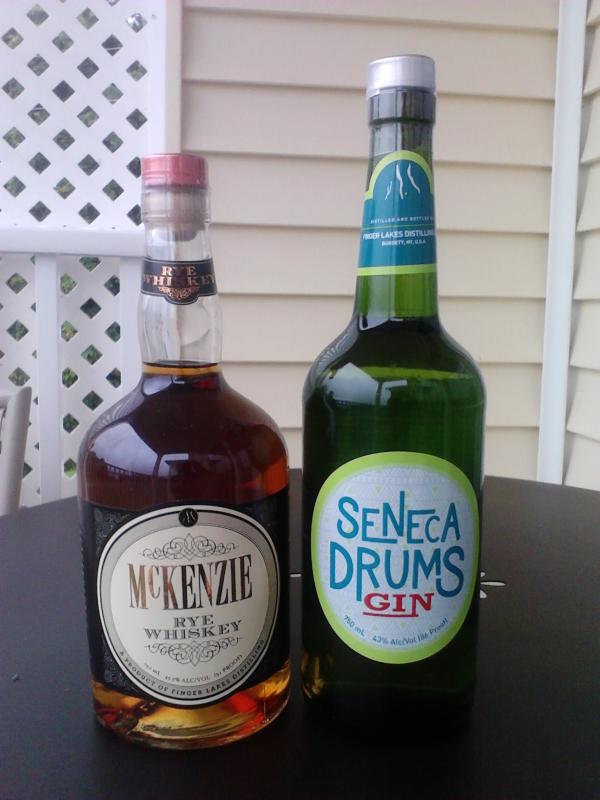
Took a break from wine tasting to visit Finger Lakes Distiling and picked up a less junipery gin and an 80% rye rye.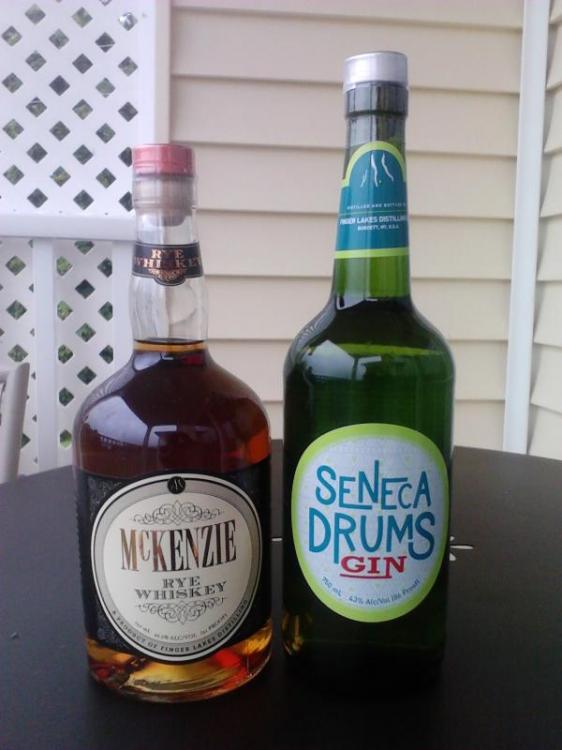
-
I tell younger scientists that the secret to being a good chemist is not as much knowing how to be precise and accurate as in knowing when you can be sloppy. So how accurate (since you are talking about calibration) do you need to be? If you are following a recipe, then you don't need to be more accurate than the person who wrote it. Once you figure out what works, you only need to be precise (unless you change equipment). I can't imagine any situation where a .01 % absolute error would matter for cooking. If your calibration weights have large unknown random errors, there isn't much you can do about it. If you have a good weight the most important thing is not to crap it up with finger prints, oxidation, etc. You can check the linearity of your scale with a stack of new coins - you don't need to know what their mass is, just put them on one at a time and plot the mass vs number of coins. Take them off in a different order to check. If your scale isn't linear, you could construct a graph to figure out a correction for different masses by assuming the error is linear between data points. For small quantities needing very accurate measurements, adsorption of moisture probably make the biggest difference. Especially since you may be in a more or a less humid area than the creator was. You can dry your powders, cool them in a desiccator, then weigh them if you really care. Even then you can have problems. Try weighing sodium hydroxide pellets some time. They suck up moisture so fast that you can't get a stable reading. I suppose if you really want accurate amounts flour you should dry it before using it but I expect most people are happy enough to adjust, based on observation of the consistency. But even if you have a well calibrated scale, there are corrections that you might need for materials with density much lower than steel if you really want accuracy. That's because we tend to weigh things in air rather than in a vacuum. Low density materials like water or solutions essentially float in air to some degree and this leads to a lack of accuracy. There are tables you can apply if you know the density or can estimate it. Is it important? IMO, not for the cooking I do, but I don't know how finicky the molecular stuff is (see my first paragraph). In any case, it is unlikely that those corrections were applied in developing the recipe.
-
FWW I ordered this 2 probe model with alarm, although I might have been tempted by the IR/probe one, had I noticed it. I just ordered one thermocouple - the needle probe with a metre lead. It seems to me that will be more versatile than a pen and I like the idea of being able to replace the thermocouple. I have a love of subcultures and think it is great that BBQ is market niche worth targeting.