
Smithy
-
Posts
13,777 -
Joined
-
Last visited
Content Type
Profiles
Forums
Store
Help Articles
Everything posted by Smithy
-
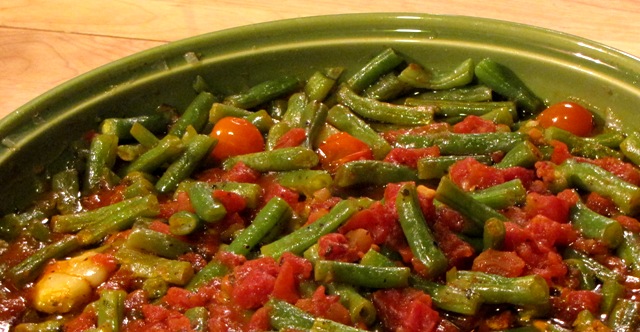
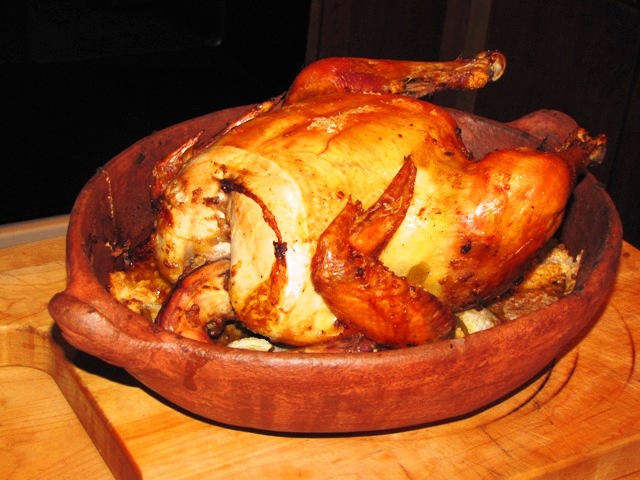
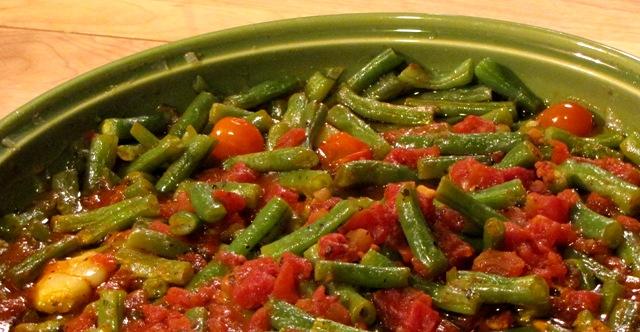
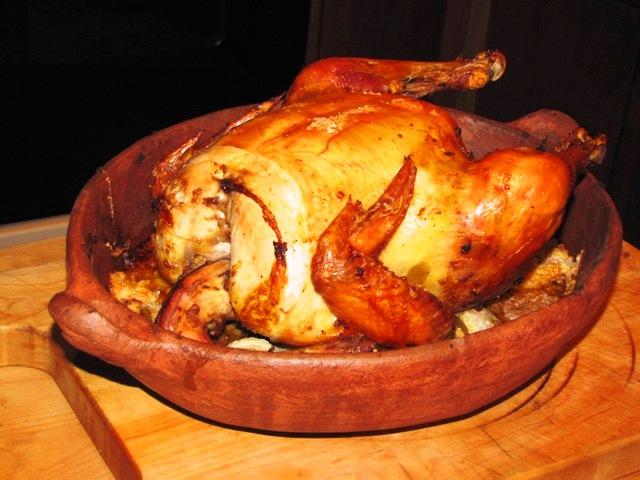
I am determined to post photos with the new system, and to attempt to show how lovely the dishes were. Trust me, the Real Deal was better, but I hope these inspire someone anyway: Green Beans, Tomatoes and Garlic Hearth-Roasted Chicken with Moroccan Flavors:
-
Last week's triumphs were the Hearth-Roasted Chicken with Moroccan Flavors, and Green Beans with Tomatoes and Garlic. The chicken came out with a beautifully golden-brown skin, and I was surprised (although I shouldn't have been) at how much difference the smen coating made. Lovely. It came out of the oven and I gloated, "I've got to take a photo of this for eGullet!" "Never mind that," my husband countered, "You've got to show them the green beans!" The colors are very festive, and the flavors wonderful. There were enough beans left over from our original meal that I served the rest to dinner guests last night. This is the very first time I've served leftovers to friends, and it was well worth it. They loved the flavors. They had no way of knowing, as I did, that the flavors were even better than on the first night. The photos weren't wonderful, but if I could get them uploaded I'd add them anyway. Alas, you'll have to take my word that the food was beautiful.
-
My clay cooking vessels vary on size, glazed vs. unglazed, and lidded or unlidded. The tagine and the Romertopf have lids and no glaze; the casserole dishes and the bean pot are glazed and lidded; the Egyptian pots are unglazed with no lids. If a lid is needed on one of the Egyptian pots I'll use parchment paper, possibly supplemented by aluminum foil. I haven't sprung for a La Chamba yet. I've used Corningware on more than one occasion for the lidded casserole. The Romertopf makes killer roast chicken. We had a lot of fun with that under the Paprika thread a few years ago. That's also about the time I learned that a lot of ceramic cookware can go on the stove top, despite the manufacturers' warnings.
-
I got home from a lengthy trip to find my copy waiting for me! Hooray! Today for dinner I cooked 3 recipes: The absolute, hands-down winner of the evening, and rather a surprise as to the way it came together, was the Chicken with Red Wine Vinegar, Tomato, and Shallots. I like chicken in almost any form, but had doubts about a sauce that began with a lot of vinegar, a touch of honey and tomato paste, all added to rich chicken broth. As the sauce was cooking down I continued to wonder whether it wouldn't be too...wild, I suppose,....strong, vinegary, whatever. I'm glad I followed the recipe precisely. The final dish was very well balanced, with a rich, complex, delicious sauce that we kept mopping up with whatever bread was available. This recipe is something I'd cook for company any time. It was also lovely. I took photos with every intention of posting them, but the photos didn't look good after all. Imagine a symphony of deep oranges, red and golds, with a sprinkling of green from the tarragon leaves over the top. Luscious! For vegetables I tried the Summer Carrots cooked in a Clay Pot. First off, I should say that I didn't have a clay pot with a tight-fitting lid - most of my clay pots are open pots, and the tagine was occupied by the chicken above. So I used a ceramic casserole dish with a lid, and there may be an equipment issue. The other factor, however, is that I'm indifferent (at best) to carrots. This dish was sweet, with tender carrots, and should please anyone who likes carrots...but it didn't do a magical transformation for me. I also did Slow-Cooked Sandpot Mushrooms. I think this dish requires really good mushrooms to show them off; I'd used standard Green Giant white mushrooms, and they tasted - well, like cooked Green Giant white mushrooms. The preparation is dead simple, and as has been noted here before, the simplest dishes rely on the best ingredients. I'll try this one again, possibly in one of my more porous clay pots, and certainly with better mushrooms. My husband is as indifferent to mushrooms as I am to carrots, but since he isn't cooking, he'll get these again. I am surprised and delighted to find numerous bread recipes as well as dessert and egg recipes. I didn't try any of them today, but will do so after I get home again. I can also attest that the chicken recipes that call for roasting them over a bed of salt are real winners. I helped test those, and I've adopted that method for my standard chicken-roasting technique. Anyone else?
-
I don't think that's normal, and it doesn't sound safe. When you say you jarred the olives according to ChefCrash's recommendation, do you mean that you started from the same preservation point as the person to whom he was posting? Or do you mean you started with something like raw olives? The answer dictates what you need to do. Caveat #1: I'm still getting used to the newly-revised eGullet, and may be missing some reference that was perfectly clear to you. In that case, please accept my apology for being obtuse. Caveat #2: I'm not a food scientist. Still...olives by their own nature don't have what it takes to kill bugs. You have to pickle or salt them, or otherwise discourage the bacteria that might grow from them. I really don't think that an exploding seal is a good sign. Is there a county extension office nearby that could help you? Please let us know more information. yours in olive adoration -
-
Well, that's a fine, unassuming way to introduce yourself! Welcome, Steve! You'll find lots of folks around here who cheerfully admit to mistakes, and others who secretly do the same mistakes but won't admit it. Elsewhere on this site you'll find folks with questions, answers, terrific ideas and great stories. C'mon in and set a spell, look around, make yourself at home, and tell us more about yourself! Nancy, who has variously burned herself, poured the stock down the drain, dropped sour cream / cucumber dill soup into the galley of a sailboat, and thrown away vintage kitchen equipment.
-
I haven't seen eggplant mentioned yet. I am very, very fond of eggplant in just about any cooked incarnation. Slice it, brush with olive oil and herbs and then grill the slices, and toss with balsamic vinegar and more oil. Roast the whole eggplant until it collapses, let it cool, peel it, and then turn that luscious smoky pulp into baba ganou, or an Egyptian salad with chopped tomatoes and onions, tossed with a lemon vinaigrette. Imam beyaldi (swooning imam) might even lend itself to the grill, although I haven't tried it. This thread is terrific. I should have realized that Steven Raichlen would have a web site, but I hadn't thought about it before seeing the link upthread.
-
Q&A -- Understanding Stovetop Cookware (2009-)
Smithy replied to a topic in The eGullet Culinary Institute (eGCI)
I did a major "uh-oh" to a beloved stockpot and am looking for some insight about what to choose for its replacement, when I get around to replacing it. I have (still) a favorite Revere Ware aluminum-disk stainless steel stockpot. A few weeks ago I burnt a stew while taking a shower...and oh, how badly I burnt it...so thoroughly, completely did I burn it that the interior bottom built up too much carbon to provide any convective cooling, apparently, and that led to a meltdown of the bottom layers. I finally figured out the extent of the damage when I realized that the (finally cool) pot was no longer level because the disks on the bottom were delaminating! All this on an electric-coil stove. I had no idea it was possible! (And no, the stew could not be salvaged.) I'd be posting this, perhaps, on the thread of mistakes never to repeat, but I have a practical question. The pot actually is still usable, now that I've scoured the interior thoroughly, but the bottom disk is no longer intact. Although the (roughly 1/2") aluminum disk is still firmly attached to the stainless pot, the outermost thin disk of stainless steel (1/8" thick?) has warped and peeled away from part of the bottom surface. The upshot is that this pot would be fine over a gas flame, useless over an inductive surface, and may work reasonably well despite its appearance over my existing stove. But it wobbles and I may decide it has to go. My question is this: if and when I choose to replace the pot, would I be better off looking for something clad up the sides of the pot rather than the disk bottom? I've been quite happy with the disk bottom for the purposes to which I've put this pot - stews, soups, pasta. In another life I started spending oodles of money on All-Clad and Le Creuset, all of which I love; however, I'm not sure the extra money for cladding will be worth it for a stock pot. I know this topic has been addressed (perhaps more than once) in this Q&A session; however, I'm hoping for a quick pointer because I can't find an outline view. -
The ingredient list for Lawry's Seasoned Salt is as follows: "Salt, sugar, spices including paprika and turmeric, onion, cornstarch, garlic, tricalcium phosphate (prevents caking), paprika oleoresin (for color) and natural flavor." It also says, in large conspicuous letters, "contains no M.S.G." which goes to show how poor my memory is. Of course, they're being cagey about some of the seasonings, but you can probably come close if you try combinations of the ingredient list through the garlic. Remember that the ingredients are listed in order of quantity, so salt is the main ingredient, sugar is the second-largest fraction, and from there you get to have fun with the other seasonings. Paprika provides obvious color and flavor. I looked in my copy of "Dear S.O.S." and found that Lawry's had provided a recipe for prime rib. It's been adapted in this cookbook for a smaller roast (8 - 10 pounds) than Lawry's usual 15-lb behemoths. In case it's useful (I haven't looked at the recipe on their web site) here's the essence of the recipe: Preheat oven to 325F. Place prime rib fat side up in baking pan. Rub with rock salt, then with seasoned salt. Roast until meat thermometer registers the appropriate temperature for desired doneness (130F for rare, 140 for medium rare, and so on). Rare worked out to 18 - 20 minutes per pound, medum rare was 22 minutes per pound, etc. They note to be sure to insert the meat thermometer into the center of the roast for the most accurate reading. I'll add that you shouldn't leave the thermometer in the meat between readings, because in my experience the metal stem heats up the meat surrounding it and elevates the reading. They add that you should let the roast stand for 20 minutes before carving. I'm pretty sure their sauce is the simple jus, but I don't remember it clearly. Good, pungent, creamy horseradish is an excellent addition, but I may have picked that up in a later life. Sorry, I don't remember anything about their salad dressing! It may well have been thousand island, since I don't remember it and that's about all I used at the time.
-
I have fond memories of Lawry's prime rib, where I ate many times. Unfortunately, that was years ago and years before I became interested in cooking. Here's what I remember: the roast was coated with a fairly thick layer of coarse salt. The outside surfaces therefore had a thick salty crust that you'd knock off before tucking into the meat. The crust seems to have helped contain juices inside the roast, and the meat next to the outer layer still had some of that salty flavor. I'd say the salt flavor penetrated no more than 1/2 inch into the meat, however. The roast was done dark on the outside and ends but still rare on the interior, so you could choose how done you wanted your meat. I don't know what sort of oven heat they used to get it that way. I get the best results here at home by cutting the ribs off (to save effort after cooking the meat) and then tying the roast back onto the ribs as a rack to keep the bottom of the roast off the hottest cooking surface. I usually use high heat to prevent the interior from getting overdone. But I don't know if that's what Lawry's did. I keep Lawry's Seasoned Salt on hand at home, but I really don't remember it being used on the prime ribs. I think the seasoning may have been simply coarse salt. Can you get their salt? If not, I can post what the product label says as to ingredients.
-
I've never thought of braising in a pressure cooker. Not that I have a pressure cooker, but I might consider it if the benefits seemed worth the cost. What would you say is the time difference? Is there an advantage other than time savings?
-
The "something wrong" sounds to me like "control issues". Your potential SO sounds like a serious control freak. It goes beyond his having different tastes and interests than yours; he's bugged by your interests and efforts, and he belittles them. If you're describing his behavior accurately, then you should bail. Now. You won't change him, and he's busy trying to change you.
-
I'm not sure where you define the "million ingredients" line, so these may be over it - but - what about a caper sauce or a puttanesca sauce?
-
I think I'd rinse the olives first. The recipe calls for salty olives, rinsed, and he's talking about olives in brine. You can always add salt to the tapenade if it seems to be needed. That looks like a good recipe! I'm glad you posted the link. There's some interesting reading at the new Lindsay Olives web site. They have a section titled Olives 101 that gives information about flavor profiles of different varieties, curing methods, sources and so on. Elsewhere on the web site there's a recipe section. I was looking for spread or dip recipes and found some pretty interesting dinner dishes as well.
-
I feel your pain. Literally. As near as I can tell, ONE HALF BOTTLE of red beer (Killian's Irish Red, for an example that comes to mind readily) will give me the blinding headache you describe, for 12 - 24 hours. I no longer try to drink red beer. I have the same experience from certain red wines, and I'd give a lot to know in advance which ones do it so I don't have to take the experimental approach. I can (and do) drink zinfandel, cabernet sauvignon, pinto noir and a number of other hefty red wines with no trouble. ONE SMALL GLASS of Rosemount Diamond Label shiraz will give me a terrible headache all the next day, even if I've restrained myself to water for the rest of the evening. Unfortunately I discovered this after we'd bought a case of it.
-
I've just discovered Etsy's counterpart in the food world: Foodzie It's billed as a marketplace for small artisan food producers and food growers. Looks interesting, although I haven't tried working through it. I do like Bravo Farms' cheese, however, and I see they have a site there.
-
Looking for some good Turkish recipes.
Smithy replied to a topic in Middle East & Africa: Cooking & Baking
I have The Sultan's Kitchen and can attest that it has good recipes, although I wouldn't know whether they're authentic. Two of my favorites are Sultan's Delight, a lamb tomato stew, served over creamed eggplant (hunkar begendi, pardon the spelling). Lamb and eggplant are available year-round in Duluth now, so maybe they'd be available to you as well. If you want to see what those dishes look like, go to this post from my food blog. Edited to add: their Circassian Chicken is also quite good. Since my other Turkish cookbooks have a similar dish I think it must be considered standard fare. I do tone down the cayenne a bit, however; The Sultan's Kitchen's version is pretty hot. -
Extra note: sorrel really does just melt, except for those pesky stems I mentioned above. The Zuni Cafe panade to which I referred simply requires that you remove the main ribs from the leaves, then lay the leaves into the layers with the other ingredients (sauteed onions, chunks of cheese, chunks of bread). The equivalent recipe that calls for chard requires that you sautee the chopped chard first. I don't think I've tried sorrel with new potatoes, but I'm thinking it would be very good.
-
One other trick for the sauce is to save a small amount of the chopped sorrel and use it as a garnish on the sauce before serving. I love sorrel, but it really does turn a dread army drab green when it's cooked. The green garnish will liven it up. Could use another green herb, of course. The Zuni Cafe cookbook has a recipe for a sorrel panade that I think is out of this world. It's ridiculously easy to make, as well; however, I wouldn't recommend your changing plans tonight. Chicken with sorrel sauce is another of my go-to recipes. One thing I've learned the hard way is that you really must pull out the main leaf veins (ribs) if the leaves are large. I decided to skip that step one time. The larger veins on the large (old) leaves rolled into little spiky hollow needles that just couldn't be chewed comfortably. We had to fish them out of our dinner that night. I don't think this is a factor with young leaves or the smaller veins.
-
*bump* I am now in the unfortunate position of being able to report on this particular slow cooker. (Hamilton Beach 6-qt Set 'n Forget Programmable) The temperature setting is a cruel hoax. The cooker only has 3 thermal settings: high, low, and keep warm. In temperature probe mode, you set the desired temperature - and when the probe senses that temperature, the cooker turns down to "warm". Which is pretty low. You can set the cook time under timed mode, and when it reaches the end of the cook time it will turn down to "warm". That's all the "timed cook" mode does, though: you can't program it to turn on at a specific time. I still don't know the set points of the 3 heat settings, and it isn't worth trying to work it out. This cooker will not maintain a specified temperature. It's going back. Edited to add the make and model, in case the link I quoted above quits working.
-
I've been working to eradicate the mice in our new-used trailer. Our cats and dog have been helpful, but since we don't live in the trailer all the time their access is limited. The mice have cheerfully ignored the ultrasonic mouse repeller that I purchased. (They probably think it's singing a squeaky lullaby.) Open snap traps have too much potential to injure a curious household pet, but I've had excellent success with d-Con's No View, No Touch rotary snap trap. It isn't cheap, and it isn't reusable, but it works.
-
I second Hard H20's suggestion. I've had a few hides tanned in order to make the deerskin leather vest and/or skirt I want someday. They're still sitting in my storage area, waiting for my "someday" to arrive. Every hide since then has gone to the "Hides for Habitat" box, whence said hide will be turned into something useful that earns money for its program. The boxes are all over the place up here. You can probably find them in your area pretty easily, as well. eta: and yes, skinning is pretty easy. The best knife to use is something with a fairly sharp edge but not much of a point, to minimize the risk of poking a hole in the skin. The blade edge should be sharper than a butter knife, but again, not so sharp that it would readily slip through the connective tissue and slice the skin.
-
OK, I'll bite. What is tiger butter, and how do you make it? Anything as good as you describe, I've got to try.
-
My propane-fired gas grill does not leave off-flavors. Why would a propane torch do that?
-
The big (1-lb bottle), basic torch is a lot cheaper, and it's available at any hardware store. Amazon has a torch kit (3 nozzles, sparker, propane bottle) for $39.99. If you buy the trigger (self-lighting) head and the bottle at a hardware store, it should cost you less than that. Aside from the "small torch for small kitchen" issue, I can't see why someone would go for a mini-torch when the basic one will do. $100 differential is a lot to pay for the "aww, it's so cute!" factor.