
Mjx
-
Posts
7,674 -
Joined
Content Type
Profiles
Forums
Store
Help Articles
Everything posted by Mjx
-
Pineapple and coffee (esp. bitters, which cut through the sometimes excessive sweetness of pineapple) Fernet and chocolate
-
I'm not sure if we're looking at the same Nathan Myhrvold post, but in the one I was referencing, he states that the Gastrovac is 'just a vacuum chamber'. It sounds like since then, the Gastrovac has been redesigned into something rather different (and actually, sous vide is, literally 'under vacuum' (not necessarily a complete vacuum, since that's not so easy to reach/hold in most kitchens), so the intent of the term is going to depend on the context (e.g. cooking sous vide, infusing sous vide)).
-
You'll find a lot of discussion of cooking under vacuum in the forums, just look for the discussions of cooking 'sous vide' (for whatever reason, the French term for 'under vacuum' caught on early). There isn't much that is specific to the Gastrovac, apart from this, in the Sous Vide: Recipes, Techniques & Equipment (Part 1) topic, but I'm fairly certain that the information on various other vacuum chambers is applicable.
-
This (I know this is old, but I just came across this now). A blade is the most efficient at removing almost all the muck. I use a scraper that's designed for this purpose (Gaggenau thoughtfully included one with our cooktop, but at least in Denmark, you can find these in any supermarket, and they're also great for removing polymerized fat from the inside of oven doors, so they're not single-use-only gadgets), which is essentially a holder for a razor blade. It loosens pretty much everything except hard water stains, and the mildly abrasive cleaner for glass ceramic cooktops takes care of the rest. This appies toinduction cooktops, too, by the way, since the surfaces are identical. With the icreased popularity of induction cooktops in the US, the cleaner may be more readily available than it was, last I looked.
-
Seems like an excellent time to exhume this discussion, and [once again] wax nostalgic over the atrocities that were foisted on you under the loose category of 'school lunch'. The peanut butter and jelly sandwiches that my mum made during the years I went to school in the US were pretty bad: Arnold's whole wheat bread (which was weird to me, since I was used to firmer, entirely unsweetened bread, in Italy) with home-made peanut butter and whatever jam was deemed appropriate for a child raised on health foods. The oil from the peanut butter would separate out and soak into the bread, so by the time it was unwrapped from its cling film, it was in a state resembling rigor mortis, and there was a whiff evocative of wet dog fur to season it. I don't think I ever ate one, I couldn't gag them down. Sometimes, the canteen offerings were more attractive, other times, not so much, but I seldom had a chance to eat the school food, because my parents dissaproved of it (looking back, I can't blame them). So, what have the rest of you got?
-
At the US school I attended, I recall the 'Chicken a la King' regularly served in the canteen being referred to by the kids as 'runover chicken on a roll'. This was still pretty generous, in my opinion, since It was atrocious, looked like cat sick.
-
I've used unsweetened berries and bay leaf to make a sort of compote to serve with game, including duck. I don't have a hard and fast recipe, but just add a little gin, whisky, or rum to the pan to deglaze, bring down the temperature, if necessary add a little boiling water to cover the bay leaf I simmer in the now-deglazed pan for two or three minutes, reduce out any excess liquid, add the berries and a pinch of salt, and cook until they start to ooze juice (I don't like my berries very cooked). I sometimes add a pinch of cinnamon or a small clove. Sometimes (generally, with store-bought berries in the winter), a small amount of acid adds some dimension.
-
This topic has been locked before it turned into a bloodbath, and because it was contributing nothing, and going nowhere useful.
-
There are many forms of stainless steel, and some of them contain aluminium. Apparently, these alloys are designed with increased the strength in mind, which seems to have minimal utility in your average kitchen. I'm sure your local library has works that can fill in the details.
-
http://www.economist.com/news/science-and-technology/21642107-alloy-iron-and-aluminium-good-titanium-tenth http://www.popularmechanics.com/technology/news/a13919/new-steel-alloy-titanium/
-
That looks gorgeous. Is the texture like a slightly more robust schiacciata fiorentina?
-

Any interest in a Singapore/Thailand photo blog?
Mjx replied to a topic in Elsewhere in Asia/Pacific: Dining
This topic has been locked since the blog is now up and running. -
I too find that (once it's drained/the stock is pressed out of it) the meat left on the bones used for stock doesn't have much to offer, in terms of flavour or texture. It's still useful protein, so if there's a significant amount of it, I strip it off the bones, and save it to mince and use as a filler in things like filled pasta, larb, stews, that sort of thing (i.e. dishes where the meat is broken up small anyway, and so seasoned that the flavour of the meat is more or less background). I tend to keep i int the freezer until there's what looks like a useful amount.
-
I'm up to my eyes in work at the moment (which iwhy I'm still awake at past 1.00), but google scholar should turn up some credible studies if you search for [cancer fasting]. Find me a researcher who does not bring some form of bias to his or her research, and I'll prove to you it is an impressively realistic android. An acknowledgement of potential conflict of interest has the advantage of making a study's audience imore discriminating in its acceptance of the research; we might not even be having this exchange, if the researchers had no connection to the company mentioned. A lot of the responses to this study seem directed at words associated with the titles of newspaper articles about it, and people tend to have a remarkably visceral reaction to the word 'fasting'. In this case, 'stepping back' is crucial, since it means 'not glaring wildly at that one word, and screaming at it incoherently to go away, because it has scary associations'; there is way too much of that. Keeping in mind that this is a mini, modified fast is absolutely important, under the circimstances.
-
There is a lot of research on the effects of fasting on human health (executed with varying degrees of rigour, as is the case with any field of research), much of which originated in its effects on cancer cells, and then led researchers to explore the possibility of extending the findings to healthy humans. Since you review journals, you probably have access to substantial collections of research articles, so I definitely recommend taking a look (resist the temptation to cherry-pick, just dive into the 'fasting + human [cells]' area, and enjoy the rabbit hole!). Transparency is generally preferable, but without hearing the other side of this (and which has to do with an entirely different article), I simply don't believe I have enough information to draw conclusions about this. It would be lovely if science could work free of commercial interests, but because even simple research comes expensive, it is not at all unusual for research to be funded by a commercial enterprise, or for a researcher to have an interest in the the enterprise. This does not automatically invalidate, or even undermine, the research, just as disclosure of potential conflict of interest (which there is, here) doesn't automatically eliminate the risks associated with them. Again, I think it is crucial to step back and see what this study is saying, which comes down to there being indications that spending five days a month eating a reduced amount of food has some health benefits. This is not a drastic suggestion. Even if the major benefit to a given individual ends up being that it makes him or her think more about food, health, and the connection between the two, that's something, since most people in the Western world are so accustomed to taking for granted the regular consumption of large, even excessive amounts of food.
-
The article was published in Cell Metabolism (a well-respected journal that does not publish 'pseudoscience'), and may be found here: http://www.cell.com/cell-metabolism/pdfExtended/S1550-4131%2815%2900224-7. The presentation of what is very clearly and honestly described as a pilot study on humans is on p. 9 (right hand column, bottom of page). It's also important to consider this study in a broader context: preceding it are literally decades of credible studies addressing the effects of fasting on human health. This is no more some new 'food trend' than, say, washing your hands before eating. What makes this study interesting is that it explores an alternative to fasting that appears to yield similar effects. Eating lightly 5 days a month is extremely unlikely to be difficult or problematic for most adults; it's quite a stretch to describe this as a 'low calorie lifestyle'. Page 27 gives a clear breakdown of the macronutrient ratios employed, so this is easy to DIY if you have a scale and look up the caloric values of proteins, fats, and a carbohydrates; there's no need for (or claim that) special products must be used (although I'm certain some pople would appreciate the convenience of something of that sort, if it becomes available). If you step back, and look at this as involving food as such, this kind of eating pattern also offers a great opportunity to amplify flavour in small portions of food, and really appreciate it in a way that only happens when you're truly hungry.
-
For me, most alcohol proved rather disappointing, although I always liked it in things such as sweets. The lovely colours, especially seen with light coming through, made it seem like it would have to surpass all the usual things I drank (with the possible exception of orzata), and essentially be the manifestation of a whole new, higher level of flavour. When I finally tried it, it was such a let-down, sour/bitter, and burning or stinging. The whole experience was a lot like Denis's discovery of what 'carminative' actually means. I persisted, because at some level, I continued to believe what I had in the first place/I'm freakishly optimistic about the strangest things, and eventually found a few iterations that approximated my expectations: some liqueurs, boal madeira (I still haven't tried Chartreuse, because I so want to believe it is amazing). But I still like alcohol best as asupporting ingredient in something essentially non-alcoholic.
-
Definitely. Before the verdict of a comprehensive starch intolerance was reached, and after a crushingly disappointing rice flour loaf that looked and smelled gorgeous, but turned to library paste when chewed, I eagerly tried every alternative flour/powdered starch that crossed my path. Surprisingly (?), for 'breadiness', various flatbreads and crackers seemed far more satisfactory than loaves. None of the wheat/grain-free recipes I tried was particularly satisfactory, and I was happier with the results I got form tweaking standard recipes. When making these, in addition to using my 'flour of the moment' instead of wheat flour, I generally replaced all, or nearly all the liquid in the standard recipe with egg white. Slack doughs and batters definitely gave better results than firm doughs.
-
How do you feel about clafoutis? I've made these replacing the wheat flour with buckwheat/rice flour (also, rice starch; essentially, whatever non-wheat flour was lurking in the flour drawer, I know buckwheat is off the table for you), and the results have always been surprisingly like a traditional version, possibly because the amount of egg is what provides the structure. I've made this with the usual fruit, and (since my boyfriend loathes cooked fruit) also versions with chocolate pieces/various kinds of dried fruit.
-
Certainly! http://noblepig.com/2009/12/guinness-stout-ginger-cake/ (and, in case you're curious, I believe that the recipe in the Oregonian from which she says she adapted this is http://www.oregonlive.com/mix/index.ssf/dessert-recipes/ginger_barleywine_cake.html) A few notes: I prefer to weigh my flour, and for this recipe, I use 283g; the recipe does not include salt, but is much better with the addition of 1/2 teaspoon of salt; where it says to use a large saucepan for the stout+molasses mixture, make sure it is really large, err on the side of 'too big', since this stuff foams up lik mad when you add the baking soda (I transfer the mixture to a huge metal bowl, then add the baking soda, since the only pot large nough in our kitchen is a colossal stock pot).
-
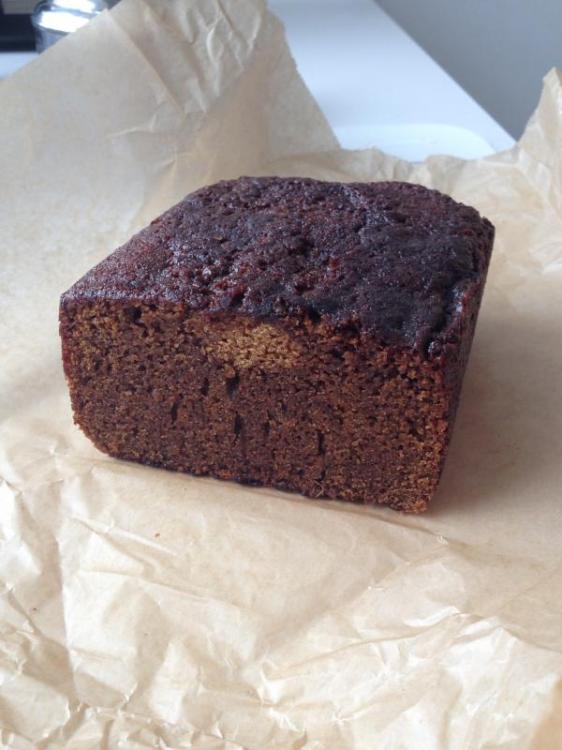
Guinness Stout Ginger Cake: It goes fast.
-
Cooking Issues addressed the question of killing lobsters humanely and to optimize their flavour, in 'How to become a Seafood Anesthesiologist and Kill your 4th of July Lobster'.
-
Guinness Stout Ginger Cake. Looks unimpressive, but is full of complex flavour, and has a lovely texture. The step that requires the use of a large saucepan should say 'huge'; the stout mixture really foams up a lot. Planning on making this in a week or so.
-
Basic "Birthday cake" recipe that doesn't use a stand mixer?
Mjx replied to a topic in Pastry & Baking
I've made most of the basic cakes in The Best Recipe, using just a hand mixer/various stirring gadgets (when I've been visiting friends with very minimally equipped kitchens). The results have routinely been good to exceptional, and I like to experiment with flavours, so at one point or another, I've added more or less anything you can think of (sometimes in significant quantities) to these things. I make the devil's food cake most often (pretty much everyone I know wants it for their birthday), and at least once made it using just a standard fork and tablespoon. Keep in mind that creaming, then whipping a butter sugar+mixture gets old fast (you'll probably want a lower working surface than usual), so a recipe like a hot milk cake may be the way to go: it uses melted butter (or a chiffon cake, which uses oil). ETA There's a decent chance of finding this book on sale/at a library, but PM if that doesn't work out, and you want a recipe. -
I have my doubts, given the responses, but fair enough, I sounded like an ass. I can see the reason for the focus on Guy Fieri, though: of all the repulsive personalities mentioned, his public persona (I'm differentiating this from the way he may actually be in private) is easily the most actively, even aggressively offputting (and it may be deliberate).