Shel_B
-
Posts
4,805 -
Joined
Content Type
Profiles
Forums
Store
Help Articles
Everything posted by Shel_B
-
Perhaps you misunderstood my question. I'm interested in getting that crispier crust without overcooking the inner part of the brownie, leaving that nice a chewy and fudgy. The pans you mention seem like they'd just give me more edge, but not a more crispy edge. Is that correct? In doing some poking around, I came across a suggestion by Alice Medrich. She says that rather than baking brownies at the more typical 325-deg F temperature, one should bake at a higher tem (400-deg she said) for a shorter time. Any thoughts on her suggestion for crispy edges?
-
If between our two houses we fill a 5-gallon bucket with trash, that would be a lot. I don't even have a trash can in my kitchen. Whatever is going into the trash gets put out almost immediately, and it's rarely food items. We compost most all of our food scraps, or, rather, the city does. They pick up the green bucket (30-gallons or so in size, depending on customer's needs) and compost the material. The compost is used by the city in their projects, and twice a year they have a compost giveaway - just stop by the recycling center with containers, and scoop away with the provided shovels. If there's something that has to be bagged and put in the trash, we generally use the compostable bags provided by the local organic grocery.
-
This afternoon I baked up a batch of brownies - my first ever - and they turned out pretty well. Rich, somewhat chewy, fudgy, and very chocolatey. One corner was cooked so the edge had a crispy kind of crust to it, something I liked quite a bit. The contrast between the crust and softer brownie was very appealing. I'd like to know if it's possible to get that crust around the edge without overcooking the brownie's interior. Maybe a heavier hand with the oil on the pan's sides, perhaps using butter instead of oil for the pan, or .... ? Thanks!
-
I found this thread accidentally, while searching for something else. Thought I'd bump it up as there have been a lot of changes in the landscape since 2008. In our area plastic bags are no longer available at most stores - grocery stores, liquor stores, household goods stores like Bed, Bath, & Beyond, department stores, and so on. Restaurants are allowed to use plastic bags for carryout orders. The only bags that are available in grocery stores are, by law, paper made with a minimum percentage of recycled material, and the shopper has to pay for them. Otherwise, it's bring your own reusable bag or buy one at the store. We have been using reusable bags for many years, long before it became a requirement, but I have a tendency to shop on the spur of the moment and sometimes don't have a bag with me, and this is especially true when I'm taking the bus or riding a bike. Otherwise, we keep several bags in the car. I found a very nice bag made of 100% recycled bottles and other materials. It folds very small, and stores in its own, attached pocket and the whole thing attaches to a belt loop with its own small, carabiner made of recycled aluminum. I hang that puppy on my door handle, and stick it in my pocket on the way out. It compacts to a size similar to a pack of cigarettes, so it fits easily into a jacket pocket, or even a pocket in my jeans. A couple of the markets use compostable bags instead of plastic to put your produce, grains, etc., into. These are great because they serve the same function as plastic bags for carrying out you veggies, but they go into the landfill and compost down. They are made of some vegetable matter. Our community takes plastic bags at the local recycling center and also picks them up when the recycling truck comes by once a week. We place our small plastic bags, such as found in packaging or food wrap, in a larger plastic bag, secure I, and of to the recycling it goes. We no longer put plastic bags in the trash ... never, never, never. All the plastic bags we end up with get recycled.
-
From the Oscar Mayer Institute for the Advancement of Bacon comes this new, downloadable app that provides the smell of coffee and bacon when the alarm goes off. Transform your iPhone into a bacon-scented alarm clock. What a way to wake up! http://www.wakeupandsmellthebacon.com/
-
Although my experience with this is limited (I've only made two seafood dishes thus far) I'd agree about the oil. I've read and seen enough from MC, Heston Blumenthal, and some other sources, to suggest that oil takes flavor from the protein, and that using little, or no oil, is a better alternative in many instances. In my situation, it seems that I can cook certain fish and seafood items in water straight from the tap, or pretty close to it. The temp from my kitchen tap is varied between 116.5- and 119.8-degrees, which according to numerous sources is adequate for many fish and seafood. I can always add a few ounces of hotter water to bring the temp up a bit if need be. I've got to work out a process by which the pot won't suck heat out of the water, and that will require some playing around. I thought that I could heat the pot somehow with hotter water to bring the temp of the vessel up, then add water of the appropriate temp, and set the pouch into the liquid for the requisite time. Unfortunately, I have electric burners, although thus far they have not been an issue. Perhaps using very thick and heavy pots keeps the water temp more even, but that's just a supposition for now. I've been using a large Le Creuset oven to hold the water, and I also have a D5 All-Clad soup pot which, based on experiences with a D5 saucepan, should do a good job of retaining heat. My thinking is to use the heavy pots and plenty of water to minimize heat loss. More experiments are needed.
-
I don't recall if I thanked you for the info. Decided to try the spread, and will order it online next week.
-
I thought I'd bump this up as I now have another question. It seems that using oil gives a moister result, and some people have said butter adds some flavor. If using ghee or clarified butter instead of oil or plain butter, might that result in the best of both options - more moistness because I'm using more fat together with a good butter flavor?
-
Then I shall call what I am doing Low Temperature Water Bath Cooking.
-
Thanks for the pointer. Not sure yet if I need such an item, but time and experience will tell me.
-
At first I hadn't thought about the vacuum business, and it's still not clear to me why cooking under vacuum is necessary, but as it happens, I may have a Foodsaver setup around here somewhere, if I didn't give it away some years ago. I'll certainly see if I still have it. However, I continue to wonder if it's really necessary, or necessary in all situations. From Modernist Cuisine: "Although sous vide literally means under vacuum in French, the defining feature of the sous vide method is not packaging or vacuum sealing; it is accurate temperature control." Additionally, in this video http://modernistcuisine.com/2012/11/watch-nathans-modernist-cuisine-story-on-nova-sciencenow/ - at 8:56 into the video - you can see Nathan serving Martha Stewart salmon cooked in a Ziploc bag, and from the image I saw, it sure didn't look like there was any vacuum involved. So, what's the story? Is vacuum necessary?
-
Tonight I did a very quick and almost haphazard SV of a couple of frozen salmon fillets. 5 quarts hot tap water into the Le Creuset. The pot and the amount of water helped, I'm sure, to keep the temp pretty stable. Set the burner on the lowest setting to keep the water warm. I mistakenly set the water temp too high. It hovered around 135-deg F for most all the cooking. Checking back here, it was suggested to cook at about 15 to 20 degrees lower. I did learn how easy it is to maintain a fairly constant temp with the setup I used. Next time, a lower temp. As an experiment, and because I was anxious to get started, I put the fish into the pot without removing it from it's cryovac(?) package. Not knowing what to look for, I don't know if this was, or was not, a good idea. I can see the downside is not having any sauce in which to cook the fish, but for me that's not a big deal. I don't mind plain salmon, sprinkle a little S&P and I'm good to go. I am definitely going to try this again. The fish almost cooks by itself, there's very little energy spent cooking it, cleanup is a snap, and there's no fish smell in the house, which bothers Toots quite a bit. Thanks to all for your help. Onward with experimentation!
-
There's a sporting goods store across the street from my apartment, and I'll have time to take a look at what they have. I figured out where I could keep a cooler of the size shown in your post. Thanks!
-
There is some frozen fish in vacuum packages (from TJ's freezer) sitting in my freezer. Could I just dump a package into some hot water of the appropriate temperature, and cook the fish in the package it came in? Any need to thaw the fish before cooking?
-
Nice recipe idea ... what's self raising flour, and do I need it?
-
Very enticing article ... it has a few advantages compared to the oven or stovetop, and one very great disadvantage: space I'd have to do some careful planning and measuring to store a beer cooler in my small apartment, but I suspect it is doable. How large a cooler would be advisable, or, perhaps a better question, how small a cooler can I get by with, assuming for now that fish and chicken would be the most cooked items and for no more than two people.
-
Thanks for your comments. Very helpful. I don't know how low my oven can go, but I do know that my Breville toaster oven can get down around 120-degrees, and I do have a container that will hold water that can fit inside the oven. How much water can I minimally use ... the container I have in mind holds but two quarts, less, of course, the amount taken up by the item being cooked. Doing it on the stovetop seems like a lot of work, but the water, because of the quantity, might be able to hold a pretty steady temperature, and I do have a few very heavy, thick pots that should help maintain an even temp. Does that sound about right for stovetop SV?
-
Thanks so much. The article gives me a starting point. I imagine that temp control wouldn't (couldn't?) be as precise as a dedicated setup, but it might be OK for a few first, rough experiments. It seems that I have most of the needed items.
-
Could something approximating sous vide be done with a properly sealed bag and a water bath in the oven?
-
Thanks for all the help. Right now my use of eggs is limited, but should I get more adventurous with my oven, your help will be even more valuable. Thanks! I recently acquired a small, digital kitchen scale, and there will surely be some egg weighing experiments coming up.
-
Earlier today I made popovers, and the first egg that was broken into the bowl was a double-yolker. It's been years since I've seen a double-yolk egg (I once saw a triple!), and I suspect that, with my new egg supplier, I may see more of these puppies. How do I deal with them, especially in recipes that call for multiple eggs or eggs that have been separated? Thanks!
-
Having recently been gifted with a few nice, thick, grass fed rib eye steaks, I thought I'd review some ideas about cooking them, and found this thread. The issue of butter is interesting, in that I think it does add some nice flavor, but it also has a tendency to burn. With that in mind, how might ghee or clarified butter work in place of plain butter? It seems like a good idea, but might I be missing any downside? Thanks!
-
Probably not much more than a quart at a time, if that much. For example, a head of broccoli, a couple of diced zucchini, two medium chicken breasts, 1/2 to 1 small head of cauliflower ... like that.
-
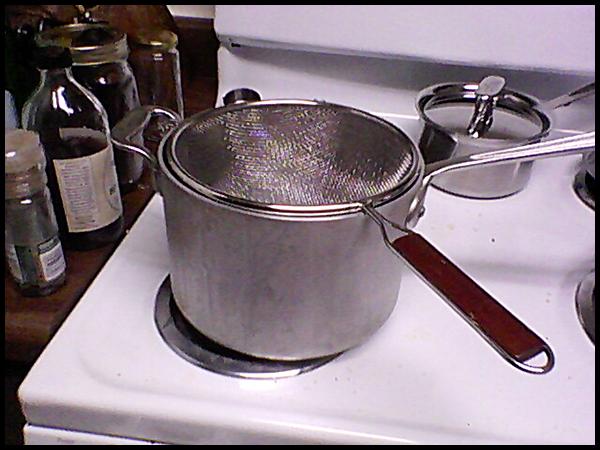
Bingo! I have a strainer that fits perfectly inside my 4-quart All-Clad saucepan, and the lid covers it quite nicely. I bet that will work just fine as a steamer basket, and eliminate the need to buy any additional vegetable steaming gear. I can also set a small plate inside the strainer, allowing me to steam fish or poultry, albeit not large amounts. Thanks for mentioning your steamer basket.
-
Because I don't know about the quality, and the diameter is a bit less than I would prefer. A lot of the steamers I looked at had quality issues, such as fins coming loose or falling off, legs that weren't well secured, and poor quality stainless steel that rusted. Some had design flaws that were unacceptable to me, such as handles that were too long to fit inside the pots I'd be using. That's why I asked here, where people do a lot of cooking and may have had a lot more experience with these things than I. I subscribe to the idea that "the more you know, the better your luck."