

paulraphael
-
Posts
5,175 -
Joined
-
Last visited
Content Type
Profiles
Forums
Store
Help Articles
Everything posted by paulraphael
-
Yeah, this is a sauté that you've finished with some flamed booze. Nothing like a braise, and doesn't require the silly quantities of whisky that you'd probably need with a braise. Your technique is traditional for pan sauces. More commonly done with cognac. Regarding the meat being oily, this doesn't have to be a thing. Meat can't absorb oil from the pan; it stays on the surface. So there shouldn't be a difference in meat oiliness if you use a little oil or a lot. But you'll get the best browning results if you use plenty of oil; its purpose is to fill in all the gaps and conduct heat to the meat. Once the meat's cooked (before you make the pan sauce), pour the excess oil out of the pan. Assuming the pan drippings are properly browned and stuck to the pan, you won't lose them. If you want to reduce oil farther, just blot off the surface of the meat with a paper towel.
-
I walked by, but am not really a sake drinker. They do indeed have quite a selection. I was overwhelmed, so video called a friend in Chicago who cooks a lot of Japanese food and does all his grocery shopping at Matsua. He said, "that one, get that one!"
-
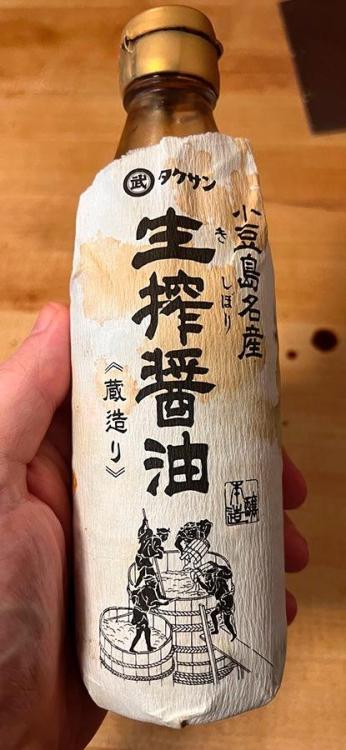
I don't know what this is, but it's the best I've had. [Edited to add: just did a reverse image search and found it here: https://www.amazon.com/Kishibori-Shoyu-Artisinal-Unadulterated-preservatives/dp/B004XX1NKQ. Kishibori Shoyu, aged in cedar. I got it at Japan Village in Brooklyn and am pretty sure I didn't pay this much.]
-
Some industrial ice creams are made this way (I'm not sure why exactly). They have to use powerful homogenizers, and still they sometimes have texture problems. I suspect that with home equipment you'd be disappointed in the results. You would probably need some kind of emulsifying ingredient (yolks would work).
-
Oh, yeah, I'm proud of my pancakes with vent-aged glaze of mixed oils. It's a house specialty.
-
Looking at houses mostly. Taking cues from if there's already a hood venting to the outside.
-
I do. It's not the best arrangement. We're shopping for a new place right now, and I'm insisting on a place where we can put in a 36" range and a commercial-style hood that vents outside. Without ripping the place down to the studs.
-
The vent on mine is aimed at my face.
-
And I think some of them have powerful blowers. In some cases they're designed to either be a proper venting hood or a recirculating hood, depending on if you hook them up to ducts or to a filter unit. Others are like mine. Understandable more as retro / ironic art installations.
-
We have the standard NYC grease-recirculating hood. I almost never turn it on, because adding lawnmower sound effects to the cooking process, while slightly changing the direction of the smoke and splatter, doesn't strike me as much of a value-add. My workaround is that I often have to clean pans before cooking, in addition to after. We also use window fans, and a huge HEPA air filter. They get turned almost every time I cook on the range, because I use a lot of heat. Eating good food without smoke and splatter means ordering takeout.
-
I've had the 12" Mauviel version of this since the 1990s (no lip, 2600 grams). It's one of my 2 or 3 favorite pans. Just a great compromise of heat retention and responsiveness. Very even heating, even on a crappy stove. A big enough bottom to work as a traditional saute pan, but a good shape for tossing food as well (if you don't mind the workout. And it will probably last forever. I knocked it off the counter once and it went flying. My heart sank. But there wasn't even a mark on the pan. The floor was the loser in this transaction.
-
I wish someone would make 2.5mm clad copper with a thin carbon steel disk welded to the bottom. Or if some genius could figure out a way to do this as an aftermarket mod.
-
An added expense with the non-alcoholic concoctions might be short shelf life. For my personal cocktail making, I stick mostly to spirits, so I don't have to worry about expensive fresh things going bad.
-
Huh. I've never used a brush with marinade. The only things I'll brush on the surface of roasting or grilling meats are fat-based, and those stick to a silicone bristle.
-
I recently got a few of the silicone brushes (some obscure Amazon brand) to replace the bristle brush I'd been using (probably unwisely, maybe disgustingly) for everything sweet & savory for the last 10 years. My assumption was that bristle brushes are probably better ... at least more precise, if you need that. But you can never truly clean them, so you have to keep them segregated for specific uses. No one wants the sponge cake you glazed with the bristles that basted the suckling pig. I chose easy ... silicone goes in the dishwasher, so I can just grab whatever brush is on top. So far no regrets. They look like they'd be ineffectual and imprecise, but I don't find a practical difference. I'm not using them for anything where I have to worry about extreme evenness or visible brushstrokes. If you do that kind of thing, maybe get bristles just for that, and don't let anyone else use them.
-

Short-grain brown rice (asking for a friend ... )
paulraphael replied to a topic in Kitchen Consumer
I weigh water for most things, but for rice have taken to using the volume markings on the zojirushi. I'd prefer to do it by weight, if for no other reason than right now, my survival depends completely on not losing the rice cooker measuring cup. But it would also be good to have some more control over the process. -
Short-grain brown rice (asking for a friend ... )
paulraphael replied to a topic in Kitchen Consumer
Using less water seems to be the simple solution here. We used about halfway between the white and brown rice amounts and it got a thumbs-up from the boss. Probably will do a bit more refinement. The Rice Factory site is interesting. Suggests that the rice we're getting is probably not completely unmilled (RF says you have to work up to truly unmilled rice to improve your tolerance to such a fiber bomb. No thank you!) -
I'm surprised this works! I use the freezer bowl attachment for a KA mixer, and chill it in the regular freezer (kept at around -20C). This gives a residence time of 7 to 10 minutes (total time of churning, down to a drawing temperature of -5 to -7C). Once I tried using the "quick freeze" feature on our freezer ... a button you can push if you have to put something big and not fully chilled into the freezer. It drops the temperature down to around -26C for a few hours. When I did this, the mix froze so fast that dasher completely jammed. It has a spring-loaded clutch to keep the mixer from ripping it to shreds, which is exactly what would have happened without it. I could not turn the dasher even a millimeter with my hands. This was a failed experiment!
-
It's worth getting used to, if you insist on steeling. You'll be able to hold a more consistent angle, and apply more consistent pressure. When you hold the steel pointed out into space, it's moving all over the place, because you're not a robot.
-
For the most control with a rod, plant the tip vertically on the cutting board with one hand and very gently arc the knife downward on each side. The tv-chef methods are mostly good for frightening Bugs Bunny when he's tied up in your cauldron.
-
In today's wirecutter: recommended nonalcoholic cocktail fixins.
-
I was thinking of of big commercial griddles, or the similar ones built into fancier consumer ranges. But if the technology could scale down, I'd welcome it in a stovetop version. I recently bought 3/16" thick 2-burner stovetop griddle. It's about a 20 lb slab of steel that's lots of fun to cook on, but it doesn't actually conduct heat very evenly. Between its huge size and relatively week conduction of steel, you can't use the whole surface for things like pancakes. I probably wouldn't pay $250. Unless it were an upcharge on a $7,000 range, which would make that kind of money seem cheap.
-
I suspect this is helping remove the burrs you raise on the stones. But it's a very aggressive way to do so, and it may be undoing some of your progress. If you stick with the rod, I'd suggest using the lightest possible pressure ... less than the weight of the knife. There are also gentle techniques you can use with the stone itself, or with a piece of hard felt, or even with a wine cork or scrap of wood.
-
Short-grain brown rice (asking for a friend ... )
paulraphael replied to a topic in Kitchen Consumer
Thanks Duvel. I think we'll try this first. We were going to try medium-grain, but she tells me the restaurant's rice looks short grain like ours. And your solution is easy and free. -
I bet you won't find anyone using a honing steel on a straight razor (at least not more than once!) But stropping straight razors is pretty standard. Traditionally people would use unloaded leather, which I think mostly served to remove burrs. Now people also use leather as a medium for very fine abrasives, as a final stage of sharpening. You can get powdered diamond or boron that's the equivalent of 20,000 or higher grit stone. This lets you put a very refined and polished edge on a razor, with some ability to deburr, and without as much need for precision as you need on a hard stone. I found this works less well on knives. For years I used a leather strop loaded with 0.5 micron chrome or diamond abrasive for finishing and touching up my gyuto. Then Jon Broida at Japanese Knife Imports convinced me to stop doing this. I went to him looking for a new knife because my Tadatsuna gyuto dulled too quickly. He said the problem wasn't the knife; it was me. And the OCD sharpening techniques I learned from the internet. He wanted to sell me a new finishing stone, not a new knife—a 6000 grit japanese stone to replace my 10,000 grit one and the strop. And he was right. My edges don't feel as much like a straight razor anymore (because I'm not sharpening them like one) but they perform great and hold on to that performance for days instead of hours. That super-polished straight razor-like edge was amazing for about 20 minutes. But for whatever reason it didn't last. The slightly lower grit edge doesn't push-cut quite as well right off the stones, but actually slices better. It slips through things like the skin of a soft, ripe tomato even after several days of use. I sold my years-old 10K stone to someone for the same price Jon sold me the new one. Probably to someone who's serious about shaving! The only thing I miss is that the strop was pretty convenient for touch-ups. But using the stone for touch-ups isn't too bad. Jon got me to try microbevels, which are very fast to create and touch up. It's more of a hassle than honing a European knife, but I only have to do it every couple of weeks, and that's if I'm cooking every day.