
David Ross
-
Posts
5,035 -
Joined
-
Last visited
Content Type
Profiles
Forums
Store
Help Articles
Everything posted by David Ross
-
I suppose the question is "Even if they only eat two spoonfuls, would they have a cardiac incident if the taste was not 'classic'??" We discussed the issue here. A minor tweak would be to use fresh crimini mushrooms (perhaps I am deceived by the darker color but I think they have more flavor then white buttons) and some haricot verts or other thin young green beans (Trader Joe's has excellent frozen ones) and using a simple white sauce as the binder. I snuck some fried shallots (from Asian market) over the top of the last one my step mom made and it was a flavor boost without being shocking - more of an enhanced familiar taste. My recipe is basically the same as Heidi's. I use haricot verts sauteed in butter then garnished with some toasted, slivered almonds. Now you can use the canned french-fried onions, but I'm going to use some fried shallots that I can get at the local Asian Market. They are tiny little deep-fried nuggets bursting with flavor and I can buy a 16oz. jar for about 2 bucks. Mind you, it doesn't have the soy sauce or cream soup called for in the recipe on the onion can from the supermarket.
-
I have to agree with Chris H.-I'm not a big fan of pumpkin in the pie style so I'm doing something different with pumpkin for dessert this year, albeit not a cake. And I'm with Chris A.-I'm planning on using ras el hanout spices. I typically make a Thanksgiving dinner a week after the actual date with the family. Their tastes are not quite as adventurous as mine and I would have a hard time getting them to even try something other than what we've eaten at Thanksgiving for the past 50 years or so. Oysters on the Half Shell, Fresh Lemon Roasted Squash Soup, Foie Gras and Black Truffle Mousse, Ras el Hanout Spices, Buttered Croutons (I'll do a basic roasted squash, cream soup, then I'm going to stir in some foie gras mousse studded with black truffle that I buy from D'Artagnan. The foie gras should melt into the soup. I'll season it with ras el hanout.) Slow-Roasted Turkey and Gravy Sage Sausage Dressing with Dried Cranberries and Hazelnuts Mashed Russet Potatoes Pureed Yams with Pecan Streusel and Marshmallow Spiced Ras el Hanout Cranberry and Orange Relish Haricot Vert with Buttered Almonds and Fried Onions Pumpkin Panna Cotta, Walnut Shortbread, Huckleberry Compote
-
 Last week, the second edition of "Eating Las Vegas 2012, The 50 Essential Restaurants" was released. My how things have changed in the Las Vegas restaurant scene in the past year. To refresh your memory, this was the "Top Ten," list that was included in the 2011, first edition: -Alex, Wynn, (now closed and Chef Alex Stratta has landed in NYC) -Bartolotta Ristorante di Mare, Wynn -Bar Masa, Aria -Cut, Palazzo -Guy Savoy, Caesars Palace -Joel Robuchon, MGM -L'Atelier de Robuchon, MGM -Picasso, Bellagio -RM Seafood, Mandalay Place -Twist, Mandarin Oriental You can read our discussions about last year's Top Ten here. Authored by the three most recognized, (and qualified), Las Vegas Food Writers--John Curtas, Al Mancini and Max Jacobson--the 2012 edition has three new surprise choices in the Top Ten: -Bar Masa, Aria -CUT, Palazzo -Guy Savoy, Caesars Palace -Joel Robuchon, MGM -L'Atelier de Robuchon, MGM -Picasso, Bellagio -Twist, Mandarin Oriental -Le Cirque, Bellagio, (new) -Estiatorio Milos, Cosmopolitan (new) -Michael Mina, Bellagio (new) I have no real problems with the list, but I would say that in terms of service, cuisine and overall experience, Le Cirque is far above my most recent experiences at Twist and Guy Savoy. (You can read the reviews here). While I respect the Michelin stars that Gagnaire and Savoy have garnered, the Maccioni Family and their Staff present a more memorable haute cuisine dining experience to their customers. I have never been on Rick Moonen's Top Chef bandwagon, so it is nice to see that both Milos and Michael Mina landed on the list in honor of their seafood-based cuisine. While both Milos and Bartolotta procure the freshest Medittereanean seafood, Milos hit a chord with the dining public when it opened last year with their 3-course under $25 lunch specials and a more convivial, and affordable, atmosphere than the competition down the street at Wynn.
 -
I couldn't tell from the video, but it looked like they added milk rather than cream?
-
It felt cheap when I saw the clip for next week. Oh no, please no. They won't bring back the "Pig Butcher Boy" for "one more elimination cook-off." Will they?
-
Can't wait to hear, and see photos, of your meals.
-
I agree. I let one of my Bolognese sauces sit in the fridge for three days and it was much better when reheated.
-
Not really sure if rattlesnake is "Texas" cuisine, but Bravo is billing one of tonight's challenges as a sort of battle rattlesnake.
-
Wow, so many wonderful Bolognese dishes. Whether it's "traditional" or not, I think we opened the door into how a classic Italian sauce has so many possibilities for so many different tastes.
-
Paul--Delicious. Based on what I see here, I need to make my own fresh spinach pasta ribbons. And by the way Mjx, I think the Bolognese over Rigatoni looks delicious.
-
I've never subscribed to the grandmother principle. Everything I recommend is done for a specific reason. Adding ingredients at different times means that they will cook differently and have a different impact on the taste. You add cream or butter to a dish as a finishing element after it has finished its key cooking, otherwise it splits. Same thing applies to vinegar, which loses its volatility and the sourness that you want it to achieve if you cook it. You can cook and reduce cream, which I do in one of my pepper sauces. This reduces and caramelises to provide a counterpoint to the heat of the pepper. But I'd never do this in a Bolognese as it would detract from the meat profile with an unnecessary sweetness. Actually, I think you and Margaret are saying the same thing, i.e., "mine is right, yours is wrong, but all DELICIOUS!"
-
Dave, since making fresh pasta is far from rocket science, might this be a subject of one of your future cook-offs? Flour and water (egg or not) and a will to eat pasta? Some years ago when I had several high metabolism males at table, I used to turn out a fresh pasta most nights a week. It's a simple feat that should be revived and made part of our general repertory. Definately a good subject for another Cook-Off.
-
Great job in the kitchen--so far. ScottyBoy has promised us his take on Bolognese. Shelby, tell us how all the duck flavors worked.
-
It was the aforementioned recipe from the Time-Life Series the Foods of the World: The Food of Italy. Per the recipe I didn't add the milk or cream early on and let the sauce cook for hours. The sauce had already cooked for about 4 hours. In both the milk batch and the cream batch I added it the last few minutes of the cooking process and stirred it a few times to incorporate it into the sauce and to insure the sauce was heated well.
-
I should add that the recipe I followed instructed one to add the cream at the last "few" minutes of cooking--don't stir it in too early and let it cook for hours.
-
The grating of cheese was very light so it only added a bit of salty flavor. I did stir in some chicken broth when I sauteed the confit with the sprouts and channterelles so the mix wouldn't be too dry. Then added the pasta and just a spoonful of the pasta water to again keep things moist.
-
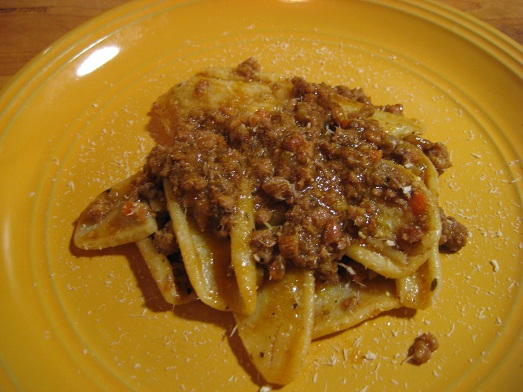
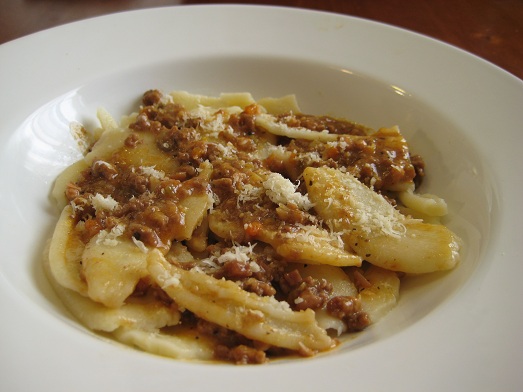
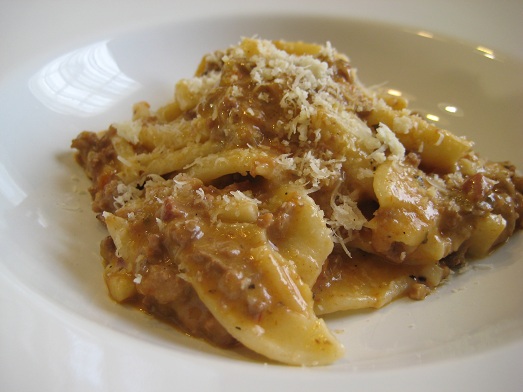
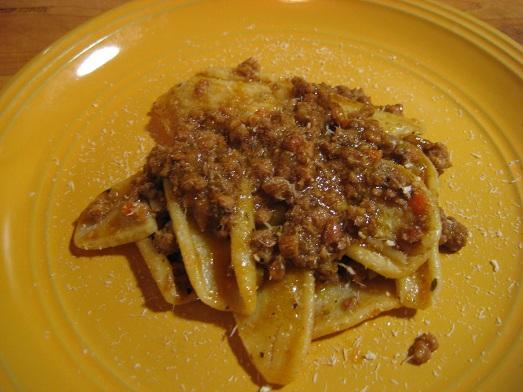
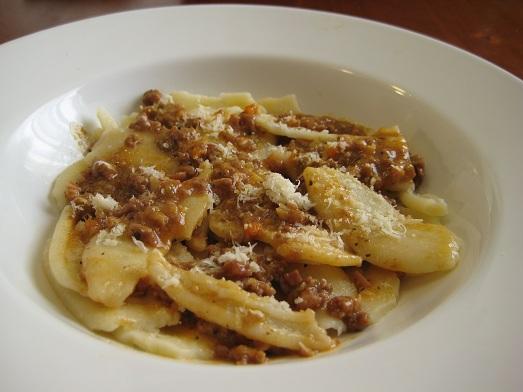
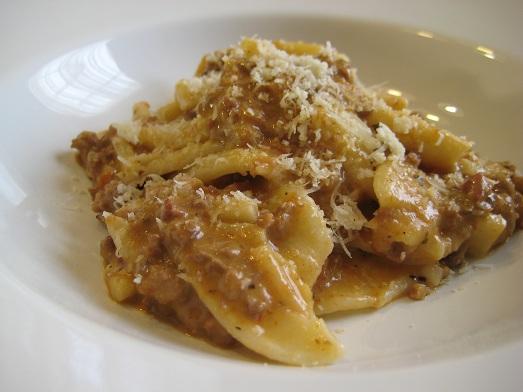
Well, today I finished my Bolognese challenge with three variations of the sauce, 1) No cream or milk, 2) With milk, 3) With Cream. Each dish was served with the Cencioni pasta and garnished with a small amount of finely grated Parmesano-Reggiano. I must say I was surprised with the results: No cream or milk- With milk- With cream- The first version, sans dairy, was not technically "traditional." It had good texture and substance and decent flavor. The second version, with milk, had an added creaminess but not an overpowering creamed flavor. It tempered the first sauce and had added flavor. The third version was my least favorite. The cream almost tasted bitter in competition with the meats and the small amount of chicken liver. In fact, I pushed the bowl aside after just a few bites. I definately won't be eating a Bolognese made with cream in the future. Which version was my personal winner? #2 with the addition of milk. I was suprised yet gave myself a bit of a chuckle. I learned that in my case of searching for Bolognese, the traditional style with dairy, aka milk, was the best.
-
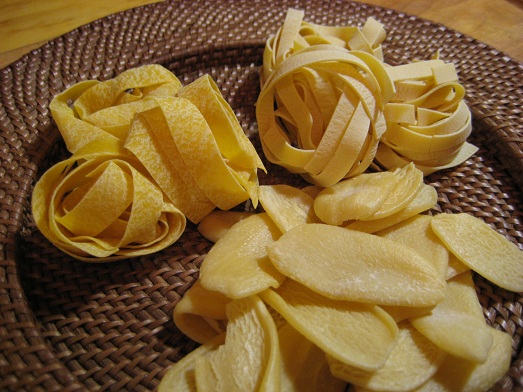
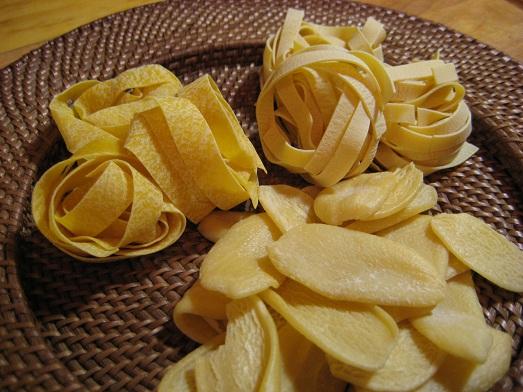
Chef Pellegrini told me that typically Bolognese is paired with a flat pasta like Pappardelle or Tagliatelle and preferably fresh. We don't have much in terms of fresh-made pasta where I live, but we do have a very good, small Italian market where I bought dried Pappardelle, Tagliatelle and Cencioni. Cencioni is literally "little rag" pasta-a befitting name for its shape which looks like shards of torn rags. It's smooth on one side and textured rough on the other side so any sauce will cling better to it. I wasn't familiar with Cencioni when I spotted the package in the store, but it was flat, little scoop spoons if you will and I thought it would hold up well to the Bolognese. Left to right-Pappardelle, Tagliatelle and bottom, Cencioni- I love Pappardelle, but the brand I bought is somewhat thin and falls apart quickly. For a tough sauce like Bolognese with a lot of structure, I went with the Tagiatelle which was thicker yet the width of the noodle was thinner than the Pappardelle. The Cencioni took a lot longer to cook, about 30 min. in boiling, salted water. In the end, the Cencioni would prove to be my favorite.
-
The liver in my Bolognese was very subtle. However, I put a lot of chicken liver in the meat sauce I use for Canneloni and Lasagna. It adds the unctuous creaminess when combined with the besciamella and tomato sauce I used in those dishes. Did you use the 1 lb ground meat to 1/2 lb chicken livers (2:1 ratio) of the recipe you mentioned ? I used about 31.7 oz ground meat to about 5.3 oz chicken liver (roughly, 6:1 ratio), and I'm finding the liver's presence pretty assertive... and I like liver. I'm trying to figure out what's goingon, here. No, I fudged on the liver to meat ratio in the classic recipe I used. I only used about 3 chicken livers, sauteed in butter but left rare, then minced and put into the meat mixture.
-
The liver in my Bolognese was very subtle. However, I put a lot of chicken liver in the meat sauce I use for Canneloni and Lasagna. It adds the unctuous creaminess when combined with the besciamella and tomato sauce I used in those dishes.
-
Was there a reason for using red onion over say a sweet yellow onion or was the red just what you had on hand?
-
Dishes always evolve, but, beyond a certain point they become something else, so they outgrow the original name. But rather than think in terms of feeling obligated to call it a name that says it's almost-but-not-quite bolognese, it makes sense to think in terms of one now having the privilege of calling it something else, say, 'ragù Ross' My bolognese is simmering away the last of the broth. It smells distinctly livery (I used chicken livers), which makes the clove and bay leaf more important, I think. I'm still pondering the use of gelatin. At first I wasn't sure about the strong flavor of the clove, but now it makes total sense based on your description. Liver and clove seems like a very natural pairing of flavors.
-
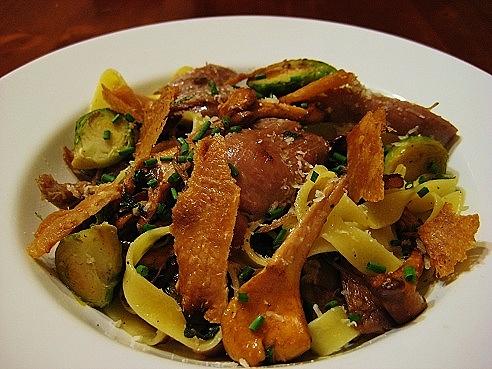
I've got a lot of pasta right now because I'm in the midst of the eG Cook-Off 57: Bolognese Sauce here. So in order to use up the tagliatelle I have, I did a dish with one of my favorite Fall ingredients--Duck Confit. I make homemade confit and this batch, (4 duck hindquarters), has been resting in fat for about three weeks. I gently pulled the skin off the duck and then pulled the meat off the bones. Laid the skin on a non-stick sheet and slowly roasted it in the oven at 350 until it was golden brown and crispy. Then sauteed the duck confit meat with Brussels sprouts, fresh chanterelles, garlic, a bit of chicken stock, thyme and sage. Then tossed with tagliatelle and a little dusting of parmesano-reggiano. Garnished with some chives that are still growing in the garden even though winter has arrived. The final, and best, part of the dish were the duck 'cracklings.'
-
I mentioned earlier that I really like the Bolognese episode of "In search of perfection", and I've experimented with Heston Blumenthal's recipe for the perfect "spag bol" a few times. So I decided to give it another go, this time with photos. This is an interesting recipe because it's the result of an attempt to bridge two worlds- firstly the world of the traditonal ragu alla Bolognese, and secondly the world of the English/American/Australian "spaghetti bolognese" - a tomato based pasta dish that, as Heston says, "does not exist in Italy". As I mentioned a few posts earlier, it is theorised that the westernised "spaghetti bolognese" didn't actually evolve from the traditional Bologna dish, but rather was the result of Italian migrants adding meat to their more familiar tomato sauces simply because they could afford to. If this is true, then ragu alla Bolognese and spaghetti bolognese have quite separate histories. So this recipe was developed for a TV show, and it's more complex than the traditional ragu alla Bolognese while trying to remain familiar to those who grew up with 'spag bol'. Regardless of how you think it fits into the overall Bolognese discussion, it's a very tasty dish and is one of Heston's more accessible recipes. I've veered away from the exact recipe in a few places - firstly I've used 100% beef where the original calls for a mix of ox tail and pork, and secondly I haven't used the exact herbs that Heston uses. 1) The first step, recognisably Heston, is to caramelise some onions with star anise. 2) I roughly cut up the beef and added my own variation - a few teaspoons of liquid smoke. After a short period of marination, the beef was quickly browned in a smoking hot pan, and the pan was deglazed using chardonnay. 3) The basic soffrito (heavy on the carrots) is sauteed while the chardonnay reduces in the background. 4) Then the meat, chardonnay reduction and caramelised onions are added along with 1 cup of milk, some water, and then everything is left to simmer gently for 6 hours. 5) With vine-ripened tomatos on sale, I decided to stick to the actual recipe and make the tomato sauce from scratch. Normally I'd just use 2 cans. The fresh tomatos are peeled, and the pulpy centres are scooped out and collected in a strainer. This pulp is salted and left to drain- the liquid actually has more flavour than the tomato flesh, which is chopped up and added to a saucepan that has sauteed onions in it. Out of interest, I weighed the liquid that drained from the tomato pulp and it was exactly 250grams. The pulp is discarded, the liquid is added to the tomatos. 6) So now we have two pots simmering on the stove. The large one with the meat in it, and the smaller one with the tomato sauce. 7) This is where we veer away completely from traditional, and firmly into Heston territory! The tomato sauce is pepped up with a range of ingredients that add depth and umami, none of which you'll see in an Italian recipe for Bolognese! These include sherry vinegar, fish sauce, worcestershire sauce, tobasco sauce, more star anise, cloves and ground coriander seeds. I have loads of parmesan rinds saved in the fridge so I added a small piece too. 8) These two pots are left to simmer. When the tomato sauce has simmered for two hours it has reduced to a thick consistency and tastes absolutely delicious, with loads of depth while still being instantly recognisable as a tomato sauce. 9) To finish off the tomato sauce, about 100mls of olive oil is added and the sauce is "fried" over high heat for a few minutes. The sauce is then drained and the oil saved. I actually weighed the oil to see how much of it I got back and I ended up with slightly more than the 100ml I started with! This is a rich, deep yellow, tomato flavoured oil that will be used to dress the pasta. The tomato sauce is now added to the meat and the ragu is left to simmer for an addional two hours. 10) Finally, after a total of 8 hours simmering, the dish is ready to serve. I boiled supermarket parpadelle and when it was cooked, it was drained and then tossed in some of the tomato oil. In the last few minutes, fresh herbs were stirred through the ragu (basil and thyme), along with a few dobs of butter. The ragu is seasoned with salt, pepper and a dash of sherry vinegar, and served on top of the pasta with a dash of fresh parmesan. Some more tomato oil is dotted around the plate. I've made this recipe a few times and cut different corners every time. It's safe to say that the single most defining element of the recipe is the star anise, which adds a distinctive depth that doesn't taste like aniseed or fennel. I don't think I'll bother with the fresh tomatoes again, as it's much easier to use canned and the end result is basically the same. The fresh herbs don't seem to add much either, and I'm not sure you'd notice if they weren't there at all. It's definitely not ragu alla Bolognese, and it's a step up from basic 'spag bol'. But it's delicious! Thank you for your in-depth review of a decidely uncoventional Bolognese. You've brought forward some very interesting issues that we've already lightly touched upon but we should discuss further--1) When we admit to changing the "traditional" Bolognese, whether it be the issue of milk/cream, herbs or the "tomato element," are we not honoring the Mother sauce by introducing new flavors? 2) In the restaurant kitchen it would be sacrilegious to call Chef Blumenthal's dish "Bolognese." So is a professional Chef obligated to call the dish "Ragu in the 'Bolognese' style" when it isn't traditional?
-
Yes, 1-no dairy, 1-cream, 3-milk!